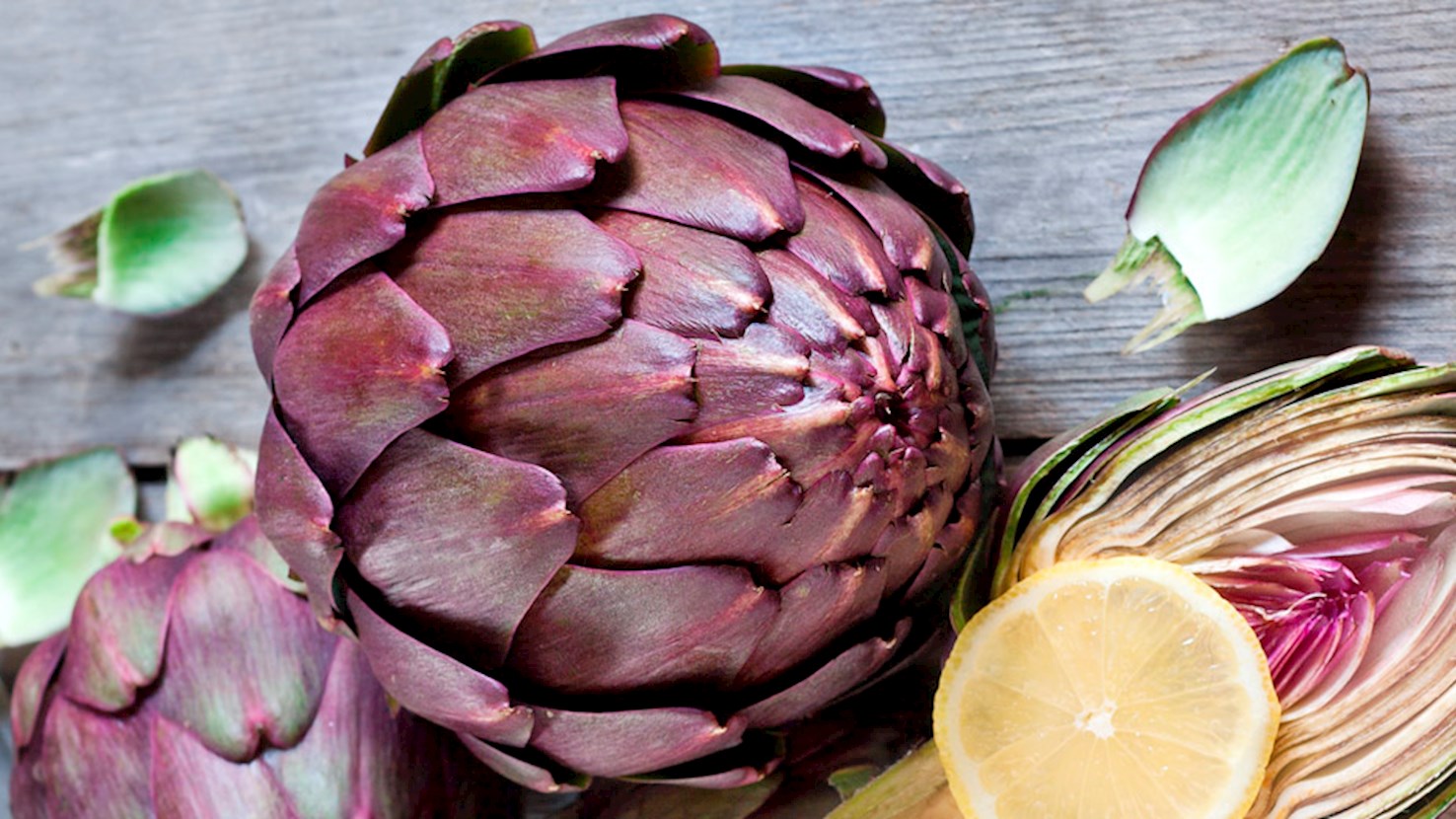
Artichaut du Roussillon are artichokes produced in the Pyrénées Orientales region in France since the 16th century. The artichokes are thought to be a part of Roussillon's cultural heritage and since they are produced on a large scale, they form the landscape through the seasons, with their green-purple tops pointed to the sky in springtime. They have a mild taste and a tender, not too fibrous texture. They can be eaten raw and because of their well-closed bracts, they have a good keeping quality. One of the first artichokes in spring, these vegetables are exclusively harvested by hand. Prepare this highly praised artichoke with salt, steamed, poached or sautéed in a saucepan.
Grown primarily along the northern coast of Brittany, the castel is a distinct, heavy cultivar of the globe artichoke family. Agricultural researchers at the French National Institute for Agricultural Research initiated a localized breeding program during the late 20th century to engineer this specific plant. They intentionally crossed existing local strains to yield a crop that withstands dropping winter temperatures far better than older regional thistles. The resulting botanical structure produces a pale green, tightly closed floral head with exceptionally broad, fleshy scales and a massive central receptacle. A defining biological trait of this cultivar is its delayed bract-opening mechanism, which physically prevents the bud from expanding and drying out during post-harvest transport, maintaining a compact sphere from the field to the market. To render the dense vegetable edible, cooks submerge the entire unpeeled head in large pots of boiling water or utilize a pressurized steam environment until a knife easily pierces the thick base. The castel is consumed by systematically plucking the outer leaves by hand. The fleshy scale of each leaf is dipped into a mustard-infused vinaigrette, a thick garlic emulsion, or melted butter, drawing the soft tissue across their teeth before discarding the tough remnants. Once the exterior layers are completely removed, the consumer uses a spoon to scrape away the inedible, hairy choke, exposing the tender, concave bottom, which is then sliced. To mitigate the palate-altering effects of the chemical compounds, these artichokes are typically enjoyed with highly acidic, unoaked white wines like Sauvignon Blanc or a sharp Chenin Blanc, alongside slices of crusty sourdough bread to absorb the sauces.
The Camus de Bretagne is a massive, ash-green cultivar of the globe artichoke grown extensively across the Finistère and Côtes-d'Armor departments in northwestern France. An agronomist based near Paris developed this specific plant line around 1810, and coastal farmers in Brittany eventually adopted it as their primary agricultural yield due to the area's temperate maritime climate. Cultivation demands intensive manual labor, as the perennial thistles remain in the soil for up to three years. Workers sever mature flower buds by hand between May and November, prioritizing the large central bud, which routinely weighs over 400 grams. Unlike smaller varieties, the dense, rounded head features tightly packed, broad leaves and a substantial internal fibrous mass known as the choke, which requires thorough cooking before consumption. Cooks generally submerge the intact vegetable in boiling salted water or steam it whole until the thick fleshy base becomes completely tender. A chemical compound present in plant tissue, called cynarin, actively inhibits the sweet receptors on the human tongue; when a person drinks plain water immediately after eating the vegetable, the sudden rinse of this compound creates an artificial, highly pronounced sugary sensation in the mouth. Individuals consume the cooked buds as a primary appetizer at domestic tables and local brasseries across the country. Eating the plant involves manually pulling away the outer scales one by one, submerging the fleshy lower portion into a sharp vinaigrette, mayonnaise, or clarified butter, and scraping the soft pulp off with the front teeth. After discarding the tough outer foliage and scooping out the hairy central choke with a spoon, the remaining concave heart is portioned with cutlery. Because the active chemical components aggressively distort the palate and clash with most alcoholic beverages, sommeliers typically match the heavy vegetable with highly acidic, bone-dry white wines such as Muscadet or Sancerre to forcibly cleanse the mouth between bites.
TasteAtlas food rankings are based on the ratings of the TasteAtlas audience, with a series of mechanisms that recognize real users and that ignore bot,
nationalist or local patriotic ratings, and give additional value to the ratings of users that the system recognizes as knowledgeable.
For the “Top 3 French Artichokes” list until June 02, 2026, 1 ratings were recorded, of which 1 were recognized by the system as legitimate.
TasteAtlas Rankings should not be seen as the final global conclusion about food. Their purpose is to promote excellent local foods,
instill pride in traditional dishes, and arouse curiosity about dishes you haven’t tried.