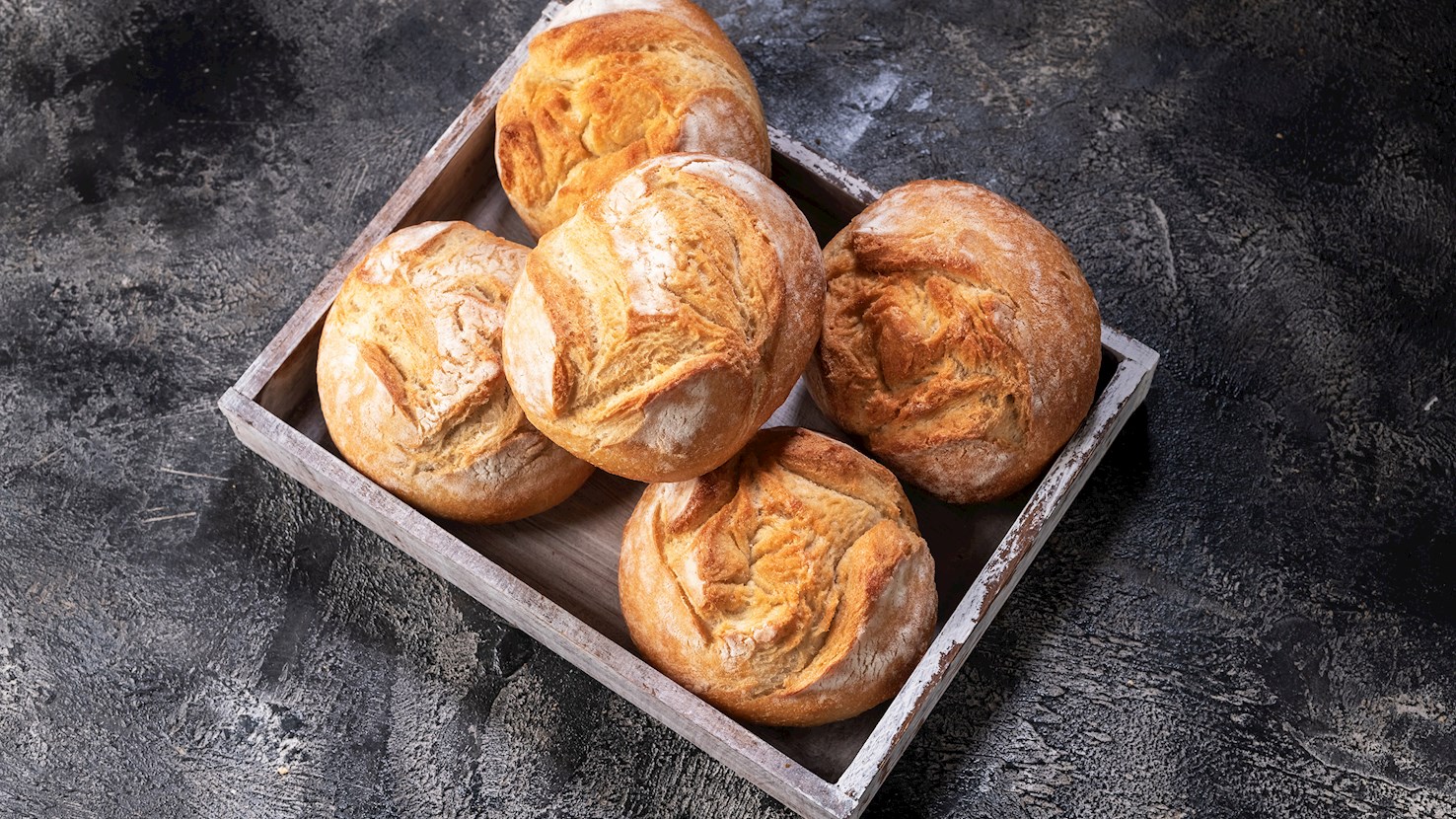
Schlumbergerli is a traditional bread roll originating from Basel and it can be traced back to 1872. The rolls are made with a combination of flour, yeast, salt, and honey. The dough is sprayed with water and baked until golden. If properly prepared, the irregularly-cracked crust should be delicate and crisp, but still soft. These bread rolls are named after Amedée Schlumberger, a banker from France who moved to Basel and started to miss a particular French bread, so Basel bakers made him something similar, and Schlumbergerli was born. The bread is eaten for breakfast, as an accompaniment to main dishes, or on its own with sweet or savory fillings such as butter or fruit jam.
Bürli is a round Swiss bread roll from the German-speaking cantons—especially the east around St. Gallen—made from a very soft dough of white or semi-white flour, water, yeast, salt, and a touch of malt, baked as paired “double” rolls or in fours so the pieces join at the seam and develop a crisp, flour-dusted crust and a large, irregular crumb. Its documented past reaches to the early 1700s: a 1723 Appenzell note already mentions “bürle” served in inns, indicating a small white-flour bread seen as a luxury for tavern service rather than a farmhouse loaf, and mapping of Swiss small breads shows the style tied to traffic-linked, urban, prosperous areas; sources suggest it began in eastern Switzerland and spread west, later appearing in Romandy under local names. Bakers achieve the hallmark texture by using unusually high hydration—nearly as much water as flour—prefermenting the dough overnight, then mixing salt and malt into water, folding in the preferment and flour, letting the very fluid dough rest, and shaping it gently without further kneading so fermentation gases stay trapped; two or four pieces are set together, dusted with flour, and slid without final proof into a very hot oven, which produces the thin, shattery crust and open crumb. Sold in various sizes (roughly 80–180 g / 3-6 oz, depending on the baker), bürli is eaten at any time of day and commonly served with veal bratwurst or cervelat or split and filled with fleischkäse or ham; in Rapperswil’s Fasnacht custom “eis-zwei-geissebei,” loaves are even tossed to children from the town hall windows alongside sausages and sweets, a practice recorded since the 1940s. At the table, it fits breakfast trays and butcher-stall grills alike, pairing well with Swiss cheeses, cold cuts, mustard, and beer, or with soups and salads where its airy crumb and robust crust hold up to dipping.
Zürcher Murren is a braided white bread roll from the German-speaking region of Switzerland that combines milk, butter, yeast, flour, sugar, salt, and malt into a mildly sweet, enriched dough. The earliest written reference to the Murren appears in a state archival document in Zürich dating to 1508, and detailed descriptions matching the rolls we know today appear in late nineteenth-century sources. For many years, the Murren were considered a festive treat because fine white flour was once reserved for special occasions; Zürich bakers originally made them before becoming more widely available across northern and central Switzerland. To prepare the Murren, a dough is made from flour, milk, butter, yeast, sugar, salt, and malt. The dough is allowed to rise, then divided into small pieces. Each piece is given five shallow cuts on top using a special tool, which, after baking, creates the bread’s characteristic star-like or pointed surface. The rolls are coated with egg yolk and baked until golden and glossy. Zürcher Murren are best eaten fresh, often at breakfast with butter, jam or honey, or as a snack alongside coffee or tea. They appear routinely in Swiss bakeries and supermarkets across the German-speaking cantons, typically paired with mild cheeses or a hot beverage.
TasteAtlas food rankings are based on the ratings of the TasteAtlas audience, with a series of mechanisms that recognize real users and that ignore bot,
nationalist or local patriotic ratings, and give additional value to the ratings of users that the system recognizes as knowledgeable.
For the “Top 3 Swiss Bread Rolls” list until July 16, 2026, 18 ratings were recorded, of which 14 were recognized by the system as legitimate.
TasteAtlas Rankings should not be seen as the final global conclusion about food. Their purpose is to promote excellent local foods,
instill pride in traditional dishes, and arouse curiosity about dishes you haven’t tried.