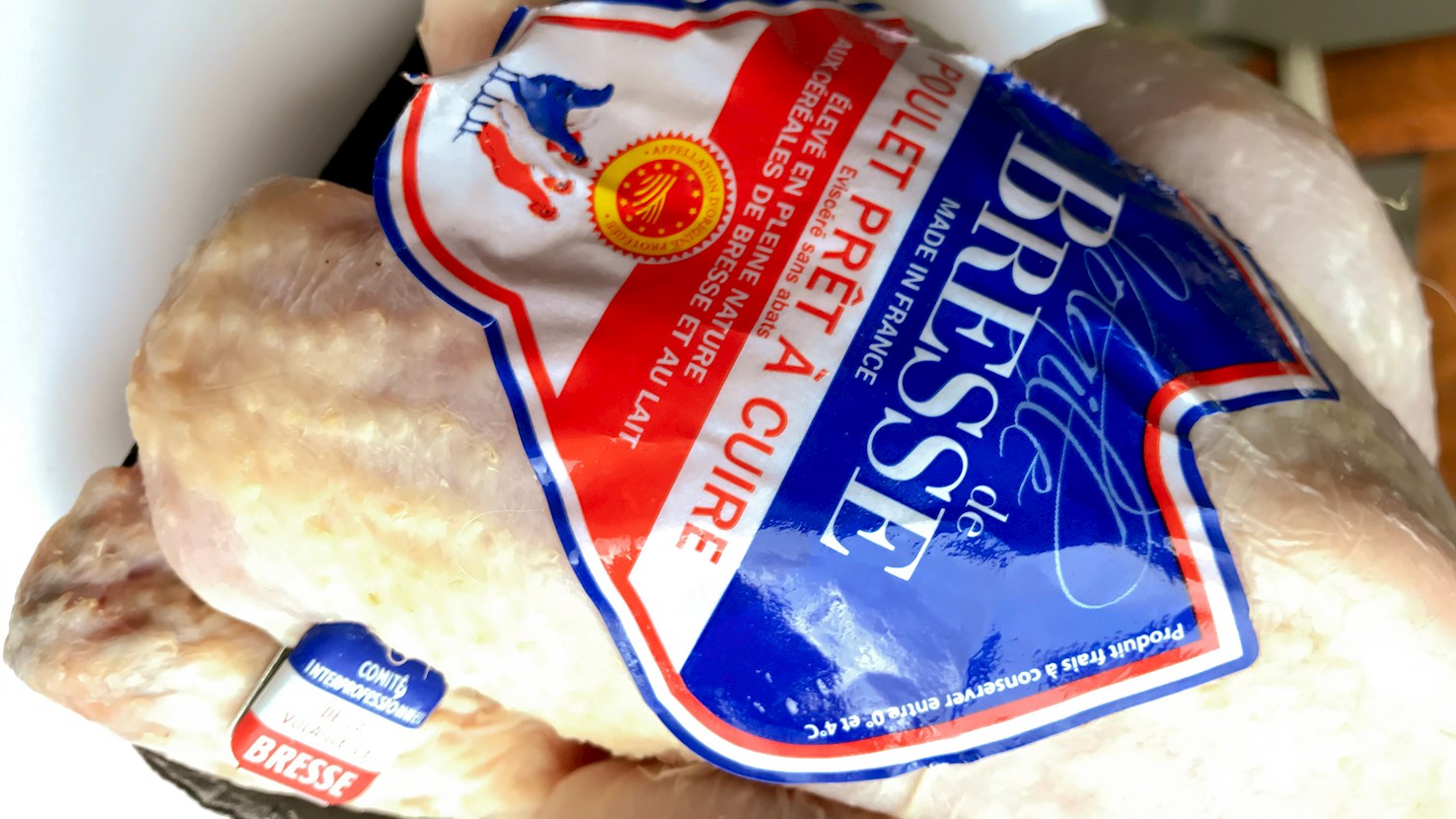
Volaille de Bresse is the white variety of poultry from the French region Bresse and the Bresse breed. The birds have blue feet, a red crest and white feathers and flesh, which has been mentioned in the municipal records since the 16th century. In the mid-19th century, a famous gourmet even wrote about the succulence of the Bresse poultry meat. The animals graze on the vast grassland and feed on the natural growing food - cereal, maize and buckwheat. Bresse chicken produces a marbling of the meat effect during the fattening period, and so, just like beef, develops the juiciest, firm, yet tender meat possible, infused with the flavor of all the local leaves and seeds. The intense, deep, gamy flavor of the meat is incomparable to the standardly-produced ones. In cooking, remove the thighs and legs from the body while they are still pink, and finish them after the white meat is done to retain the moistness of the meat.
Poulet du Périgord is a breed of slow-growing chicken from the region of Périgord in the south-west corner of France. These meaty chickens with firm muscles have a white or yellow skin that hides just the right amount of evenly distributed fat. Both the rearing and slaughter of poulet du Périgord takes place inside the aforementioned geographical area, and Périgord slaughterhouses have developed a specific know-how that contributes to the product’s quality and reputation. Poulet du Périgord are sold as dressed (bird plucked and gutted, with head, feet, and offal), ready to cook (bird plucked and gutted, headless, with or without tarsus), and métifait, or semi-prepared (bird plucked, gutted, with or without tarsus and with the head tucked under the wing). Their weight can range from 1 kg for ready to cook version, to 1,3 kg for a dressed one.
Poulet de l'Ardèche and Chapon de l'Ardèche is fresh meat from chickens and capons that are slaughtered when they are at least 81 days of age (chickens) or 150 days of age (capons), and are reared in the French region of Ardéche, with access to hills and pastures in the open air. The animals feed on vegetables, minerals and vitamins, where the share of cereals amounts to at least 80% of the total diet. As a result, the meat is firm and moist with an intense flavor and a dark color. Ardéche farm poultry is highly praised and rewarded with several medals in agricultural competitions due to the high meat quality. Enjoy this tasty poultry meat roasted, grilled, in teriyaki sauce or paired with potatoes, mushrooms and white wine.
Marans is a dual-purpose breed of domestic chicken originating from the port town of Marans in the Charente-Maritime department of southwestern France, raised for its dense table meat and dark chocolate-brown eggs. The breed emerged in the late 19th century through the crossbreeding of local marshland game hens (poules des marais) with English fighting cocks and Asiatic feather-legged breeds like the Langshan and Brahma brought by trading ships docking at the local port. Unlike blue eggs whose pigmentation permeates the entire calcium carbonate wall, the dark reddish-brown hue of Marans eggshells is caused by protoporphyrin IX pigments secreted by the hen's oviduct lining during the final 3 to 4 hours of shell formation, creating an exterior mucosal layer that dries into a dark coating on top of an otherwise white shell base. What is unique to Marans eggs is this thick exterior pigment layer, which seals the shell pores more tightly than standard eggshells, reducing internal moisture evaporation and slowing bacterial entry to extend the egg's shelf life. Culinary preparation of Marans poultry meat involves dry-roasting whole birds with salt and herbs, braising butchered pieces in wine sauces, or simmering spent hens into stocks, while Marans eggs are soft-boiled, hard-boiled, poached, fried, or emulsion-whipped into mayonnaise and hollandaise sauces. Marans meat and eggs are consumed across French agricultural regions, European specialty markets, and global poultry farms, where roasted chicken portions and poached dark brown eggs are served alongside crusty bread, steamed potatoes, buttered asparagus, or fresh green salads, paired with dry red Bordeaux wines, crisp Muscadet, light pale ales, or sparkling mineral water.
Coucou de Rennes is a breed of domestic chicken characterized by its strictly barred black-and-white plumage, raised almost entirely in the Ille-et-Vilaine department of Brittany. During the late 19th century, a local physician named Doctor Ramé crossbred existing regional farm hens with heavy imported Asiatic and English Dorking varieties to engineer a robust bird with superior meat yields. Following a near-total disappearance during the mid-20th century due to the widespread adoption of rapid-growth industrial farming, municipal agricultural conservationists and a localized ecomuseum initiated a strict recovery program in 1988 to systematically repopulate the genetic line. A defining biological trait of this specific fowl is its exceptionally slow physiological development, requiring a minimum rearing period of 130 to 150 days on open pasture before reaching optimal slaughter weight, a timeframe that yields an unusually dense, well-oxygenated muscle fiber structure with a naturally high bone-to-meat ratio. Cooks generally prepare the dressed bird by lightly stuffing the abdominal cavity with raw garlic and herbs before applying a thick external coating of coarse salt and dairy butter. The whole carcass is roasted in a dry oven at high temperatures, with the chef routinely basting the skin with the rendered animal fats accumulating in the metal pan to ensure a crisp, blistered exterior. Once the internal juices run completely clear, the meat is left to rest at room temperature before being carved into its primary anatomical sections. People consume the carved portions using standard cutlery at upscale regional restaurants, specialized gastronomy fairs, and domestic tables during weekend gatherings across the Breton basin. The roasted chicken is frequently plated directly over a bed of roasted potatoes or butter-seared winter root vegetables. To balance the rich lipids and firm texture of the meat, individuals pair the meal with poured glasses of dry, unfiltered Breton apple cider or light-bodied red wines with soft tannins, such as Pinot Noir or a chilled Cabernet Franc.
Poule noire de Caussade is a small-sized chicken breed originating in France. Its roots go back to at least the mid-19th century, when agricultural competitions in 1869 already described it as “much appreciated,” and by 1905 a formal breed standard was established, followed in 1911 by the founding of the Caussade poultry club. Over time the breed nearly vanished with the rise of industrial poultry strains, and by 2014 only about 60 breeding females had been counted, prompting dedicated conservation efforts. The Poule noire de Caussade is raised in extensive outdoor systems: birds are kept in large open runs where they forage freely, fly readily (often perch in trees), develop strong pectorals and a slim skeleton, and are accustomed to both cold and heat. The standard describes the rooster at an average 1.5 to 2 kg (3.3-4.4 lb) (or up to 2.5 kg / 5.5 lb) and the hen slightly smaller; plumage is glossy black, comb red and upright for the rooster (inclined for the hen), tarsal color slate-grey, legs and body finely built. Among its variations one can find differences in size (some specimens closer to 2.5 kg, others more modest), differences in rate of lay (hens average 150-180 eggs per year, white-shelled with a large orange yolk and scant white), and small variations in plumage gloss or comb shape depending on lineage. A distinctive characteristic of the poule noire de Caussade is its combination of meat quality and rustic adaptability: despite its modest size it produces fine white meat, often described as close in taste to game, and the birds remain hardy when kept outdoors, unlike many modern breeds. The meat is eaten roasted whole or as parts (breast, thighs) in fine restaurants, often paired with high-quality ingredients such as Quercy truffle, and is best matched with bold Southwest French red wines, perhaps Gaillac or Cahors, and served with simple rustic sides—country bread, butter-washed potatoes or a light green salad—to highlight the chicken’s lean, refined flavor.
Poule Gasconne is a heritage breed of chicken from France raised for both meat and egg production. Its roots date back to at least the sixteenth century when it was cited as the bird used in the celebrated dish poule au pot by Henri IV; the breed was documented from 1860 onward in the Gers, Haute-Garonne and Tarn-et-Garonne. Its breed standard was finalized between 1907 and 1920, highlighting its dual-purpose performance, with good laying ability and substantial meat yield. The breed’s numbers fell steeply in the 1950s with the advent of industrial hybrid layer and broiler strains, but revival efforts began when the association “La Poule Gasconne” was formed in 2003, and in 2008 it was registered as a Slow Food Foundation “Sentinel of Taste”. In raising poule Gasconne birds are reared outdoors in low-density flocks, allowed to forage freely in grassland and scrub, and fed a mixed diet of cereals and pasture. Hens reach about 1.8-2.3 kg (4-5 lb), roosters 2.5-3 kg (5.5-6.6 lb), and hens produce roughly 200 eggs of around 60 g (2 oz) annually. Capons are sometimes produced by castrating roosters and rearing them for an extended period (up to eight months) to develop firm flesh and fine texture; they may be dry-plucked and wrapped in dyed woad cloth for festive sale. Variants of the breed include the standard black-plumaged version with slate-blue sheen, and bantam (naine) forms weighing around 900 g (2 lb) for roosters or 800 g (1.75 lb) for hens—with smaller size but the same genetic line. Some farms breed specifically for eggs, others for capons or meat birds raised for special events, but all adhere to free-range, slow-growth criteria. A unique feature of the breed is its combination of rustic foraging ability, slow growth and heritage identity which underlies its appeal in the revival of heritage poultry. Poule Gasconne chickens are best used in simple preparations that showcase their flavour: hens or capons are roasted whole with local vegetables, served winter-style with lentils, cabbage or potatoes, or used to make the iconic poule au pot with chicken, vegetables and broth. They pair well with light red wines from south-western France—such as Cahors or Madiran—that have sufficient structure to complement the rich meat, or with rosés that cut through the flesh’s richness while allowing for the bird’s dual egg-and-meat character to shine.
Poularde du Périgord is a variety of fattened young hen, with well-developed muscles marbled with intramuscular fat and intensely yellow skin, hiding a substantial subcutaneous fat cover. Poularde du Périgord are available fresh or frozen, as gutted birds (plucked, eviscerated fowl, with the head, feet, and giblets), ready-to-cook birds (plucked, eviscerated fowl, without the head and with or without the tarsus), and métifet birds (plucked, eviscerated fowl, with or without the tarsus and with the head folded under the wings). Their weight ranges between 1,7 kg for ready-to-cook version, to 2 kg for gutted ones.
Chapon du Périgord is a male bird belonging to a variety of slow-growing chicken from the south-west corner of France. Reared for a minimum of 150 days, chapon du Périgord is castrated before reaching sexual maturity. Its well-developed, rounded muscles are marbled with intramuscular fat, while the extremely delicate skin hides a substantial subcutaneous fat cover. Chapon du Périgord is sold as dressed (bird plucked and gutted, with head, feet, and offal), ready to cook (bird plucked and gutted, headless, with or without tarsus), and métifait, or semi-prepared (bird plucked, gutted, with or without tarsus and with the head tucked under the wing).
TasteAtlas food rankings are based on the ratings of the TasteAtlas audience, with a series of mechanisms that recognize real users and that ignore bot,
nationalist or local patriotic ratings, and give additional value to the ratings of users that the system recognizes as knowledgeable.
TasteAtlas Rankings should not be seen as the final global conclusion about food. Their purpose is to promote excellent local foods,
instill pride in traditional dishes, and arouse curiosity about dishes you haven’t tried.








What People Say