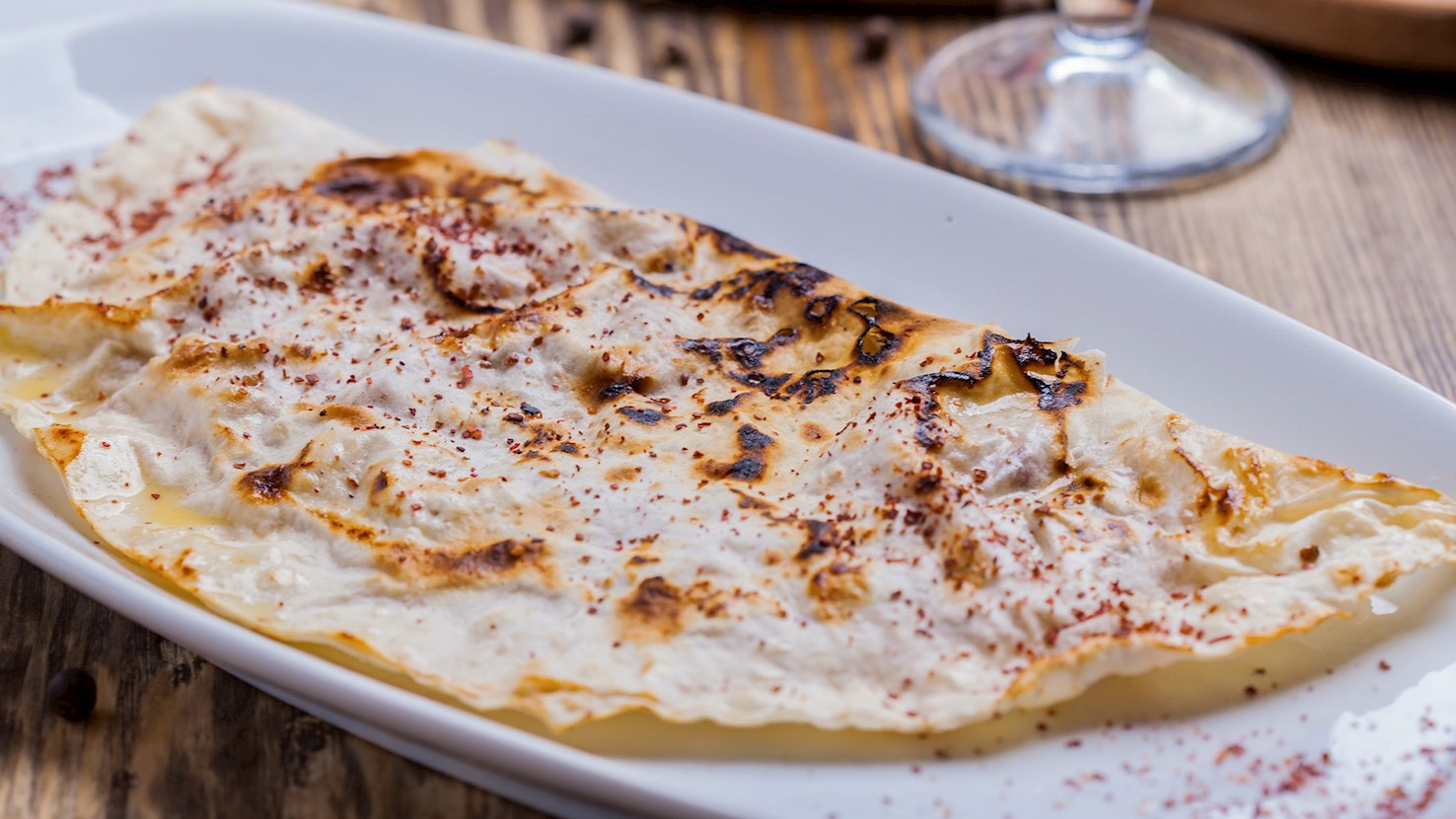
Qutab, known as gutap in Turkmenistan, is a thin filled flatbread found in Azerbaijani and Turkmen cooking. Azerbaijani qutab is usually a very thin half-moon cooked on a hot saj, while Turkmen gutap can also be baked in a tamdyr or oven or fried in oil. Common fillings include meat, fresh greens, pumpkin, and offal. The dish belongs to the wider family of filled breads found across the Turkic-speaking world, but no reliable source identifies a single creator or precise date for its appearance. Azerbaijan and Turkmenistan developed their own recognizable forms, while the closest Turkish counterpart is gözleme, which is generally treated as a separate dish rather than another name for qutab. In Azerbaijan, the dough is usually made from flour, water, and salt, rolled into thin circles, filled on one side, folded into a crescent, and cooked quickly on a saj. The finished qutab is often brushed with butter. Meat versions usually contain finely minced lamb or beef with onion, while göy qutabı is filled with seasonal greens such as spinach, sorrel, cilantro, dill, parsley, mint, and green onion. Pumpkin and sheep offal are also established fillings. Regional variations are especially visible around Lahij, Shamakhi, and the Absheron Peninsula. Corat, near Baku, is known for small meat-filled qutabs and has historically been associated with camel-meat versions. In Lahij, spring forms may contain locally gathered mountain herbs. Turkmen gutap is made in a similar folded shape but is generally more varied in cooking method. Fillings can include pumpkin, spinach, purslane, dill, green onion, meat, or mushrooms. Kädili gutap, filled with pumpkin, is one of the best-known forms. Some versions use dough enriched with egg, and the finished breads may be baked or fried rather than dry-cooked on a saj. Qutab is usually eaten hot as a snack, starter, or light meal. In Azerbaijan, meat versions are commonly served with sumac and qatıq, while greens-filled qutab works well with yogurt and fresh herbs. Pomegranate or sour fruit condiments may accompany richer meat fillings. Turkmen gutap is often served more simply, alongside tea, fresh vegetables, or fermented dairy products. Black tea is the most common beverage pairing in Azerbaijan, while both black and green tea suit Turkmen gutap. Ayran also works well with meat or greens-filled versions.
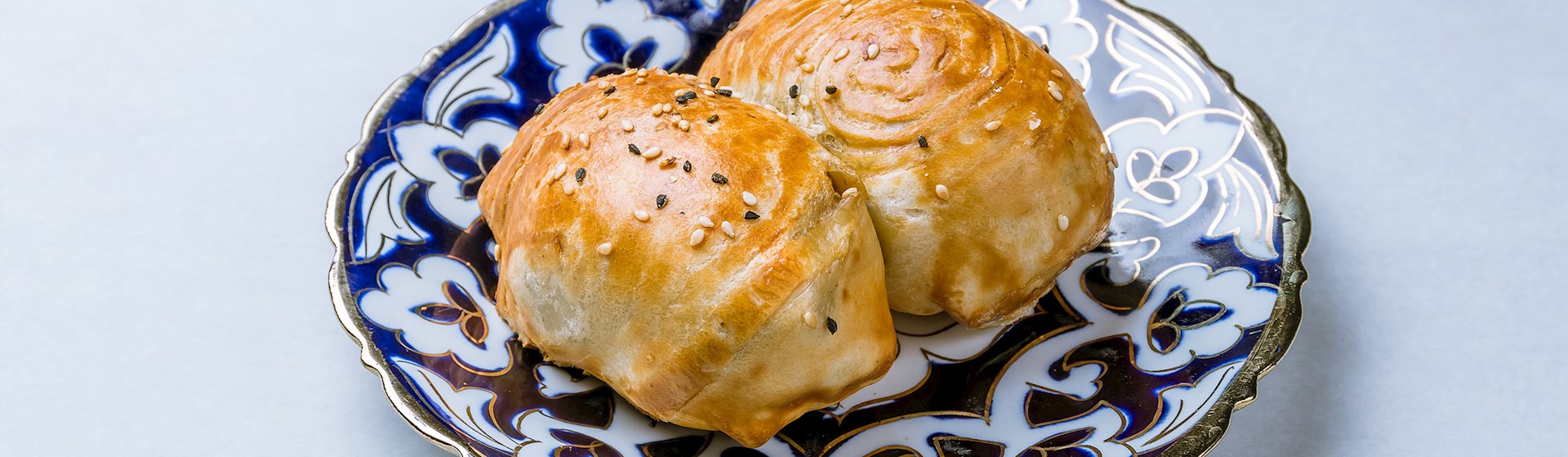
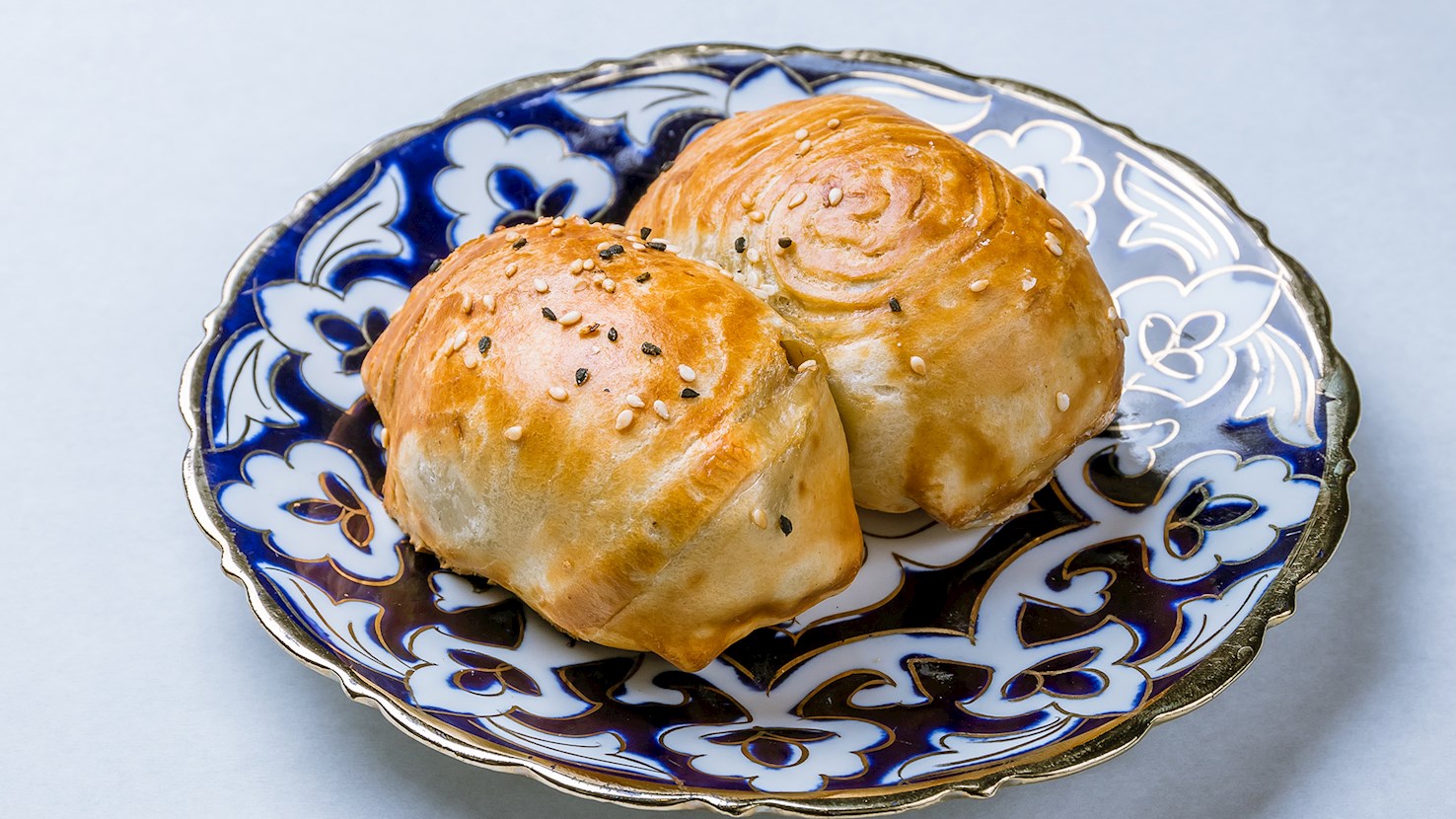
Samsa is a savory baked filled pastry originating from Central Asia, consumed across Uzbekistan, Kazakhstan, Kyrgyzstan, Tajikistan, and Turkmenistan. The dish spread throughout the region along Silk Road trade corridors via Persian culinary influences, deriving its name from the Middle Persian word sanbosag and sharing a common ancestral lineage with Middle Eastern sambousek and South Asian samosa. Preparation requires a multi-layered laminated dough or plain yeastless wheat dough, which is rolled ultra-thin, brushed with melted mutton fat, butter, or oil, rolled into a tight coil, chilled, and sliced into individual rounds that are flattened to form distinct flaky layers. The dough rounds are filled with hand-chopped lamb or beef, tail fat (kyryk), diced onions, cumin seeds, black pepper, and salt, before being folded into triangular, square, or half-moon shapes, glazed with egg wash, and sprinkled with black nigella or sesame seeds. Unlike fried variants found in neighboring regions, Central Asian samsa is baked directly against the red-hot inner clay walls of a vertical cylindrical oven called a tandyr (tandoor) or in high-heat commercial baking ovens, where water brushed onto the flat bottom of the pastry allows it to adhere to the curved clay until fully cooked. The clay oven baking method exposes the pastry simultaneously to conductive heat from the wall and intense radiant heat from charcoal coals at the base, melting the internal fat cubes into a rich broth that steams the meat and onions inside a sealed crust. Samsa is eaten hot by hand directly at street stalls, bazaar bakeries, roadside eateries, and domestic dining tables throughout Central Asia, often by turning the triangular pastry upside down, cutting open the bottom crust with a knife, and spooning in tomato-garlic vinegar sauce or hot chili relish before eating. Diners pair Samsa with hot black or green tea, fermented dairy drinks like chalap or katyk, or fresh tomato and onion salad (achichuk) to balance the high fat content of the baked meat filing.
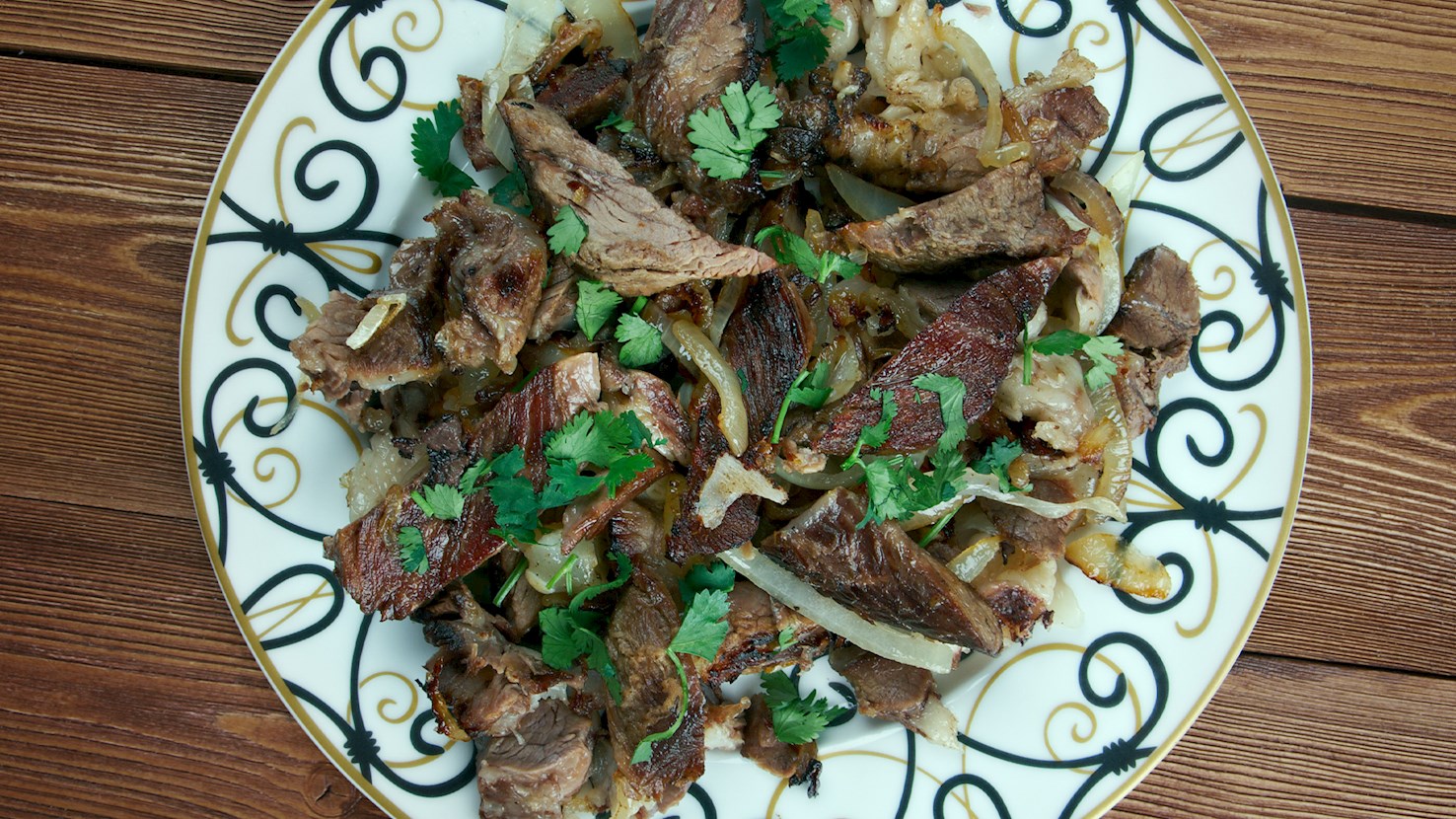
Kuurdak is a high-temperature roasted meat and offal dish originating across Central Asia, including Kyrgyzstan, Kazakhstan, Uzbekistan, and Turkmenistan, where shared nomadic heritage produced distinct national variations of the same core culinary technique. The dish developed among nomadic pastoralist societies across the Eurasian Steppe as a rapid method for cooking fresh livestock cuts immediately following slaughter (soymush), utilizing rendered tail fat (kuiryuk) to preserve and brown organ meats and muscle tissue without requiring complex kitchen apparatus. The name derives from the Turkic root verb kuurmak, meaning to roast, stir-fry, or brown in fat. Preparation begins by rendering diced sheep tail fat or heating fat in a cast-iron cauldron (kazan), followed by frying chopped onions and cubed mutton, beef, horse meat, or offal such as liver, heart, and lungs over high heat. Large chunks of peeled potatoes are added in modern variants and simmered with minimal water under a lid until soft, seasoned primarily with salt, black pepper, and garlic. What distinguishes kuurdak from other Central Asian stews is the high-temperature browning phase in pure animal fat prior to any liquid addition, creating a caramelized crust on the exterior of the meat while preserving internal moisture. Kuurdak is served hot directly from the cauldron onto wide ceramic bowls or metal platters, eaten during family gatherings, slaughter day feasts, and regional restaurants. Diners consume the dish using forks or flatbread to scoop the fat-coated meat and potatoes, pairing it with fresh flatbread (tandyrman or naan), sliced raw onions, pickled vegetables, and hot green or black tea, fermented mare's milk (kymyz), or fermented barley beverages (makhsyma).
This flavorful stew is typically prepared with mutton or lamb. The chunks of meat are browned and then slowly braised alongside onions, fresh tomatoes, peppers, and potatoes. Çekdirme is traditionally served sprinkled with parsley and is best enjoyed with Turkmen flatbread on the side.
This traditional Turkmen dish consists of çörek flatbread, sliced onions, and a meat stew that is usually prepared with mutton, beef, or lamb. The name of the dish stems from dogramak, which roughly translates as to chop up, referring to the technique of preparation in which all the elements are cooked and baked separately, then sliced and chopped before they are combined. Dograma is traditionally served on special occasions when it is usually prepared in large amounts. When assembled, the combination of meat, bread, and onions is typically placed in bowls and is then doused in a flavorful meat broth.
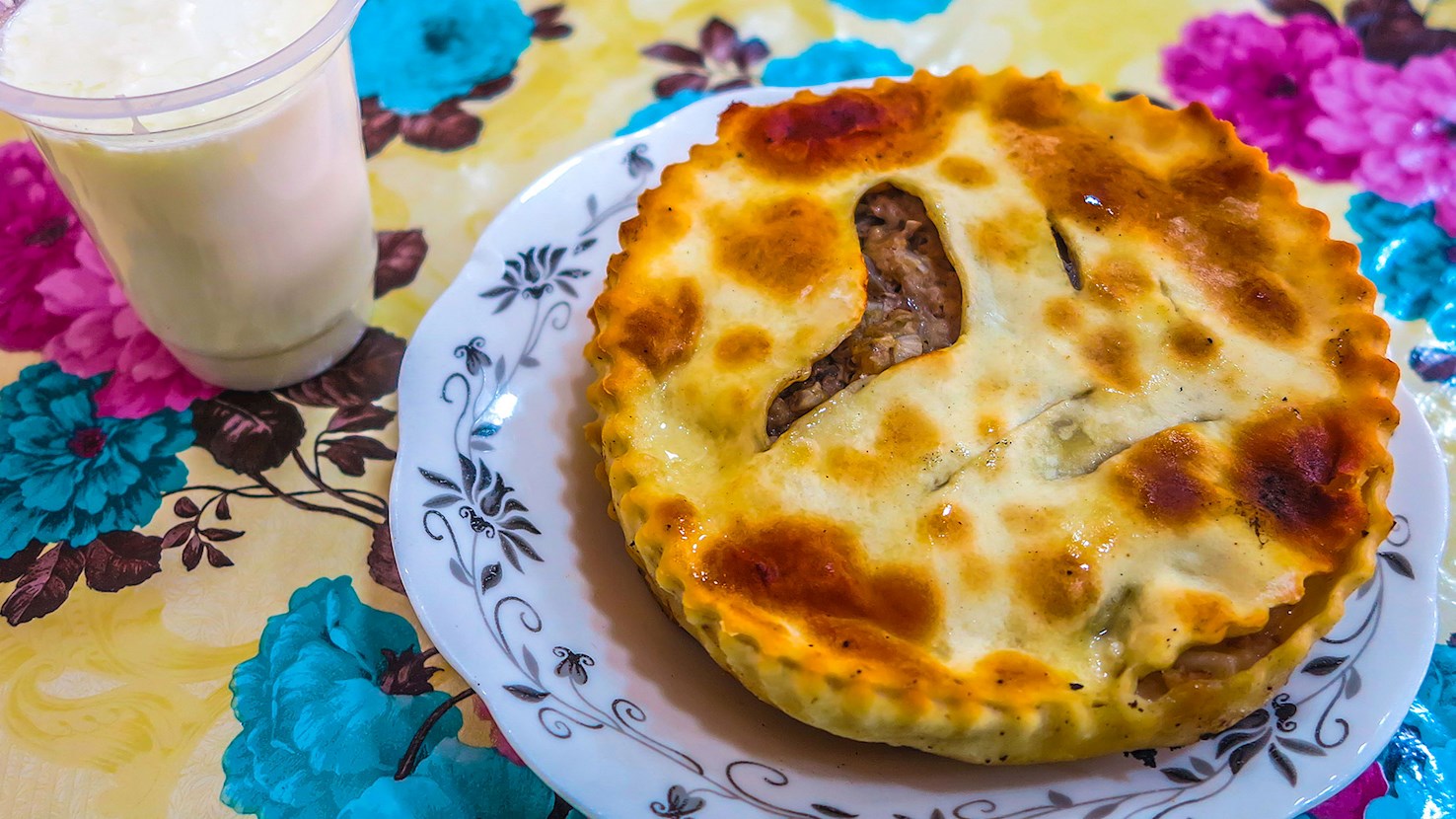
Fitchi is a Turkmen baked meat pie made from a thin, usually unleavened wheat dough wrapped around a generous filling of finely chopped or minced meat, onion, fat, salt, black pepper, and a little water to keep the interior juicy. It is found throughout Turkmenistan and became especially well known as a street and bakery food during the Soviet period; Turkmen sources note that fitchi was already one of the country’s most popular foods eaten outside the home in the 1970s, when the pies were often larger and contained even more onion than many versions made today. Its basic form is simple but quite distinctive: the dough is divided into a larger piece for the bottom and a smaller piece for the top, rolled into circles, and fitted into a shallow round metal mold. The filling, commonly beef or mutton mixed with tail fat and onion, is spread almost to the edges, then covered with the smaller round of dough and sealed tightly so the meat cooks in its own juices. Water is deliberately mixed into the filling, helping create steam inside the closed pie and keeping the meat moist as it bakes. Before baking, the top is usually pricked with a fork and brushed with water, and the pies are cooked until the crust is browned and the filling is fully done; modern home versions are commonly baked in an oven at around 200°C, while older or more rustic versions may be associated with clay-oven baking. The most characteristic fitchi has a high ratio of meat to dough, which makes it substantially different from a lighter pastry or bread snack, and the onion, animal fat, and added liquid give the filling a soft, juicy texture rather than a dry minced-meat consistency. Beef and mutton are both documented, although mutton is especially closely associated with older Turkmen versions, while some newer recipes use beef more commonly for convenience. Fitchi is eaten hot, often as a quick lunch, bakery snack, or casual meal, and individual pies are usually served whole while larger ones may be cut into wedges. It pairs naturally with black or green tea, fresh tomato and cucumber salads, pickled vegetables, or simple yogurt-based accompaniments, but it is filling enough to be eaten on its own.
Ogurdzhalinskaya shorba is a Turkmen fish-and-noodle soup associated with the Caspian side of the country and the culinary repertoire of the Ogurja, or Ogurchinsky, area, where fish plays a much larger role than in the meat-heavy cooking of inland Turkmenistan. It is made from pieces of fish simmered in a lightly spiced broth with onion, carrot, parsley root, saffron, black and red pepper, bay leaf, and sesame oil, then finished with handmade egg noodles flavored with dill. Russian-language collections of Turkmen cooking have documented the dish for decades, usually under the name shorba ogurdzhalinskaya, and they consistently present it as a distinctly fish-based regional soup rather than a variation of the better-known mutton shorbas. The method is unusually careful for such a straightforward soup. Onion and carrot are first fried in heated sesame oil, sometimes together with parsley root, to create a fragrant base. The fish is then added in fairly thick pieces and cooked only briefly with part of the saffron, black pepper, salt, and bay leaf before boiling water is added. After several minutes, the fish is removed so it does not break apart or overcook while the noodles finish in the broth. The noodles, known as unash, are made from flour, egg, water, and chopped dill. The dough is kneaded quite stiff, rested, rolled thin, and cut into narrow strips, although some descriptions note that the dough can also be rubbed through a colander to make smaller pieces. Once the noodles are tender, the fish is returned to the pot for only a few minutes, along with the remaining saffron, red pepper, bay leaf, parsley, and fennel or ajgon, after which the soup is taken off the heat and left covered briefly before serving. The combination of fish, saffron, sesame oil, and dill-scented egg noodles is what gives ogurdzhalinskaya shorba its particular identity within Turkmen cooking. It is more aromatic than a plain fish broth but still relatively light, with the noodles adding substance without turning it into a thick stew. The use of saffron and sesame oil also sets it apart from many everyday Central Asian soups, while the handmade noodles connect it to the broader Turkmen unash family of noodle dishes. Ogurdzhalinskaya shorba is served hot, usually as a first course or light main meal, with the fish pieces distributed carefully so they remain intact and fresh herbs scattered over the top. It is most naturally associated with western Turkmenistan and Caspian fish cookery, and it pairs well with Turkmen flatbread such as chorek, which can be used to soak up the broth. Black tea is the most typical beverage alongside it, while simple fresh herbs, onions, or a lightly dressed vegetable plate work better than rich side dishes, since the soup already combines fish, noodles, aromatics, and spice in one bowl.
Balyk börek is a Turkmen steamed dumpling filled with chopped fish, onion, herbs, egg, and spices, associated particularly with the Ogurjaly communities of the southeastern Caspian coast. Despite the word börek in its name, it is closer in form and cooking method to manti than to the baked or fried pastries commonly called börek elsewhere in the Turkic world. In modern Turkmen, balyk means fish and börek refers to a filled dough food, giving the dish the straightforward name “fish börek.” Its regional character comes from the food culture of the Ogurjaly Turkmens, who historically lived around the Hazar Peninsula and Ogurjaly Island and relied extensively on fishing as well as hunting and trade. Balyk börek was documented in Soviet culinary literature as “balyk börek - Ogurjaly manti”, indicating that it was already recognized as a distinct regional specialty rather than merely a generic fish-filled dumpling. The dough is made from wheat flour, water, egg, and salt and kneaded until firm. After resting for about 40 minutes, it is rolled very thin, approximately 1–2 mm, then cut into squares roughly 10 cm across. This thin wrapper is important because the dumplings are steamed for a relatively short time and should remain tender rather than develop a thick, bread-like shell. The filling is more distinctive than the dough. Boneless fish fillet is chopped by hand into pieces about 1 cm across rather than ground into a fine paste. Finely chopped onion is mixed with the fish together with black pepper, red pepper, dill, parsley, saffron, salt, and beaten raw egg. One detailed older formula also includes crushed cardamom and fennel, showing a noticeably aromatic seasoning profile for a Turkmen fish dish. The egg binds the mixture, which is assembled immediately after mixing rather than left to stand for a long period. About 25 grams of filling is placed on each dough square, and the edges are pinched together above the fish. The dumplings are arranged in a manti-kaskan, a tiered steaming vessel used throughout Central Asia, and cooked over boiling water for roughly 25–30 minutes. Steaming allows the chopped fish and onion to cook in the moisture trapped inside the dough while keeping the filling juicy and the wrapper intact. Balyk börek belongs to a wider group of Caspian Turkmen dishes in which established methods normally used for meat were adapted to fish. Culinary descriptions of Ogurjaly cooking record fish being grilled on skewers, fried in fat, combined with rice, stewed, dried, and enclosed in dough. Balyk börek represents the steamed-dumpling branch of that repertoire, and its use of chopped fish with saffron, herbs, and aromatic spices gives it a character quite different from meat manti. The dumplings are eaten hot soon after steaming and can form either a substantial starter or a main course. They need little accompaniment because the fish, onion, herbs, and spices are enclosed together, although cultured dairy such as gatyk or süzme can be served alongside. Fresh tomatoes, cucumbers, onions, and herbs also work well with the soft dough and fish filling. In a Turkmen meal, green or black tea is the most natural beverage pairing, while ayran provides a cooler, acidic accompaniment.
Balyk gowurdak is a Turkmen fried-fish dish from the Caspian coast of western Turkmenistan, where fresh fish is cut into small boneless pieces and cooked in a pot in its own fat, sometimes with a little sesame oil. The name combines balyk, the Turkmen word for fish, with gowurdak, a term connected with frying meat in fat. The dish belongs to the distinctive fish cookery of Turkmen communities along the Caspian Sea. Fishing historically had a particularly important role in the diet of coastal settlements, where sturgeon and other Caspian species were highly valued. Turkmen sources record a long-standing cultural connection with fish in this region, including references to fish imagery on medieval ceramics from Merv and beliefs surrounding particular Caspian species. Balyk gowurdak developed within a broader repertoire in which familiar Turkmen cooking methods were adapted to the fish available along the coast. The same regional cuisine includes balyk şara, grilled fish on skewers, balyk börek, fish-filled dumplings, and balykly ýahnaly aş, a fish-and-rice preparation. In this context, gowurdak refers not to preserved mutton or beef but to freshly cooked fish fried in fat. Freshness is central to the dish. The fish is cleaned, deboned, and cut into relatively small pieces before being placed in a heated pot or cauldron. Unlike many fried-fish recipes, balyk gowurdak is not defined by flour, batter, breadcrumbs, or a heavy marinade. The pieces are fried directly, ideally using enough natural fish fat to brown them, although sesame oil may be added when needed. This gives the dish a relatively direct flavor and distinguishes it from sauced or breaded forms of fried fish. While salmon is most notably featured in balyk gowurdak, the traditional dish can be prepared using a wide range of local coastal species, including sturgeon, stellate sturgeon, mullet, kutum, carp, catfish, herring, and pike-perch, with a general preference for firm-fleshed fish that hold their shape while frying. The method differs from meat gowurdak, which in Turkmen cooking can also function as a preservation technique. Meat versions are fried in substantial quantities of animal fat and may be stored for months, whereas balyk gowurdak is described as a freshly fried fish dish. The shared name reflects the frying technique rather than an identical preservation process. Official Turkmen material describes meat gowurdak as meat fried and stored in fat, making the distinction between the two forms important. Balyk gowurdak is best eaten hot, when the exterior of the fish is browned and the interior remains moist. Along the Caspian coast it fits naturally with çörek, fresh onions, tomatoes, cucumbers, or simple herb salads. A tart or sweet-sour condiment can also accompany fish dishes in the region. Green or black tea suits the broader Turkmen meal, while ayran provides a cooler contrast to the richness of the fried fish.
Gazanlama is a lamb dish cooked directly over hot saxaul coals and sealed beneath a heavy cauldron lid, a method closely associated with shepherds in the Karakum Desert. The meat is usually seasoned with salt, garlic, and paprika before cooking, then exposed to the heat and smoke of the embers rather than simmered in liquid. Its development is linked to pastoral life in Turkmenistan’s desert regions, where lamb was readily available and meals had to be cooked with the fuel and equipment carried or found in the landscape. A large metal cauldron was already one of the basic cooking vessels of Central Asian pastoral households, while saxaul provided an exceptionally useful desert fuel. The Turkmen word gazan means cauldron or large cooking pot, which explains the dish’s name and the central role of the vessel in its method. Saxaul is especially well suited to this style of cooking. Both white and black saxaul grow in Turkmenistan’s desert regions, including the Karakum, and its wood produces strong heat while the coals smolder for a long time. Turkmen sources specifically note that food cooked over saxaul develops a characteristic flavor. This made the plant an important cooking fuel in areas where conventional firewood was limited. Lamb is the defining meat for gazanlama. It is cut into substantial portions rather than small shashlik-sized cubes, then seasoned or briefly marinated with garlic, salt, and paprika. The seasoning is relatively restrained, allowing the meat and smoke to remain dominant. The dish does not depend on a complex spice mixture, sauce, vegetables, or broth. Once the saxaul has burned down to a bed of hot embers, the meat is placed directly over or among the coals. A large cauldron or cauldron lid is positioned over it, creating an enclosed cooking space. Slightly damp sand is packed around or over the cover to reduce heat loss and help contain the smoke. The result is a combination of roasting, smoking, and enclosed heat rather than ordinary grilling. This method separates gazanlama from Turkmen çişlik, where smaller pieces of meat are threaded onto skewers and cooked openly above the fire. It also differs from tamdyrlama, in which meat is cooked inside a clay tamdyr oven. Gazanlama instead uses the ground fire, coals, sand, and metal cauldron as the cooking setup, making it particularly adapted to outdoor desert conditions. The enclosed cooking environment allows larger pieces of lamb to cook more gradually than they would over an exposed flame. Fat rendered from the meat helps keep it moist, while the saxaul smoke seasons the exterior. The surface can become browned and smoky without requiring a glaze or sauce. Because the exact fire, quantity of meat, and size of the pieces vary, the dish is better defined by this cooking technique than by a precise cooking time. Although its strongest association is with shepherds and outdoor cooking, gazanlama remains recognized as part of Turkmen national cuisine. It appears at cultural and public food events, including Nowruz celebrations, and was among the dishes presented to a Russian television crew documenting Turkmen cuisine in 2024. Gazanlama is best eaten hot soon after the cover is removed. Fresh Turkmen çörek works particularly well alongside the fatty, smoky lamb, while sliced raw onion, tomatoes, cucumbers, and fresh herbs provide a lighter contrast. It can also be served with simple salads rather than another substantial cooked dish. Green or black tea fits the wider Turkmen meal, while ayran or water works well with the richness of the meat.
TasteAtlas food rankings are based on the ratings of the TasteAtlas audience, with a series of mechanisms that recognize real users and that ignore bot,
nationalist or local patriotic ratings, and give additional value to the ratings of users that the system recognizes as knowledgeable.
TasteAtlas Rankings should not be seen as the final global conclusion about food. Their purpose is to promote excellent local foods,
instill pride in traditional dishes, and arouse curiosity about dishes you haven’t tried.







What People Say