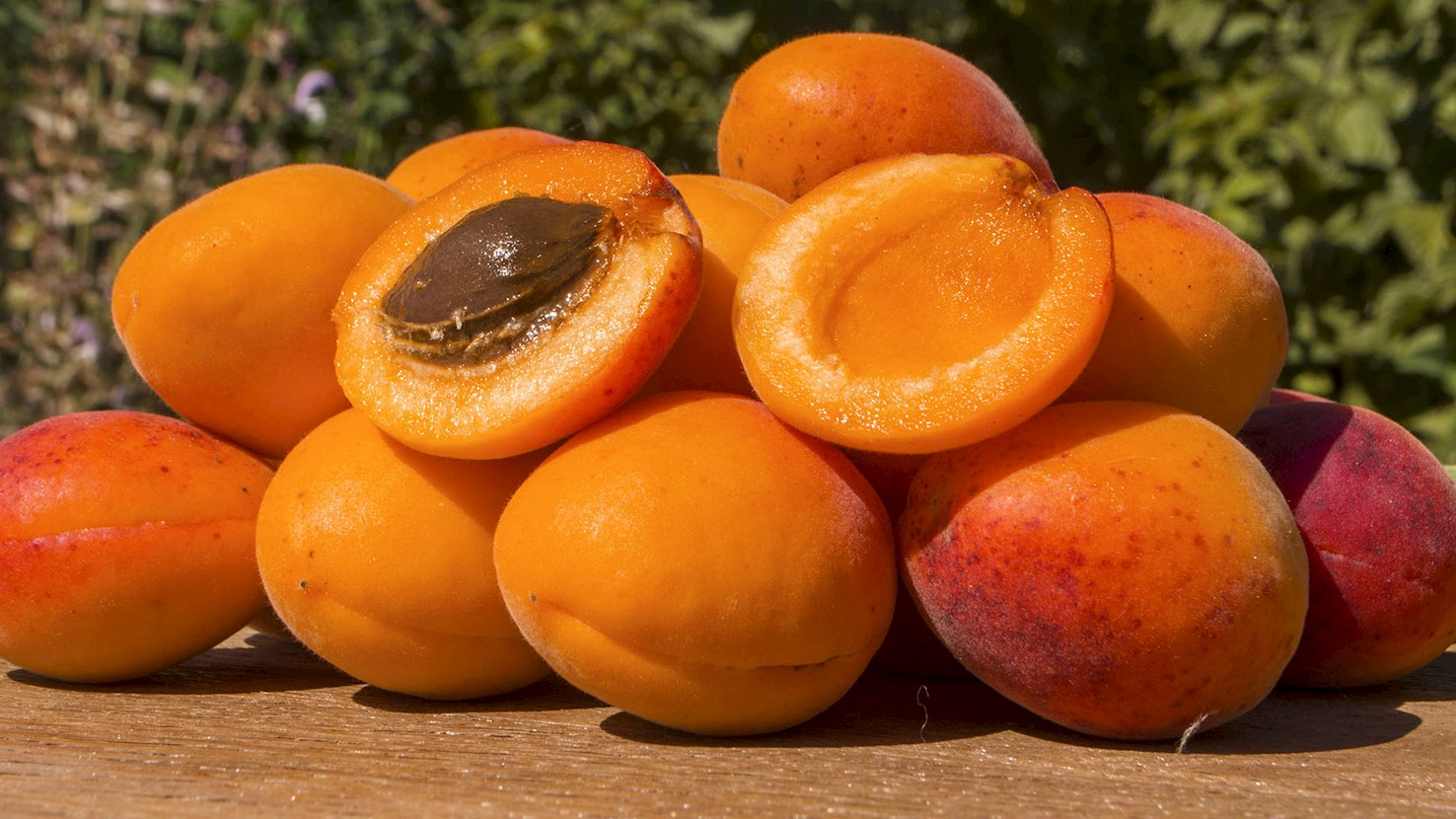
First cultivated in the 17th century in Versailles and later in the 19th century in the Eastern Pyrenees mountains, Abricots Rouges du Roussillon are small, orange to red apricots whose bright color is a clear indicator that this fruit contains high levels of beta-carotene as well as other health-beneficial ingredients such as potassium, fibre, and vitamins. These extremely aromatic apricots are an endemic variety with quite low acidity levels and a delicate, fragrant flavor. Due to the high amounts of sunshine, especially during the ripening season, the meaty Roussillon apricots are particularly juicy and sweet. They can be enjoyed in a number of ways: fresh, dried, candied, or used for preparing various jams, tarts, and pastries.
Jaumet is a table grape variety grown in France’s Roussillon region. Its cultivation dates back to an era when local growers selected vines that bore compact, cylindrical clusters suited to the Mediterranean climate and served as fresh-eating grapes rather than for wine production. The vine is planted on moderately vigorous rootstocks, trained in a semi-erect system, grown on well-drained soils with full sun exposure, the shoots are susceptible to grey rot so canopy management and ventilation are important, the grapes are harvested when fully ripe—typically early in the season compared to major wine grapes—and marketed as fresh table grapes with minimal alteration or processing. Variations in Jaumet occur in the size of the bunches (some clusters are larger and more elongated, others more compact), in berry size and skin thickness (some selections produce slightly larger berries with firmer skins, others produce smaller berries with thinner skins), and in the residual sweetness and juice concentration depending on the particular vineyard site and microclimate; a distinctive feature of Jaumet is that it is registered in the official French catalogue of vine varieties (list A) under the name “Jaoumet” and was once planted to several hundred hectares but has since declined to almost negligible area, giving it a rare status among French table-grape varieties. The grapes are eaten fresh as dessert fruit, served at the end of a meal or with afternoon snacks, and pair well with mild cheeses, light fresh breads, or a gently chilled dry white wine or sparkling wine which complements the grape’s sweetness without overwhelming it.
Coquette du Conflent is an apple variety grown in the Conflent region, part of the Eastern Pyrenees department. It originates from old orchards in the Conflent valley where growers selected for plants whose fruits were consistently sweet and had good storage capacity; over the years the trees became embedded in the local landscape and small-scale plantings survived even when the variety lost favor in large commercial orchards. The cultivation process begins with planting the apple trees on well-drained slopes or terraces, the apples develop on trees that receive sufficient sunlight and moderate water, the fruit typically has a flat, slightly asymmetric shape, with a bright yellow skin that may blush pink when fully ripe; harvest takes place in late season when the flesh reaches its full sugar content and the apples are then stored in cool, humid conditions to prolong their life and allow their flavor to mellow. Variations of the Coquette du Conflent appear in size (some fruits are larger, others more modest), in the degree of blush on the skin, and in the exact timing of harvest and storage which affects texture and sweetness; a unique element is that this apple has a very mild acidity and high sweetness, making it suitable for fresh eating or for long storage without becoming mealy. The apple is eaten fresh as a dessert fruit or served thinly sliced to highlight its subtle sweetness, and it pairs well with unsalted buttered country bread, mild cheeses such as young goat cheese, or a lightly sweet dried-fruit compote alongside a gentle white wine or sparkling cider that balances the softness of the apple without overpowering it.
TasteAtlas food rankings are based on the ratings of the TasteAtlas audience, with a series of mechanisms that recognize real users and that ignore bot,
nationalist or local patriotic ratings, and give additional value to the ratings of users that the system recognizes as knowledgeable.
For the “Top 3 Local Fruits in Pyrénées-Orientales” list until June 01, 2026, 9 ratings were recorded, of which 7 were recognized by the system as legitimate.
TasteAtlas Rankings should not be seen as the final global conclusion about food. Their purpose is to promote excellent local foods,
instill pride in traditional dishes, and arouse curiosity about dishes you haven’t tried.