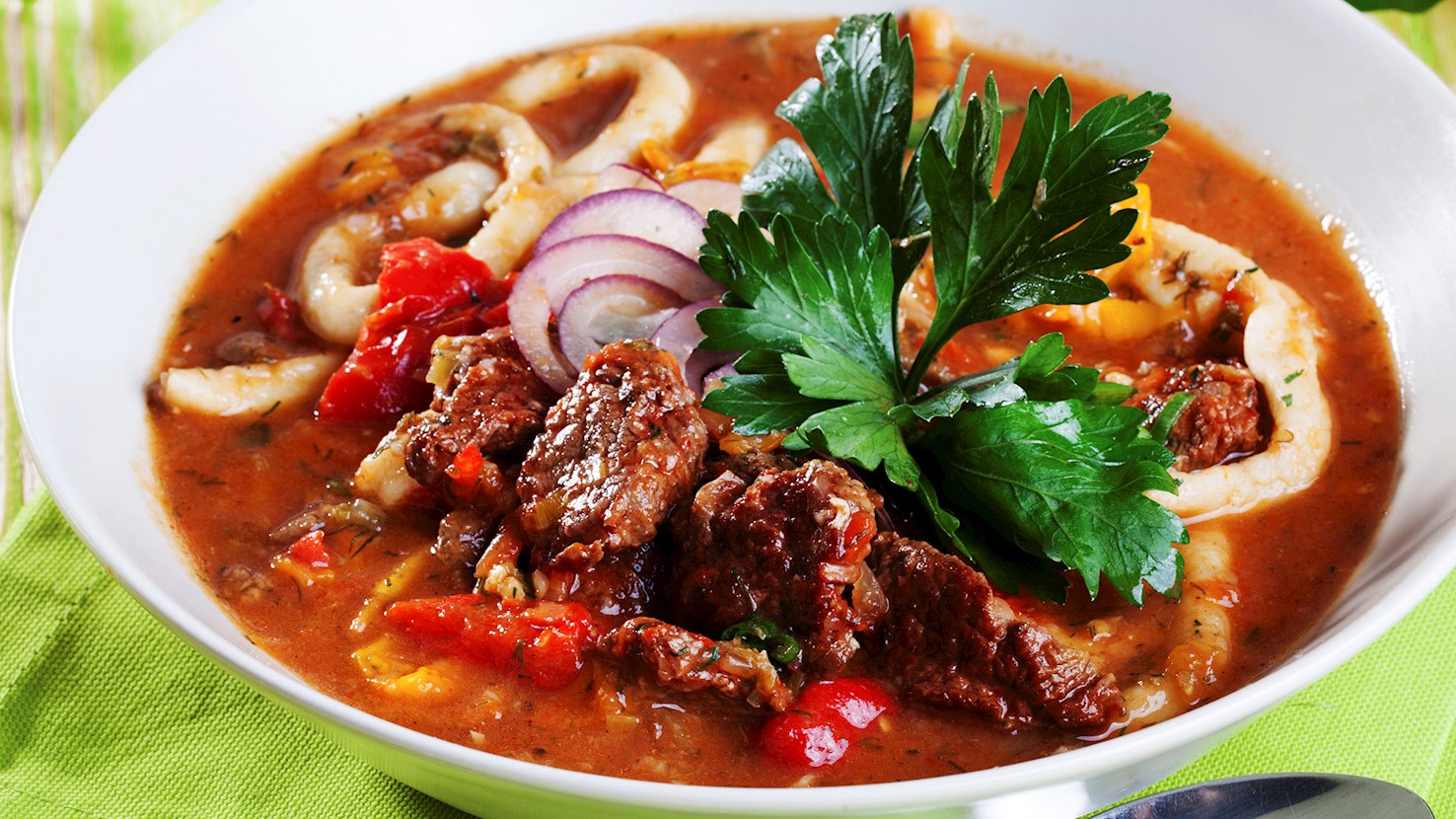
Lağman is a noodle-based dish made from hand-pulled wheat noodles served with a savory topping of meat, vegetables, and sauce, prepared across Central Asia and most closely associated with Uyghur communities in the Xinjiang region of China as well as widely cooked in Kazakhstan, Kyrgyzstan, and Uzbekistan, where it appears in home kitchens and casual eateries as a full meal rather than a side. Its development follows the movement of Turkic-speaking peoples along inland trade routes, where wheat cultivation, noodle-making techniques, and stir-based meat cookery intersected, resulting in a dish that combined Chinese-style hand-pulled noodles with Central Asian preferences for lamb, onions, and robust sauces, and adapted locally depending on available vegetables and fats. Preparation centers on a firm dough made from wheat flour, water, and salt that is rested and repeatedly stretched and pulled by hand into long, elastic strands, while the topping is cooked separately by sautéing meat, most often lamb or beef, with onions, garlic, tomatoes, peppers, and other vegetables, simmered until cohesive but not thickened into a paste, then spooned over or mixed with the cooked noodles. Serving can take two main forms, either with the sauce ladled generously over drained noodles or with additional broth added to create a soup-like consistency, and it is brought to the table immediately so the noodles retain their structure. What distinguishes lağman is the noodle-making method itself, which relies on manual stretching rather than cutting, producing strands with uneven thickness that hold sauce differently along their length and require skill and timing rather than tools. It is eaten hot, usually with a spoon and fork or chopsticks depending on local custom, commonly at lunch or dinner, and it pairs well with simple salads, pickled vegetables, or raw onions, while beverages such as black tea, lightly salted tea, or plain water are most often consumed alongside to balance the richness of the meat and sauce.
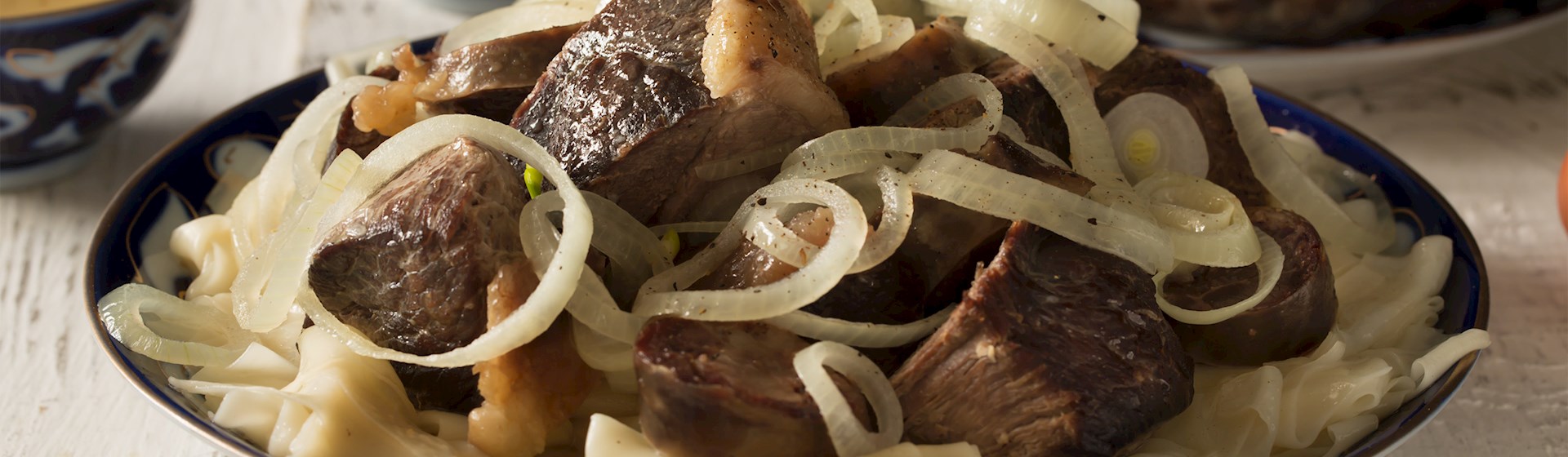
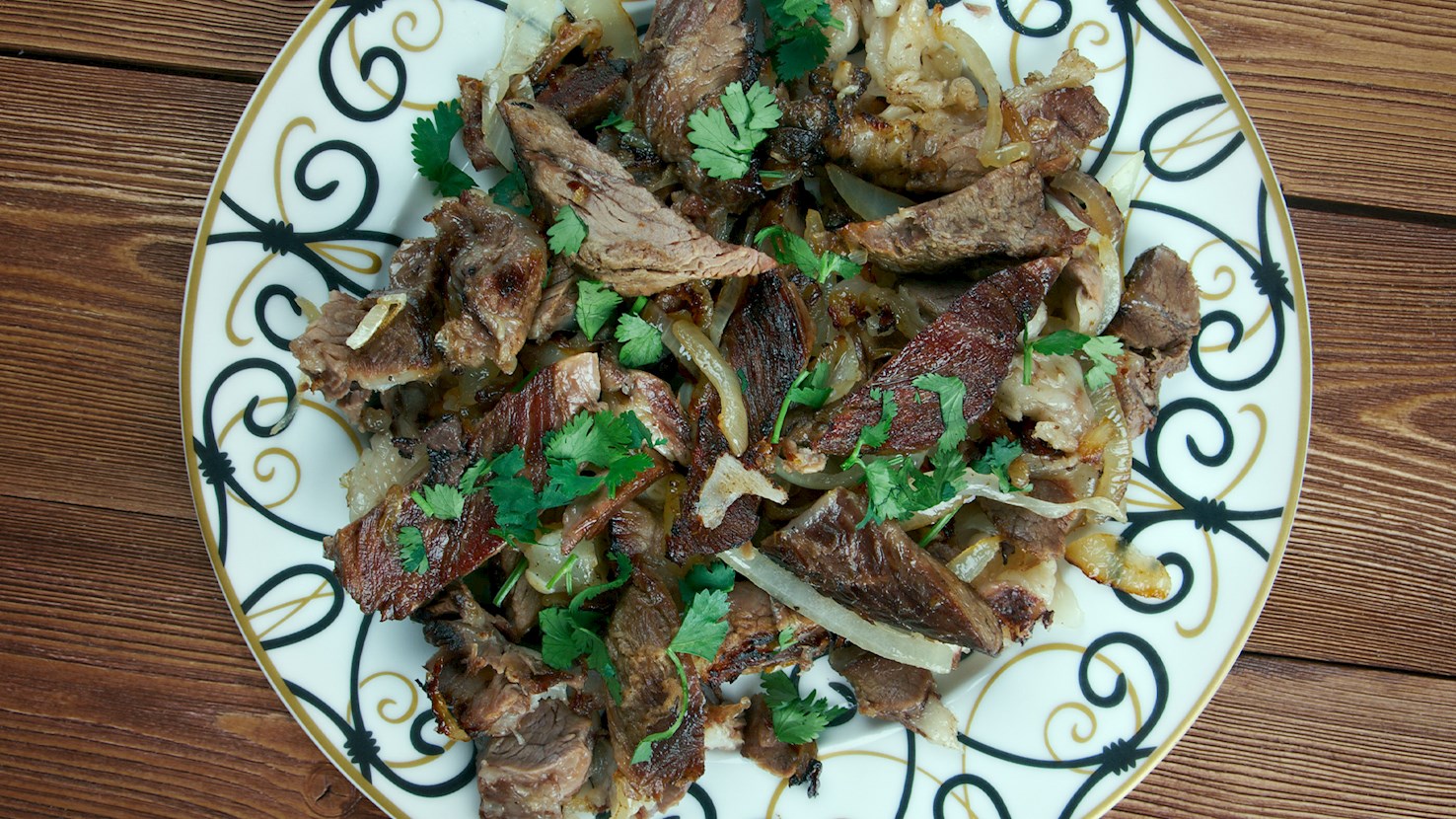
Kuurdak is a high-temperature roasted meat and offal dish originating across Central Asia, including Kyrgyzstan, Kazakhstan, Uzbekistan, and Turkmenistan, where shared nomadic heritage produced distinct national variations of the same core culinary technique. The dish developed among nomadic pastoralist societies across the Eurasian Steppe as a rapid method for cooking fresh livestock cuts immediately following slaughter (soymush), utilizing rendered tail fat (kuiryuk) to preserve and brown organ meats and muscle tissue without requiring complex kitchen apparatus. The name derives from the Turkic root verb kuurmak, meaning to roast, stir-fry, or brown in fat. Preparation begins by rendering diced sheep tail fat or heating fat in a cast-iron cauldron (kazan), followed by frying chopped onions and cubed mutton, beef, horse meat, or offal such as liver, heart, and lungs over high heat. Large chunks of peeled potatoes are added in modern variants and simmered with minimal water under a lid until soft, seasoned primarily with salt, black pepper, and garlic. What distinguishes kuurdak from other Central Asian stews is the high-temperature browning phase in pure animal fat prior to any liquid addition, creating a caramelized crust on the exterior of the meat while preserving internal moisture. Kuurdak is served hot directly from the cauldron onto wide ceramic bowls or metal platters, eaten during family gatherings, slaughter day feasts, and regional restaurants. Diners consume the dish using forks or flatbread to scoop the fat-coated meat and potatoes, pairing it with fresh flatbread (tandyrman or naan), sliced raw onions, pickled vegetables, and hot green or black tea, fermented mare's milk (kymyz), or fermented barley beverages (makhsyma).
Mypalau is a meat and offal dish centered on sheep’s brain, combined with cooked meat, marrow from hip bones, hot broth, salted fat, and garlic, and it is prepared as a concentrated, high-value food rather than an everyday meal. Preparation begins immediately after slaughter by carefully removing and cleaning the sheep’s brain, boiling it gently until just set, and cooking selected cuts of meat and large marrow bones in water to produce a rich broth, while fat is salted and softened separately and garlic is crushed rather than cooked. Serving is assembled rather than mixed, with the brain placed in a wooden bowl, surrounded or topped with pieces of meat and exposed marrow, then flooded with hot broth and melted salted fat, and finished with raw garlic stirred in just before eating so it disperses through the heat without losing sharpness. Although everyone can enjoy it, sheep’s brain is usually reserved for the elderly, and it’s also traditionally offered to honored guests. The sheep's brain is typically not given to children as it is believed that eating it would make them weak-minded. It pairs naturally with plain flatbread or dough pieces and with black tea or lightly salted broth, which complement the richness without introducing acidity or sweetness.
TasteAtlas food rankings are based on the ratings of the TasteAtlas audience, with a series of mechanisms that recognize real users and that ignore bot,
nationalist or local patriotic ratings, and give additional value to the ratings of users that the system recognizes as knowledgeable.
TasteAtlas Rankings should not be seen as the final global conclusion about food. Their purpose is to promote excellent local foods,
instill pride in traditional dishes, and arouse curiosity about dishes you haven’t tried.



What People Say