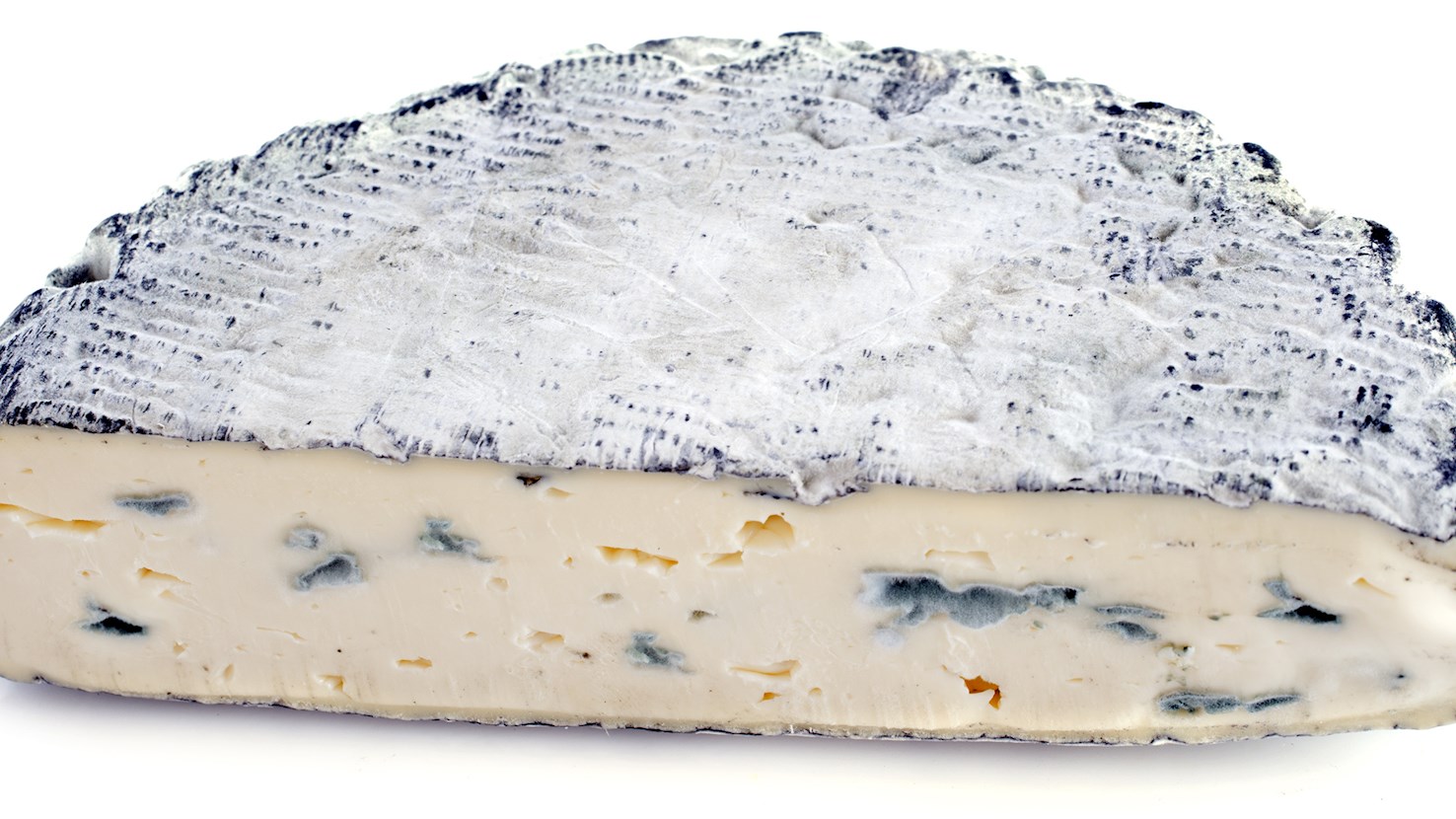
Rochebaron is a French blue cheese made from cow’s or sheep’s milk. Its texture is soft and creamy, the aroma is strong, while the flavors are mild, mushroomy, and creamy. During the production process, the curd is injected with Penicillium glaucum in order to develop blue veins throughout the body. The cheese then matures for at least 30 days, during which it is regularly dusted with ash. When ready for consumption, it is recommended to pair the cheese with fresh fruits, crusty baguettes, or a glass of earthy Pinot Noir.
Fromage aux artisons is a farmhouse cheese made with unpasteurized cow's milk from the Velay plateau (Haute-Loire) in France. Its origins trace back to rural farms around the 16th century where households used milk from their own herds to produce cheeses for local consumption and payment of rents, and over time artisans refined the process of allowing acarus mites (known locally as artisons) to colonize the rind under natural conditions. The production process begins by blending the partly-skimmed milk of the previous day with fresh whole milk, adding rennet to coagulate, cutting the curd, molding and lightly salting it, then allowing the cheese to dry for two to five days on poplar wooden slats; after this initial phase the cheese moves to an aging room where thousands of acarus (Acarus siro) are introduced or allowed to develop naturally on the rind and over a period of three weeks to two months the mites dig into the exterior and influence the aroma and texture of the cheese. Variations include cheeses aged for different durations—shorter affinage yields a firmer, chalkier paste, while longer aging delivers a more creamy interior and richer aroma—and some producers make organic versions of the cheese with certification, or carry out the aging entirely in mountain caves for slower development. What sets this cheese apart is the deliberate use of the mites on the rind as a key part of the aging process, giving the cheese its characteristic rind sculpture and subtle under-woodland flavor coupled with cream or chamomile notes. Fromage aux artisons is best served at room temperature on a cheese platter or as part of a meal, with both its rind and paste enjoyed together, and it pairs effectively with a crisp white wine from the region or a light sweet aperitif wine that balances the mild acidity and hides of dry under-wood flavor.
Bleu de Loudes is a blue-veined cow’s-milk cheese produced in the department of Haute-Loire in France. Its origin dates back to the region’s small-scale dairying where raw milk from local cows was used to produce a mold-ripened cheese with blue veins, and this form of cheesemaking evolved during the 19th century in the Velay plateau region. In its manufacture, whole raw cow’s milk is first coagulated and the curd is ladled into cylindrical molds of about 12 cm (5 inches) diameter and 12-15 cm (5-6 inches) height reaching a weight between 600 g and 1 kg (1.2-2.2 lb). The cheese is then pierced to allow the development of blue-green mold veins and aged for approximately two months in cool, humid cave-like conditions until the rind develops naturally and the interior attains its marbled appearance. Variants of Bleu de Loudes include wheels aged slightly longer for a stronger flavor and softer texture, and some producers may adjust the piercing or humidity to influence the intensity of veining; one particular feature is its roughly compact cylinder size and the combination of raw milk and specific cave-ageing which together give it a distinctive aroma and structure. Bleu de Loudes is served at room temperature on a cheese platter or as part of a meal, often accompanied by a robust red wine from the region or a sweet white wine which complements the mold-driven tang and creamy texture of the cheese.
Bleu de Costaros is a cow’s-milk blue cheese produced in the village of Costaros in the Auvergne region of France. Its origins lie in the small-scale dairy operations of the Velay plateau where cheesemakers working with raw milk developed a veined, mold-ripened cheese to take advantage of the natural caves and cool conditions of the plateau. The process of production begins with raw, whole cow’s milk which is coagulated and not pressed or cooked; the curd is ladled into molds by hand and allowed to drain naturally, then the cheeses are pierced to encourage the internal development of blue-green mold veins and aged for one to three months in caves where temperature and humidity are controlled. Standard wheels measure about 10 cm (4 inches) in diameter, 7-8 cm (3 inches) thick, and weigh roughly 550-600 g (1.3 lb); the rind develops naturally and the interior is ivory-white with irregular blue-green mold streaks. Variations include slightly different aging durations, whereby younger wheels might have milder flavor and firmer texture while more mature ones show stronger aroma and softer body, and some producers may adjust the moisture or piercings to modulate the intensity of the blue veining. What distinguishes Bleu de Costaros is the use of raw milk, the small cylinder size, the artisan hand-ladling (moulage à la louche) and the particular aroma development tied to mite activity (the “fromage à vers” nickname) that contributes to its character. Bleu de Costaros is eaten as part of a cheese board, ideally at room temperature so that its texture is creamy and its flavor fully expressed, and it pairs well with a robust red wine from the region, or with a sweet aperitif wine which complements its mold-driven tang.
TasteAtlas food rankings are based on the ratings of the TasteAtlas audience, with a series of mechanisms that recognize real users and that ignore bot,
nationalist or local patriotic ratings, and give additional value to the ratings of users that the system recognizes as knowledgeable.
For the “Top 4 Local Natural Rind Cheeses in Haute-Loire” list until May 30, 2026, 15 ratings were recorded, of which 10 were recognized by the system as legitimate.
TasteAtlas Rankings should not be seen as the final global conclusion about food. Their purpose is to promote excellent local foods,
instill pride in traditional dishes, and arouse curiosity about dishes you haven’t tried.