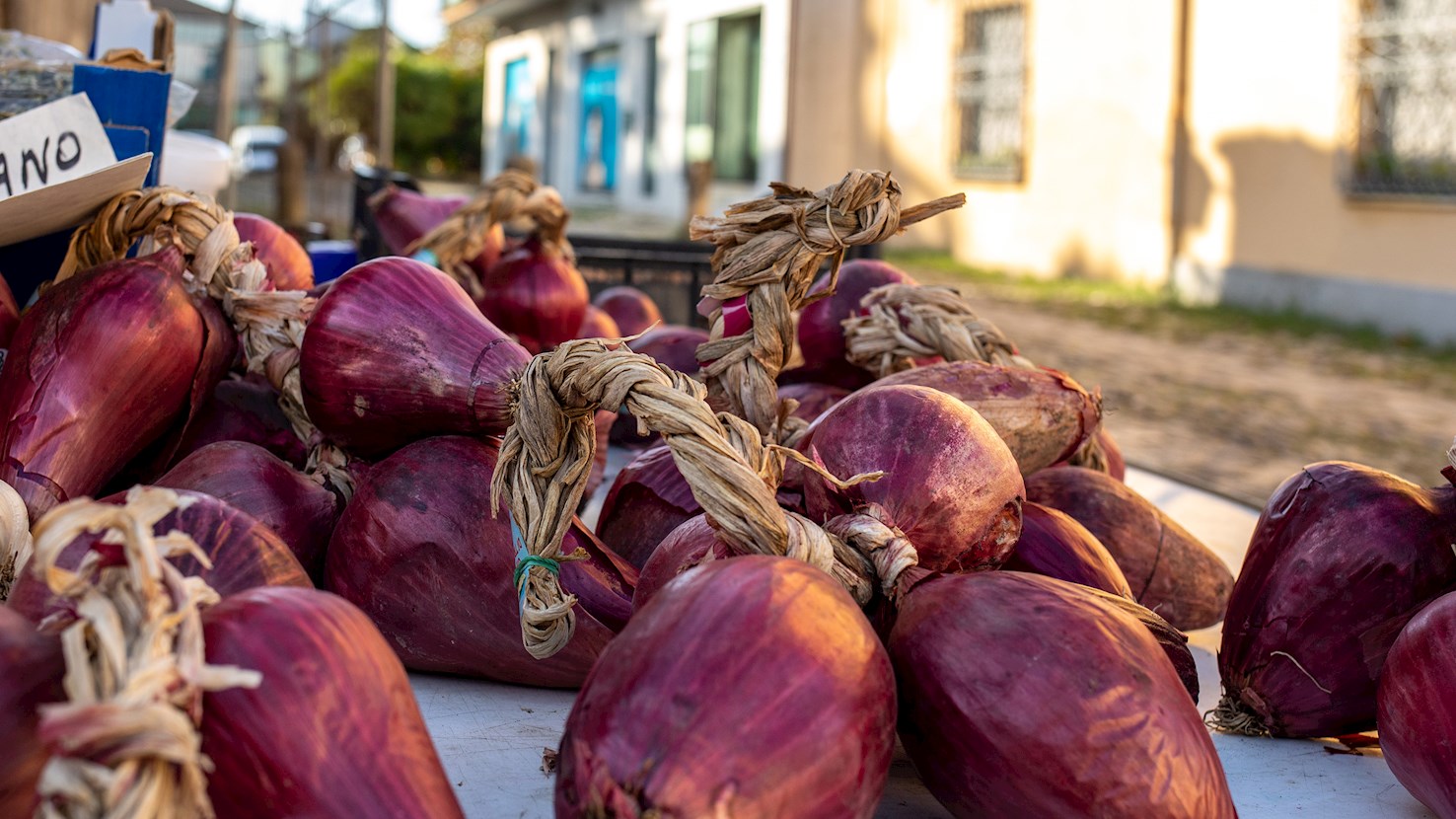
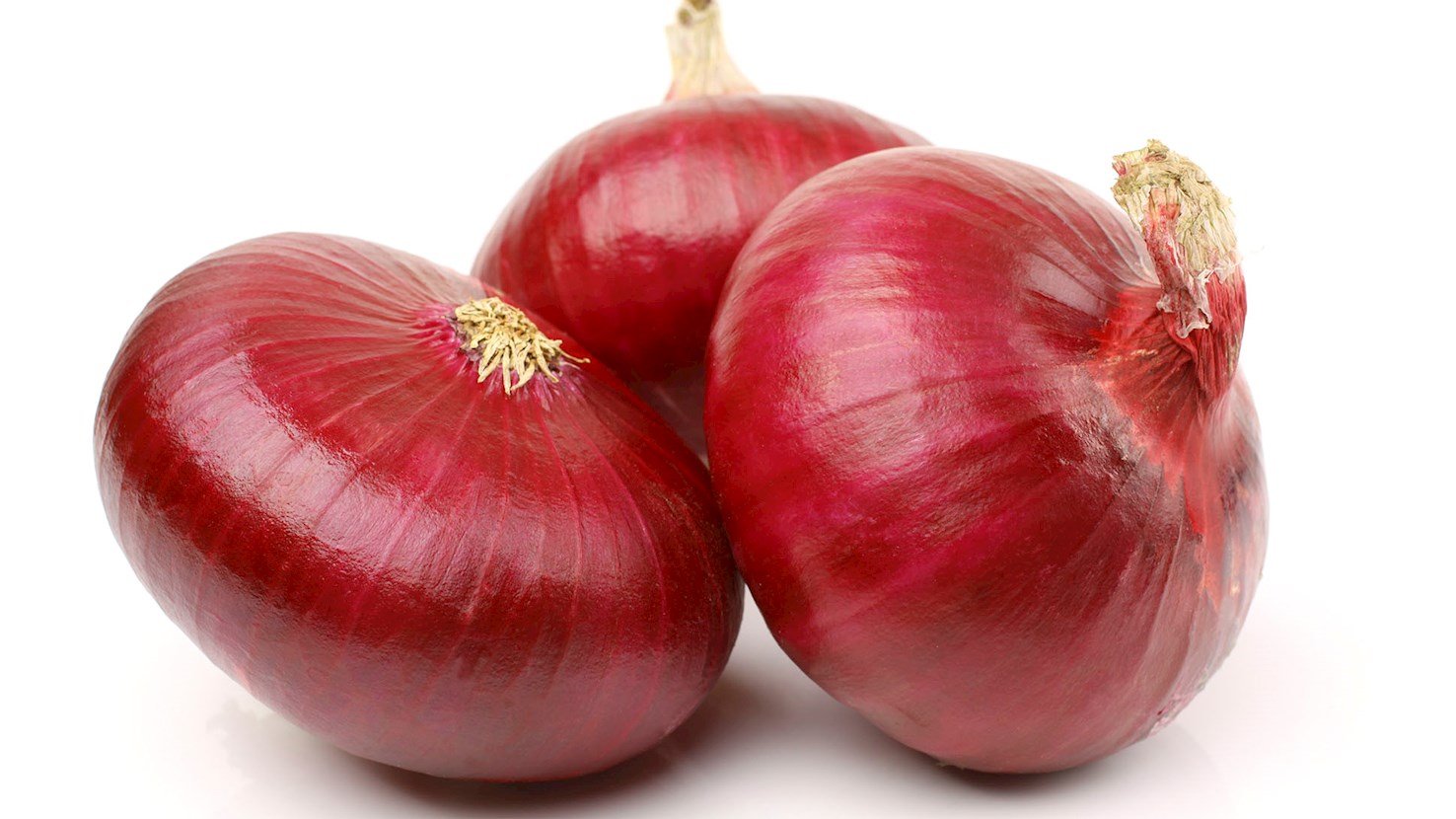
Named after the Calabrian town of Tropea settled along the Tyrrhenian coast in the province of Vibo Valentia, Cipolla Rossa di Tropea Calabria refers to the red onions of the following cultivars: Tondo Piatta (early ripening), MezzaCampana (mid-season) and Allungata (late ripening). They are further categorized into three types: Cipollotto (scallion), Cipolla da Consumo Fresco (fresh onion) and Cipolla da Serbo (preserved onion). Fully ripe Tropea onions are either round or slightly elongated, succulent and particularly sweet. Due to their pleasant flavor, these onions are most often used for sautéeing, added to salads, paired with various vegetables and cheeses, and the smallest bulbs are excellent for pickling. Also, Tropea onions are great for making marmalades, mousses or local dishes such as Tropeana onion soup and Omelette alla Contadina.
This red onion of the Ptujska Rdeča variety is widely known for its excellent culinary properties. Ptujski Lük is a red onion cultivated only in the Podravje region of northeast Slovenia, between the towns of Ptuj and Ormož, namely within Ptujsko polje, which is an area of fertile plains nestled along the banks of the Drava river. Named after 'lük', an old Slovenian word for onion, and famous for its 300-year-old tradition of cultivating exclusively onions, Ptujsko polje is still today known simply as Lukarija. The bulbs of Ptuj onions are medium sized, slightly flattened, and heart-shaped or kidney-shaped in cross-section, which is quite a recognizable feature. They have red to purplish brown skin, and white flesh with the outer leaves also tinged with purple. The significantly lower water content in Ptuj onions means this variety has a longer shelf-life and is well adapted to droughts that can occur in the Podravje region during summer. They are commonly used for savory dishes that don't require longer cooking, since this onion cooks in a relatively short time while maintaining its full hearty flavor. The aroma of these onions often ranges from mild to pungent.
Cipolla di Certaldo is a symbol of the Tuscan town of Certaldo – beloved local onions were even mentioned in book VI of the Decameron, a famous work by Giovanni Boccaccio, who was born in Certaldo. Cipolla di Certaldo truly has a special meaning for the locals - they even call themselves cipolloni, meaning big onions. There are two main types of these onions, and each is harvested in a different season. Statina is a summer onion, characterized by a light violet color, juicy texture, and relatively sweet flavor, while the dark red vernina, which is harvested in autumn, has a strong, pungent flavor. Cipolla di Certaldo is mainly grown inside the municipal territory of Certaldo, but it can also be found in the nearby cities of Montespertoli, Barberino Val d'Elsa, San Gimignano, Gambassi Terme, and Castelfiorentino. These onions are widely used in local cuisine - one of the classic local recipes combines them sautéed with stock and potatoes in a cream that is flavored with extra virgin olive oil, typically enjoyed spread on toasted slices of Tuscan bread.
This varietal of red onion with a distinct shape and color is traditionally grown on the Lake Constance peninsula of Höri. The outer skin has an intense red-brown color that does not rub off when the onions are cut, and their typical flattened form is particularly well suited to weaving traditional onion braids. Hori-Bülle onion is characterized by its delicate aroma and mild, delicate flavor. This makes it an ideal onion to eat raw – Höri-Bülle performs quite well in salads. When cooked, Bülle develops a rich aroma without losing its characteristic red color. It is no wonder that it plays a role in numerous regional recipes, whether with fish, meat, or baked into Bülle-Thin, a local single crust onion pie made with sautéed onions, diced bacon, cream, and caraway seeds.
Oignon rouge de Toulouges is a large, flat-round red onion variety grown around the commune of Toulouges in France. Its origins trace back to seed lines handed down generation after generation among local growers, adapted to the irrigated soils and water-systems of the region. Documentation from 1793 records its sale on market stands in nearby towns, described as “sweet” and “nothing like a strong onion,” which confirms its longstanding presence in local commerce. Cultivation takes place on well-irrigated regadius lands fed by the valley channel system of the local river, a setup with roots going back to the 14th century. Seed sowing begins in December, using saved seed from the previous year. Transplanting occurs between March and April. The soil must supply sufficient but not excessive moisture, since over-watering can asphyxiate the plant. Hand-harvest normally takes place in July or August when the bulbs reach their full size. Once lifted, the onions are dried, sorted by size, and either marketed individually or braided using the long flat pointed leaves—known locally as “bogue”—that grow along the irrigation ditches (agullas). The skins are intensely red and the flesh a pearly white, offering a notably sweet, almost sugary flavor. Because the water content remains high, the onions are rarely stored beyond November, and they need cool, dry, dark storage to preserve quality. While true varietal distinction is acknowledged locally, the oignon rouge de Toulouges is vulnerable to imitation because its seed is not officially registered and the acreage under cultivation is very small (estimated at around 3 hectares in the immediate area, around ten in the wider department). Surrounding communes such as Le Soler, Saint‑Estève, Canohès and Thuir supply the few remaining plots. Variations of the practice mainly concern bulb size (some specimens can reach up to 20-25 cm / 8-10 inches in diameter and weigh more than a kilogram / 2 lb) and whether the product is sold as loose bulbs or braided strands of three to four kilos. Larger bulbs tend to register higher sweetness. As a result of the limited scale and localized character, the onions are largely confined to short-circuit sales (farmers’ markets, direct sales) rather than large-scale export. This onion is most commonly eaten raw: sliced into salads often alongside tomatoes and sweet peppers, where its sweetness and crisp texture shine. It is seldom cooked, although a regional specialty is the onion tart that features the red onion of Toulouges at the annual onion fair held at the end of July. Given its flavor profile, it pairs well with light vinaigrettes, fresh garden vegetables, mild goat cheeses or olive oil-dressed dishes where the onion’s sweet flesh complements but does not overpower.
TasteAtlas food rankings are based on the ratings of the TasteAtlas audience, with a series of mechanisms that recognize real users and that ignore bot,
nationalist or local patriotic ratings, and give additional value to the ratings of users that the system recognizes as knowledgeable.
For the “Top 5 European Red Onions” list until June 15, 2026, 69 ratings were recorded, of which 48 were recognized by the system as legitimate.
TasteAtlas Rankings should not be seen as the final global conclusion about food. Their purpose is to promote excellent local foods,
instill pride in traditional dishes, and arouse curiosity about dishes you haven’t tried.