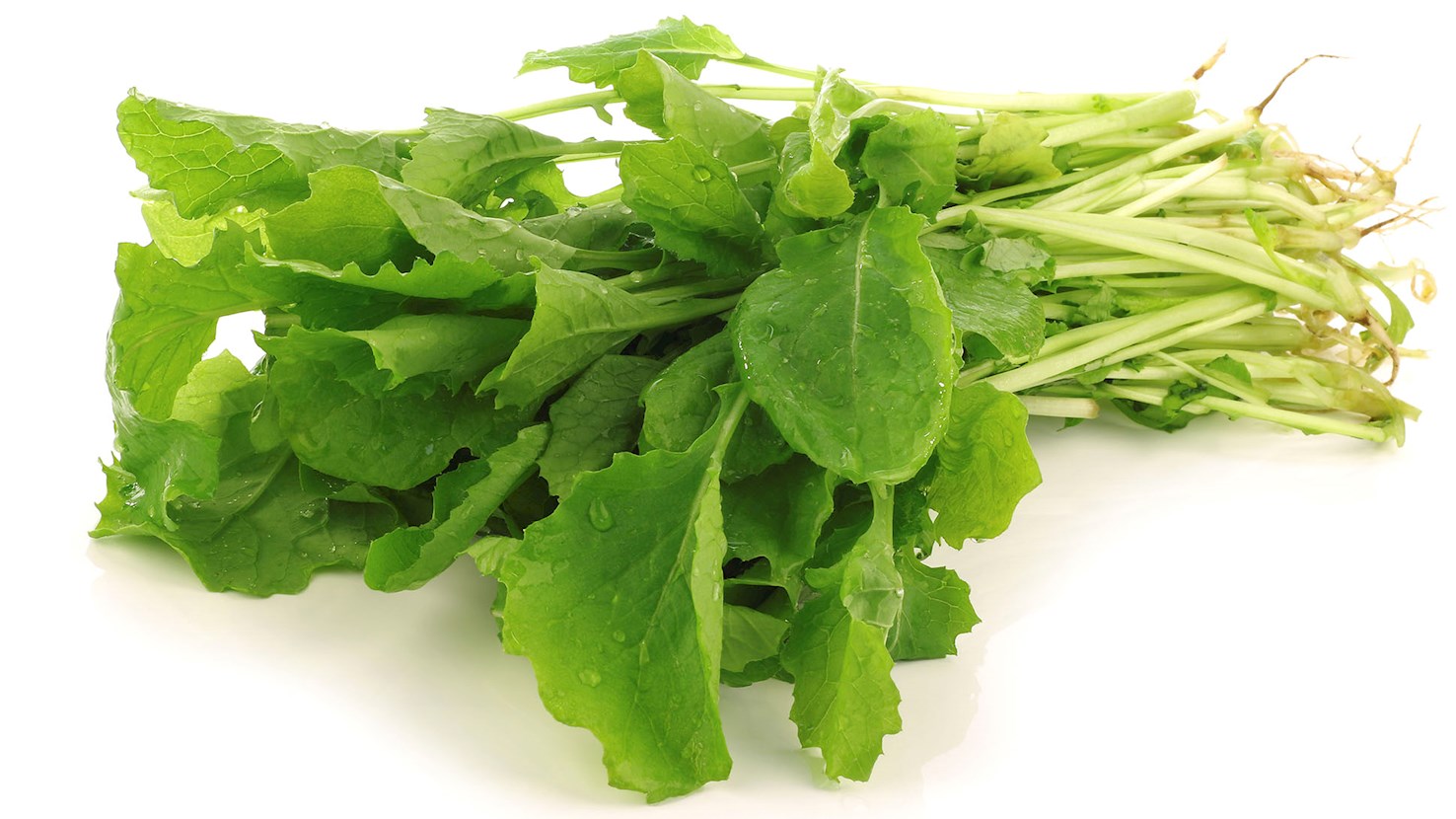
Grelos de Galicia are turnip greens of the species Brassica rapa L. var. rapain, grown in the Autonomous Community of Galicia. These turnip greens are dark green and have a slightly bitter and acidic taste. Their texture is very soft due to their low fibre content. Grelos de Galicia is harvested from October to January by hand and it is very common to see farmers markets full of this colorful vegetable in the winter months. It is a staple ingredient in local cuisine with many traditional dishes such as Galician stew featuring it as the main ingredient. Nutritionally, this vegetable is rich in beta-carotene, vitamin C, and folic acid.
The Hakurei turnip is a specialty root vegetable originally developed in Japan, a salad-type turnip characterized by a smooth, pure white skin, a globular shape, and a crisp, fine-grained interior. Unlike most storage turnips that possess a pungent or peppery bite, the Hakurei variety has a notably high sugar content and a mild, delicate flavor often compared to a cross between a radish and an apple. The entire plant is edible, including the bright green, hairless leaves that grow from the crown, which lack the prickly texture common to other turnip greens. The development of the Hakurei turnip occurred in the mid-20th century, specifically during the post-World War II era in Japan, as plant breeders sought to create food crops that could provide rapid nutritional yields during periods of food scarcity. It was bred to be a fast-maturing "Tokyo" type turnip that reached harvestable size in as little as thirty to forty days. This specific variety was introduced to the North American market in the late 1980s by seed companies focusing on diversified organic agriculture. In 2026, it is a staple of small-scale market gardening and community-supported agriculture (CSA) programs due to its ability to thrive in both spring and autumn growing windows. Preparation of the Hakurei turnip requires minimal processing because the skin is very thin and does not contain the bitter compounds found in larger, purple-top varieties. The roots do not require peeling and are typically washed and consumed whole or sliced. While the vegetable can be roasted or sautéed, it is frequently served raw to preserve its crunchy texture and natural sweetness. The greens should be separated from the roots immediately after harvest to prevent the leaves from drawing moisture out of the bulb. These greens are often prepared by quick blanching or sautéing in olive oil, as they cook much faster than kale or collard greens. It is eaten in both domestic and professional kitchens, often served simply with a light sprinkling of sea salt or integrated into miso soups and pickled vegetable platters. Regarding food pairings, it is served with creamy cheeses like goat cheese or soft brie, as the crispness of the turnip provides a structural contrast to the fat. In a beverage context, it is paired with dry, chilled Junmai Sake or lightly floral green teas, which align with the subtle vegetal notes of the root. For a more acidic pairing, sparkling water with a splash of yuzu or white wine vinegar-based dressings helps to highlight the inherent sugars in the turnip flesh.
Navet de Cerdagne is a rare turnip variety grown in the Cerdagne valley in southern France. Its cultivation can be traced back to mountain-plateau farms where growers selected a root vegetable adapted to high-altitude, limestone-rich soils and cold winters; the variety survived in limited plantings when many other local crops disappeared and has since been catalogued in the Slow Food Foundation for Biodiversity Ark of Taste for its heritage value. Production involves sowing seeds in early spring or planting young seedlings after last frost, cultivating them on well-drained, rocky or calcareous soils at altitudes around 1000–1300 m, managing moisture carefully to avoid bolting, harvesting generally in late summer to autumn when the roots reach maturity, then cleaning and storing them in cool, humid conditions to preserve firm texture and flavor. Common variations are seen in color (ranging from light-brown-to-brass hues to a more greyish brown depending on soil composition), root size (some growers aim for compact small roots, others allow larger bulbous forms) and harvesting time (earlier harvest yields firmer texture, later yields softer sweetness). A distinct characteristic of the Navet de Cerdagne is its firm flesh that remains non-stringy after cooking and its adaptation to mountain soils where few other turnip varieties perform well. It is eaten cooked — for example peeled, diced and sautéed or used in soup or gratin — and forms part of local menus, often accompanying roasted poultry or game, and pairs well with hearty mountain cheeses, fine olive oil drizzle and a crisp white or light red wine from the region.
Navet noir de Pardailhan is a black-skinned, elongated turnip from France cultivated on the plateau of Pardailhan in the Hérault department, between Béziers and Toulouse. The plateau rises gently from 450 to 800 meters within the perimeter of the Haut-Languedoc Regional Park, a zone distinct from the surrounding Mediterranean vineyards and olive groves. Its cooler and more humid climate prevents vine and olive cultivation, favoring instead pastures, forests, and mixed farming. Within this environment, the turnip found a natural home, nourished by the region’s fogs and rains that allow it to thrive through the autumn. Cultivation of the turnip has been documented since at least the 19th century, when it was canned and awarded prizes at international exhibitions. After the Second World War, agriculture declined across the plateau and the crop almost disappeared, surviving only in family gardens. In the 1990s, renewed interest in the vegetable led to its revival, and by the early 2000s young farmers, supported by older growers who passed on their knowledge, reestablished the culture of the black turnip. Local institutions and the Slow Food movement promoted its value through the creation of the Pardailhan Turnip Producers’ Association and its inclusion in the Slow Food Presidia network. Today, about twenty producers cultivate the crop, organizing an annual fête du navet noir to celebrate and promote it. The cultivation process begins with broadcast sowing in early August on well-prepared clay soils. Adequate rain before the end of the month ensures proper germination and growth before winter sets in. The plateau’s fogs are vital to its development, and locals say that the plant “drinks the fog through its leaves.” Harvesting takes place by hand from November to February, preserving the integrity of each root. The turnip’s outer skin is deep black, contrasting with its white interior, which is tender, mild, and delicately sweet with subtle notes reminiscent of hazelnut or pine nut. It must be cut lengthwise along its fibers to retain its texture. The Navet noir de Pardailhan is eaten both raw and cooked: served cold in vinaigrette, caramelized, or sautéed raw in goose fat with a touch of sugar. It is also used in stews or gratins where its sweetness balances savory elements. The vegetable’s rarity and quality make it a seasonal delicacy available for only a few months each year. Beyond its culinary appeal, its revival has supported small-scale agriculture on the plateau, linking local identity to sustainable production. The Navet noir de Pardailhan pairs naturally with roasted meats, game, or poultry, and its subtle nutty flavor complements dry white wines from the Languedoc region.
TasteAtlas food rankings are based on the ratings of the TasteAtlas audience, with a series of mechanisms that recognize real users and that ignore bot,
nationalist or local patriotic ratings, and give additional value to the ratings of users that the system recognizes as knowledgeable.
For the “Top 4 Turnips in the World” list until June 06, 2026, 16 ratings were recorded, of which 12 were recognized by the system as legitimate.
TasteAtlas Rankings should not be seen as the final global conclusion about food. Their purpose is to promote excellent local foods,
instill pride in traditional dishes, and arouse curiosity about dishes you haven’t tried.