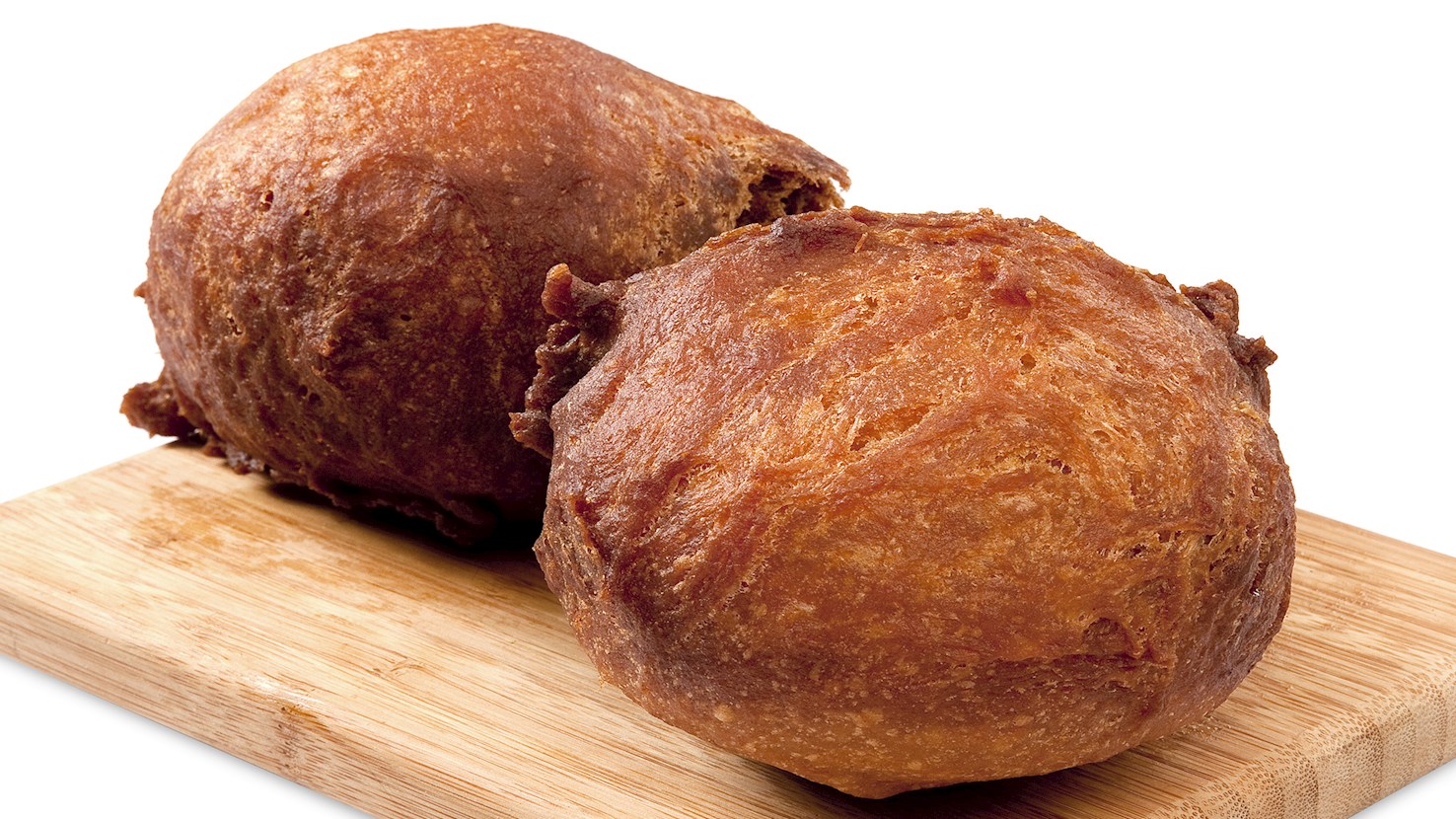
Vetkoek is an iconic South African street food item consisting of deep-fried yeast buns that are usually filled with cheese, curry, or fruit jams. It can be served as a small snack, for breakfast or lunch. The ball-shaped dough is made from salt, yeast, and flour. When served at a South African braai, vetkoek is often served with boerewors, a traditional sausage. You can also serve them as they are, or with a cup of tea on the side.
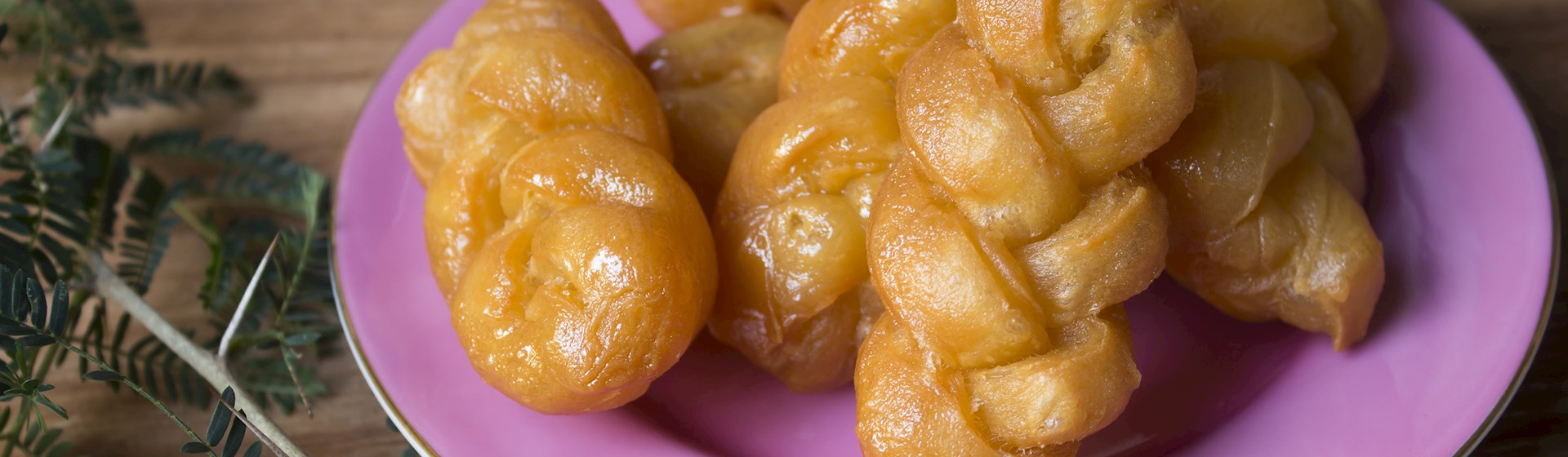
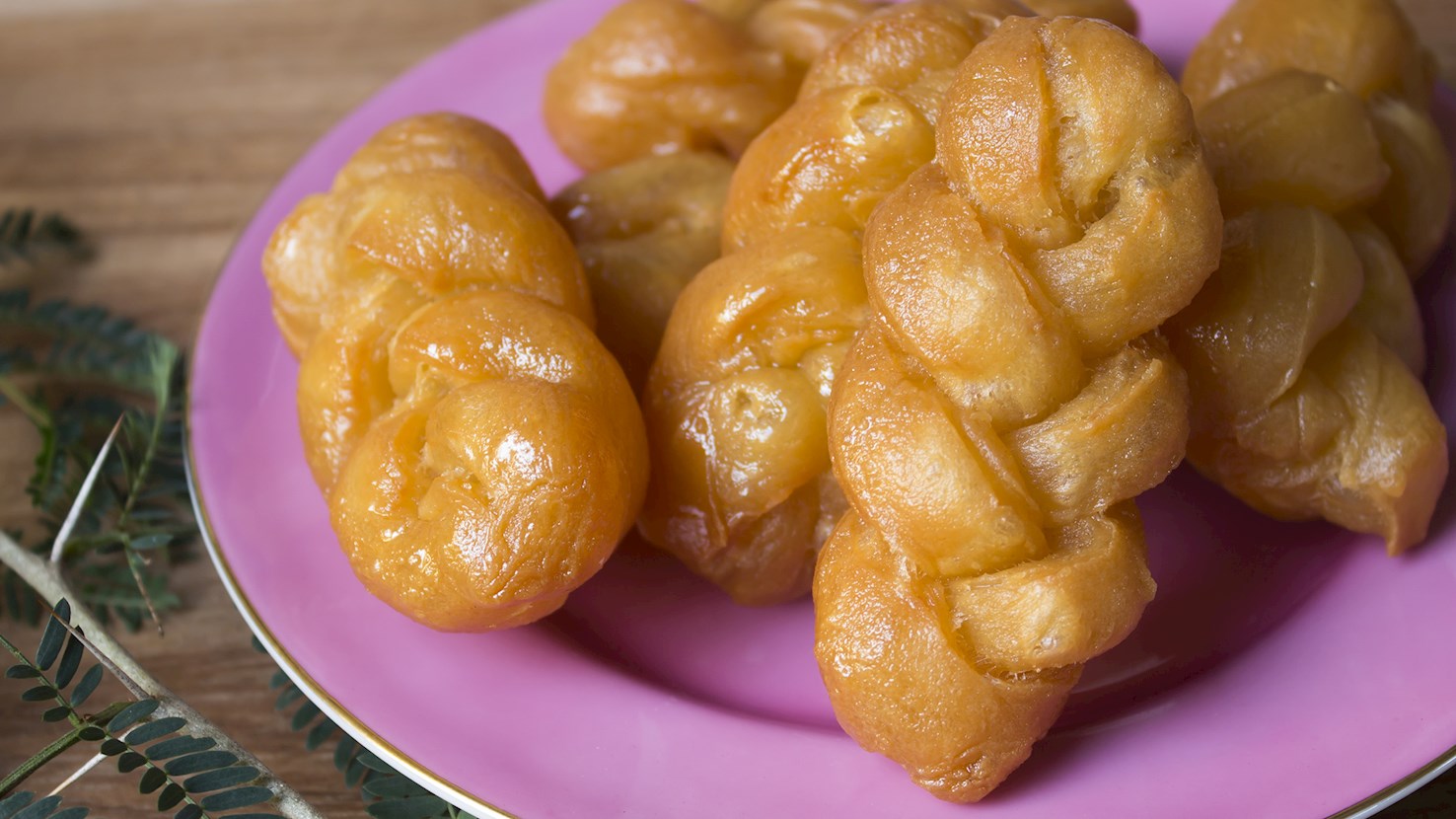
Koeksister is a sweet South African snack with a sticky appearance. It is prepared by frying braided dough strips in oil, then dunking them into a cold sugary syrup. These sticky treats are sold on every major street in South Africa, and today they can even be found in most supermarkets. It is recommended to top them with cinnamon or lemon juice before consumption.
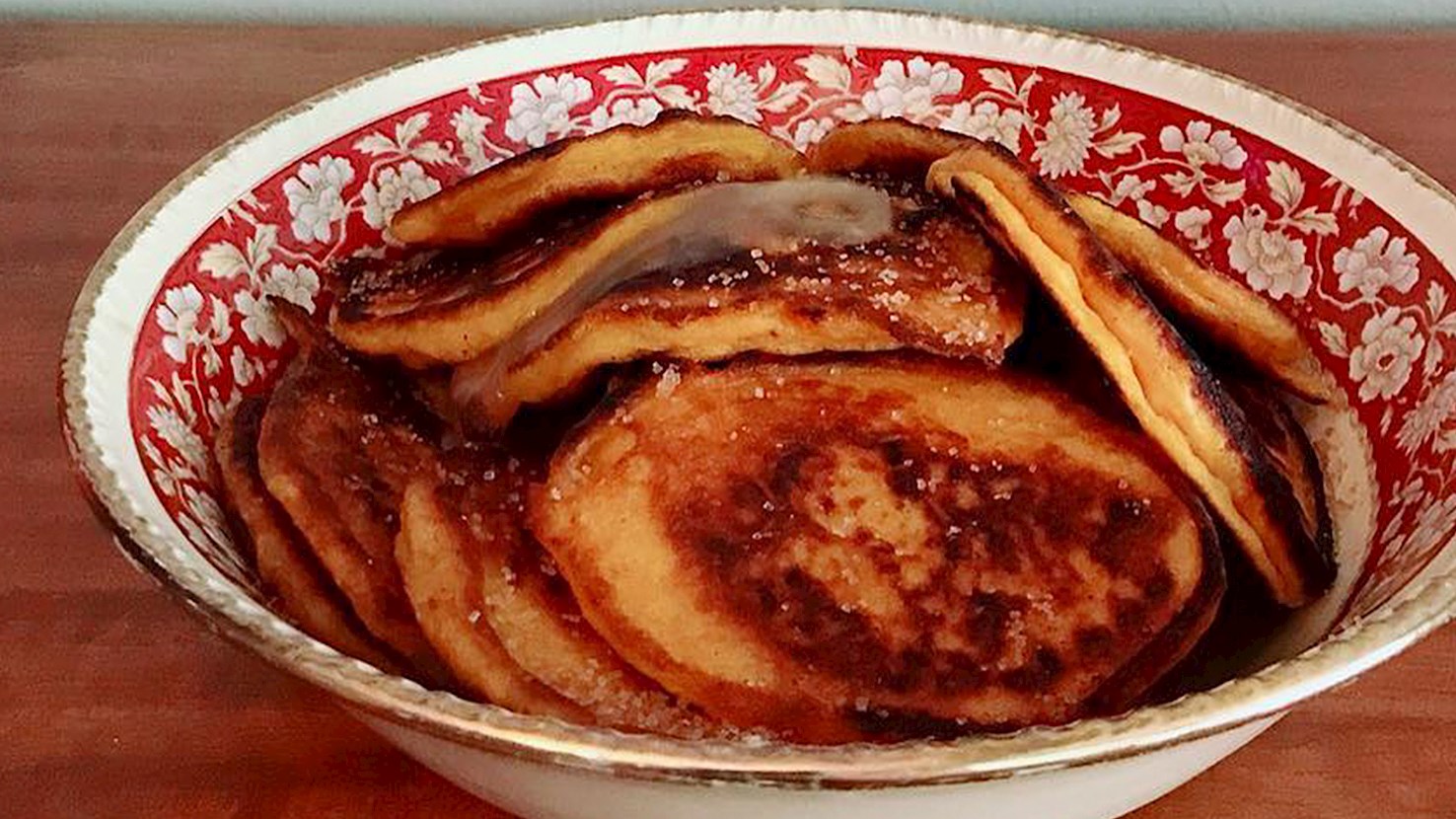
Pampoenkoekies are sweet pumpkin fritters made from mashed pumpkin, flour, eggs, and a raising agent, then pan-fried until golden. They have lightly crisp edges and a soft, moist, almost spongy center. The hot fritters are commonly covered with cinnamon sugar, soaked in a buttery caramel sauce, or served with both. The Afrikaans name translates literally as “pumpkin cakes,” although their texture and method place them closer to fritters or small pancakes. Pampoenkoekies are closely associated with South Africa, especially Afrikaner and Cape home food. Historical research into Cape food confirms that pumpkin became an established ingredient and that pampoenkoekies formed part of the developing Cape repertoire. Older menus could treat sweet pumpkin purée as a vegetable accompaniment while classifying baked pumpkin and pumpkin fritters as desserts, showing that pumpkin crossed freely between savory and sweet courses. The recognizable fritter most likely developed gradually from Cape methods of combining abundant squash with flour, eggs, fat, sugar, and warm spices rather than through one recorded act of invention. The fritters begin with cooked pumpkin. Peeled chunks can be boiled or steamed until completely tender, but they must be drained thoroughly afterward. Excess water produces a loose batter that spreads in the pan, absorbs more oil, and remains wet inside. Leaving the pumpkin in a sieve after boiling helps remove trapped moisture. Roasting is another effective method. It concentrates the pumpkin’s natural sweetness and produces a drier purée, reducing the amount of flour needed to hold the batter together. Whichever method is used, the flesh is mashed until smooth or left with a few small pieces for a slightly coarser texture. The mashed pumpkin is combined with plain wheat flour, baking powder, eggs, and salt. Sugar may be mixed directly into the batter, although some versions rely entirely on the final sauce or cinnamon coating for sweetness. Ground cinnamon and nutmeg are common additions. Vanilla, ginger, mixed spice, or a little citrus zest may also be included. Milk appears in many formulas to loosen the mixture, but it is not always necessary because the pumpkin and eggs may provide enough moisture. The exact flour quantity depends on the pumpkin. A watery purée requires more, while a dry roasted purée needs less. The batter should be thick and scoopable, holding a rounded shape on a spoon before dropping slowly. It should not resemble a rigid bread dough, but it should also not run across the pan like a thin crêpe batter. Overmixing can develop too much gluten and make the fritters heavy, so the flour is folded in only until no dry streaks remain. A wide frying pan is heated over medium heat with sunflower oil, butter, or a combination of the two. Butter contributes flavor and browning but can burn if used alone over excessive heat. Oil raises the effective frying temperature, while a small amount of butter provides a richer aroma. Spoonfuls of batter are dropped into the hot fat with enough space between them to expand. The baking powder releases gas as the batter heats, giving the fritters their soft, aerated interior. They are generally shaped as small rounds or thick, irregular discs rather than perfect spheres. The fritters usually need about two to three minutes on each side, although thickness and oil temperature determine the actual time. The exterior should become deep golden brown, while the center should be fully set and fluffy rather than wet. If the fat is too hot, the outside darkens before the middle sets. If it is too cool, the batter absorbs excess oil and becomes heavy. The first fritter can be broken open to check the center. A wet line of batter indicates that the heat should be lowered and the frying time extended. Once ready, the fritters are lifted from the pan and placed briefly on paper towels or a wire rack to remove surface oil. Butternut squash is a common substitute for standard orange pumpkin. Its flesh is generally dense, smooth, and sweet, producing a thick purée and a particularly soft interior. Depending on the variety, it may also require less draining and less added sugar. Canned pumpkin purée can be used where available, provided it contains no added spices or sweeteners. Savory adaptations omit the sugar and cinnamon and add grated mature cheddar, black pepper, chopped parsley, chives, thyme, or other fresh herbs. Onion, garlic, chili, or crumbled feta may also be included. These retain the pumpkin-fritter structure but move away from the defining sweet pampoenkoekies profile. Sweetcorn kernels can be folded into either the sweet or savory batter. They add small bursts of sweetness and a firmer bite against the soft pumpkin center. In a savory version, sweetcorn works particularly well with cheese, spring onion, chili, or fresh herbs. The simplest finish is cinnamon sugar. White granulated or caster sugar is mixed with finely ground cinnamon, and the hot fritters are tossed in it or dusted generously on both sides. The warmth melts a small amount of sugar against the oily surface, creating a thin, slightly crisp coating. A richer version uses caramel sauce. The original description of sugar, butter, water, and vanilla produces a clear or amber syrup if the sugar is heated correctly. Other established versions combine sugar with butter, cream, milk, golden syrup, vanilla, or a little cornstarch. These sauces are often pale, creamy, and buttery rather than deeply caramelized and dark. The hot sauce is poured over the fritters in a deep ceramic or enamel serving dish. Their porous crust absorbs some of the liquid while the remaining sauce pools beneath them. They can be served immediately for a contrast between crisp edges and warm sauce or left briefly so that they become softer and more thoroughly saturated. Cinnamon sugar and caramel sauce may also be combined. The sauce is poured over first, followed by a light scattering of cinnamon sugar. Adding too much dry sugar after soaking can make the surface excessively sweet and grainy, so the final coating is usually lighter when both are used. Pampoenkoekies occupy an unusual place at the table because they can function as either a dessert or a sweet side. Served after a meal, they pair naturally with black coffee or tea. Alongside roast chicken, beef, lamb, bobotie, or another deeply savory main course, their pumpkin sweetness and cinnamon provide contrast to meat, gravy, salt, and spice. They are especially associated with Sunday lunches, family gatherings, and colder-weather meals. They are best served warm and soon after frying. Unsauced leftovers can be refrigerated and reheated in an oven or air fryer, although the exterior will not be quite as crisp as when fresh. Fritters already soaked in sauce become softer during storage. Freezing is possible, but it can weaken their light texture and cause the pumpkin center to release moisture after thawing.
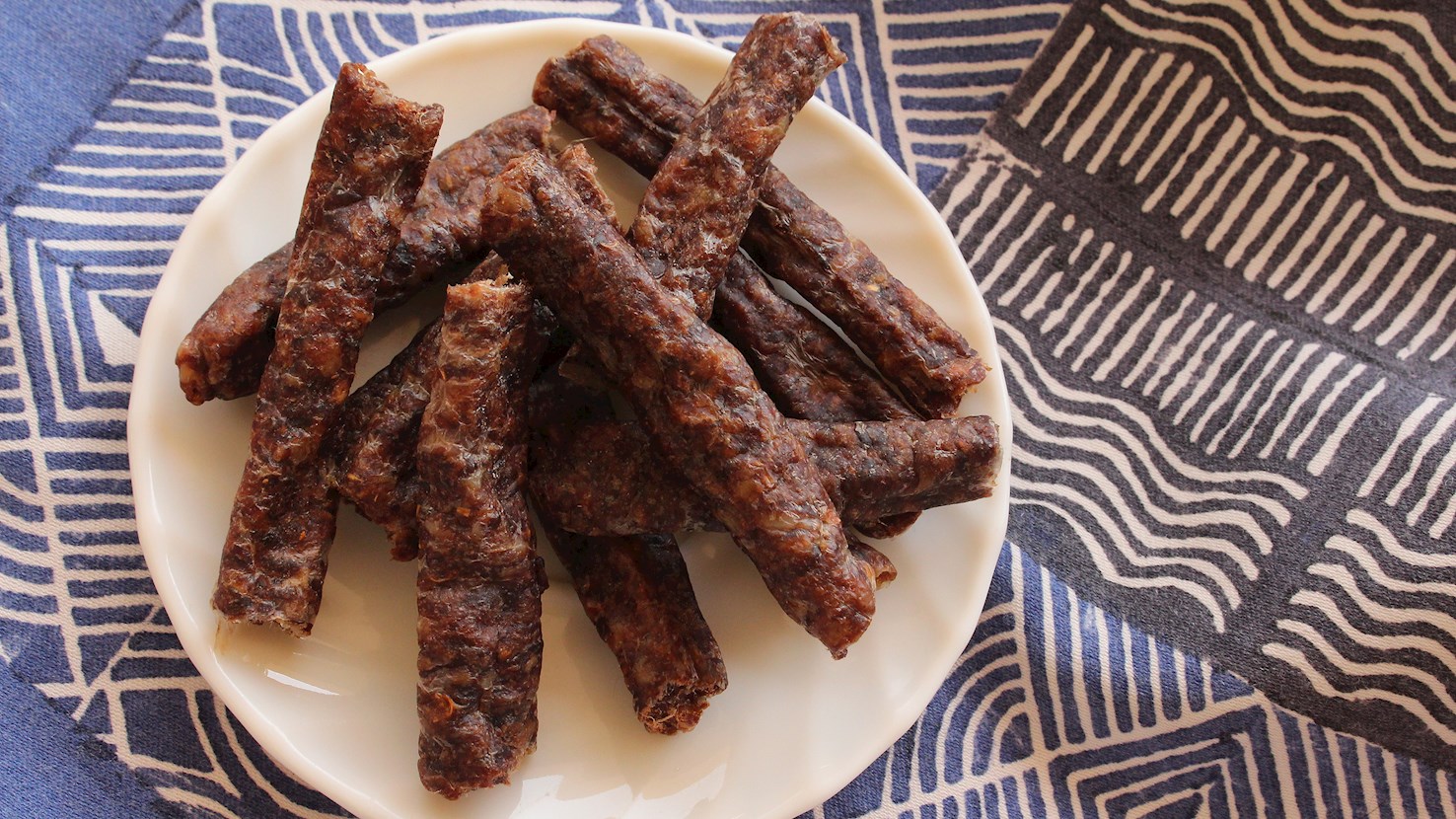
Droëwors is a dry sausage snack that originates from South Africa, where it holds a place as a popular and widely recognized food product. It is made by air-drying spiced meat sausages, usually beef-based, into a firm, shelf-stable form. The name derives from Afrikaans, with “droë” meaning dry and “wors” meaning sausage. It is closely related to boerewors, a fresh sausage, but differs in that droëwors is intended to be dried and consumed without cooking.
The development of droëwors is tied to the preservation needs of early South African settlers, particularly the Dutch-speaking Boer communities. During long treks or in rural areas with limited access to refrigeration, preserving meat through drying was a practical necessity. Influenced by techniques from Europe and the indigenous food knowledge of southern Africa, droëwors evolved as a way to turn perishable fresh sausages into a portable, long-lasting food. Over time, it became not only a method of survival but a staple item in the diet and eventually, a sought-after snack with commercial significance.
The preparation of droëwors starts with lean cuts of beef, often mixed with a small portion of lamb for flavor and texture. Pork is typically avoided because of its shorter shelf life. The meat is finely ground and blended with a spice mixture that usually includes salt, black pepper, toasted coriander seeds, vinegar, and sometimes clove or nutmeg. The seasoned meat is then stuffed into thin natural casings, usually sheep intestines, which help the sausages dry more quickly and evenly. The sausages are hung in a controlled environment with proper airflow and low humidity and are left to dry slowly over several days until they reach the desired firmness. The drying process both preserves the meat and intensifies the flavor, resulting in a chewy, richly spiced sausage that can be eaten as-is.
Droëwors is typically served as a snack and requires no further preparation once dried. It is commonly sold in butcher shops, supermarkets, farm stalls, and at sporting events and markets throughout South Africa. Many producers make it in small batches, while larger commercial operations package it for both local and export markets. It is often enjoyed alongside biltong, another South African dried meat product, and sometimes forms part of snack platters or casual meals.
Despite its simplicity, droëwors has become part of South Africa’s culinary identity and is frequently brought abroad by travelers or expatriates seeking a familiar taste of home. It is especially popular among hikers, road-trippers, and anyone needing a protein-rich food that doesn’t require refrigeration. Its long shelf life and ease of transport have made it a preferred choice for outdoor activities and long journeys. While it remains deeply rooted in South African culture, droëwors has also gained recognition internationally, appreciated for its craftsmanship and distinctive flavor.
Skaapstertjies are cooked sheep or lamb tails from South Africa, especially associated with the sheep-farming regions of the Karoo and Northern Cape and with Afrikaans braai culture. The Afrikaans name literally means “little sheep tails,” from skaap, meaning sheep, and stertjies, the diminutive plural of tail. The cut consists of small tail bones surrounded by meat, connective tissue, and a substantial amount of fat, giving it a much richer texture than familiar lamb cuts such as chops or leg. Skaapstertjies are usually cooked until tender and then finished over hot coals or on a grill so the exterior browns and the rendered fat becomes crisp. They are most often served as finger food, a starter, or a snack during a braai rather than as a large main course, since each tail contains relatively little meat and must be eaten from around the bones. Sheep tails have a long place in southern African food culture. Sheep were present in the region more than two thousand years ago, and early pastoral communities kept fat-tailed types in which substantial energy reserves were stored around the tail and rump. European visitors to the Cape from the late sixteenth century repeatedly described the unusually large tails of sheep kept by Khoekhoe pastoralists, while later colonial records show that tail fat was valued for cooking and other household uses. This does not mean that modern skaapstertjies can be traced directly to one early preparation, but it establishes a long-standing regional appreciation of sheep tail fat and meat. The Karoo later became one of South Africa’s major sheep-farming regions. During the nineteenth century commercial sheep production expanded there, first with wool breeds such as Merino and later with breeds selected more specifically for meat. The Dorper, now strongly associated with dry South African regions, was developed during the twentieth century from Dorset Horn and Blackhead Persian sheep. Modern skaapstertjies may therefore come from Dorper and other contemporary meat breeds rather than from the very large fat-tailed sheep described in early accounts. The tail remains one of the fattiest parts of the animal, and this determines how it is cooked. Simply putting a raw tail over fierce coals can brown the outside before the connective tissue has softened. For that reason, one of the most common methods uses two stages: the tails are first simmered, steamed, or braised until tender, then transferred to the braai to brown and crisp. The first cooking stage can take roughly one to three hours depending on size and age, although a pressure cooker shortens the process considerably. Once tender, the tails are drained and often allowed to cool slightly so the meat firms around the bones and is easier to grill. The simplest preparation uses only water, salt, and perhaps a few aromatics during the simmering stage. Bay leaf, pepper, coriander, onion, or cloves may be added, but they are not essential. Once tender, the tails are placed over medium-hot coals and turned frequently. The goal is to render and brown the exterior fat rather than continue cooking the interior. Because large amounts of fat drip onto the coals, flare-ups can burn the tails quickly, so moderate heat is preferable to direct intense flames. Some of the most characteristic Karoo versions use little more than coarse salt, black pepper, and lemon. This keeps the flavor of the lamb dominant and balances the richness with acidity. More elaborate versions may use coriander, rosemary, thyme, garlic, Worcestershire sauce, vinegar, biltong spice, or braai spice. Sweet-and-sour glazes containing chutney, tomato sauce, vinegar, Worcestershire sauce, or wine are also used, while curry-flavored marinades appear in some recipes. These are variations rather than requirements; the combination of slow tenderizing followed by grilling is much more consistent than any particular seasoning. Skaapstertjies can also be braised slowly with stock, onions, herbs, spices, or vegetables, then grilled or seared at the end. This produces a very soft interior and can preserve more flavor than boiling in plain water. Some modern South African restaurants use the same basic cut in more elaborate starters, pairing slow-cooked or chargrilled tails with pickled vegetables, cultured dairy products, salads, or spiced sauces. Their characteristic texture comes from the high proportion of fat and connective tissue around the small bones. Long cooking converts collagen into gelatin, while the final grilling renders surface fat and creates crisp edges. The result is considerably richer than a lamb chop, so the tails are generally eaten in small quantities. Size varies greatly between animals: some tails contain mostly bone and fat, while larger ones can be noticeably meatier. Skaapstertjies are usually eaten with the hands. Their small bones and irregular shape make a knife and fork less practical than simply holding each tail and removing the meat directly. Lemon wedges are especially useful because their acidity cuts through the rendered fat. In braai settings, the tails are often cooked and served early while larger cuts of meat are still on the fire, effectively functioning as an appetizer. They are particularly associated with the Karoo because lamb and mutton are central to the region’s food culture and agricultural economy. The semi-arid landscape supports extensive sheep farming, and skaapstertjies appear at farm gatherings, meat festivals, restaurants, braais, and specialist butcher shops. They are also eaten elsewhere in South Africa and in neighboring Namibia, particularly in areas where sheep farming and Afrikaans braai culture are prominent. At a braai, skaapstertjies can be served alongside ribs, lamb chops, skilpadjies, or boerewors, although their richness makes lighter accompaniments particularly suitable. Tomato and onion salad, coleslaw, pickled onions, green salads, or acidic relishes work well, while roosterkoek or braaibroodjies can make the meal more substantial. Beer is one of the most natural beverage pairings, especially a cold lager. Dry cider also works well, while Cinsault, Pinotage, or Syrah suit more strongly charred versions. A dry Chenin Blanc with good acidity is especially effective with skaapstertjies seasoned simply with salt and lemon.
A koe'sister is a spiced, yeast-risen doughnut coated in boiling sugar syrup and rolled in desiccated coconut, originating from the Cape Malay community in Cape Town. The confection developed within the Dutch Cape Colony during the seventeenth and eighteenth centuries, created by enslaved Southeast Asian artisans and laborers who adapted Dutch koekje (cake) and sustje (sweet roll) frying techniques by incorporating Indonesian and Malaysian spices like cinnamon, cardamom, ginger, aniseed, and dried tangerine peel (naartjie). Preparation involves combining flour, sugar, yeast, and ground spices in a bowl, stirring in warm milk, water, butter, and egg to yield a wet, sticky mixture that is brought together without formal kneading to preserve light air pockets, allowing the slack dough to rise until doubled, shaping small oval portions using oiled hands, deep-frying the portions in hot oil until dark brown, simmering the cooled fried rolls in a heavy sugar-water syrup infused with ginger or cinnamon, and immediately tossing the sticky pastries in fine desiccated coconut. What is unique to the Cape Malay koe'sister compared to the Afrikaner koeksister is its soft, sponge-like interior colored with aromatic botanicals and dusted with coconut, whereas the Afrikaner variant uses an unleavened, baking-powder-based dough that is firmly kneaded, shaped into a tight braid, deep-fried, and submerged cold to produce a crisp, syrup-soaked, glassy exterior. Koe'sisters are eaten across the Western Cape in family homes, local bakeries, and street stalls, most notably as an established Sunday morning breakfast staple, served warm directly after syrup-coating and eaten by hand, paired with strong black coffee, rooibos tea, spiced chai, or warm milk.
TasteAtlas food rankings are based on the ratings of the TasteAtlas audience, with a series of mechanisms that recognize real users and that ignore bot,
nationalist or local patriotic ratings, and give additional value to the ratings of users that the system recognizes as knowledgeable.
TasteAtlas Rankings should not be seen as the final global conclusion about food. Their purpose is to promote excellent local foods,
instill pride in traditional dishes, and arouse curiosity about dishes you haven’t tried.





What People Say