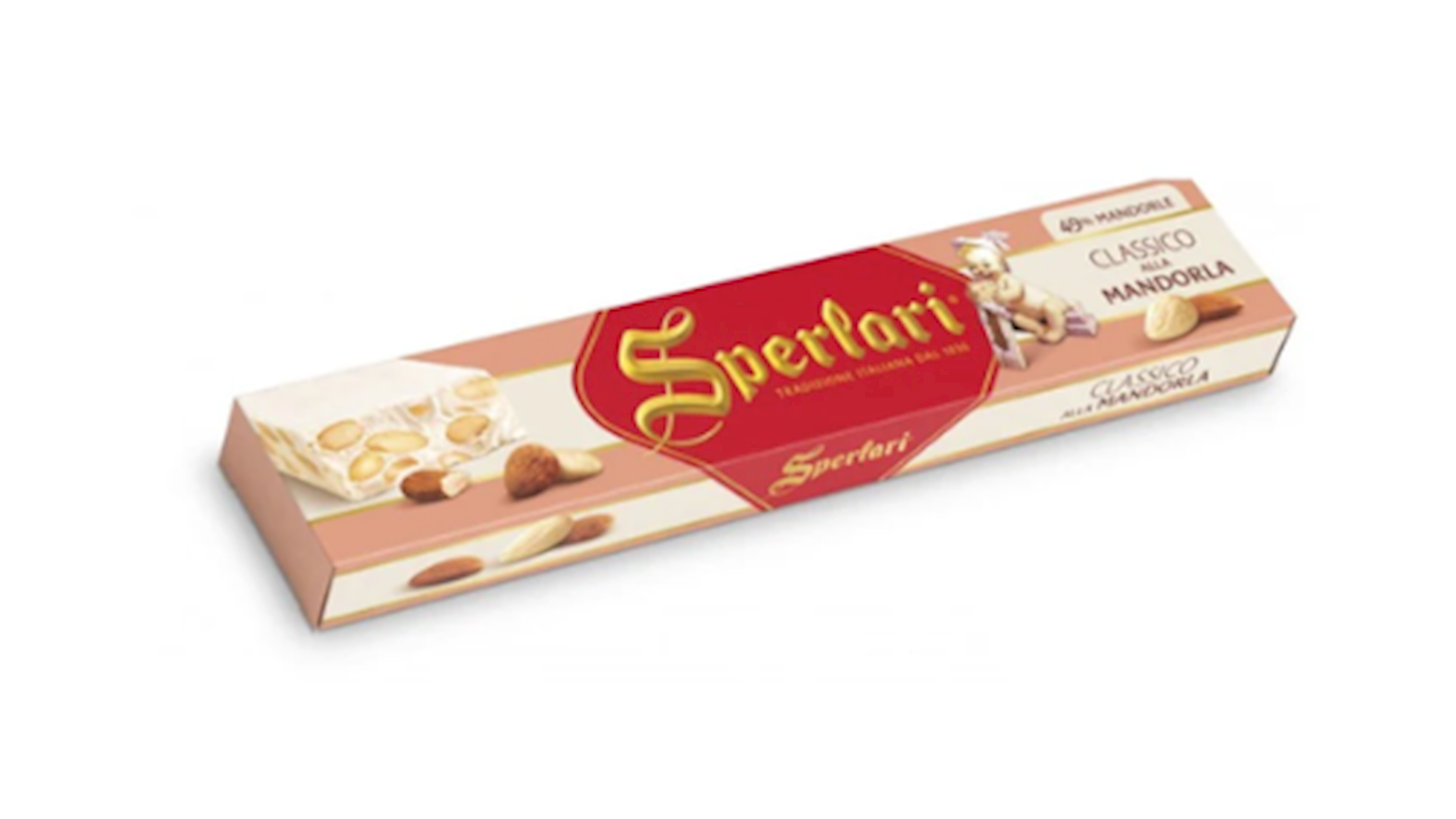
Sperlari is one of the oldest Italian confectionery companies, founded in 1836 in Cremona by Enea Sperlari as a small family-run shop specializing in traditional local products such as torrone and mostarda, which still form the core of its identity. Over time, the company expanded its portfolio to include a wide range of sweets such as candies, jellies, licorice, and seasonal products, becoming a well-established name within the Italian confectionery sector. Its development has been shaped by a balance between preserving traditional recipes and adapting to modern production methods, allowing it to maintain consistency while evolving its product range. Despite changes in ownership and integration into an international group, Sperlari has retained a strong connection to Cremona as both a production center and a symbolic reference point for the brand. Today it operates as part of Katjes International, focusing on strengthening its market presence and expanding into new product categories. The brand continues to be associated with authenticity, regional heritage, and long-standing craftsmanship, positioning it as a representative example of Italian confectionery tradition adapted to a contemporary market context.
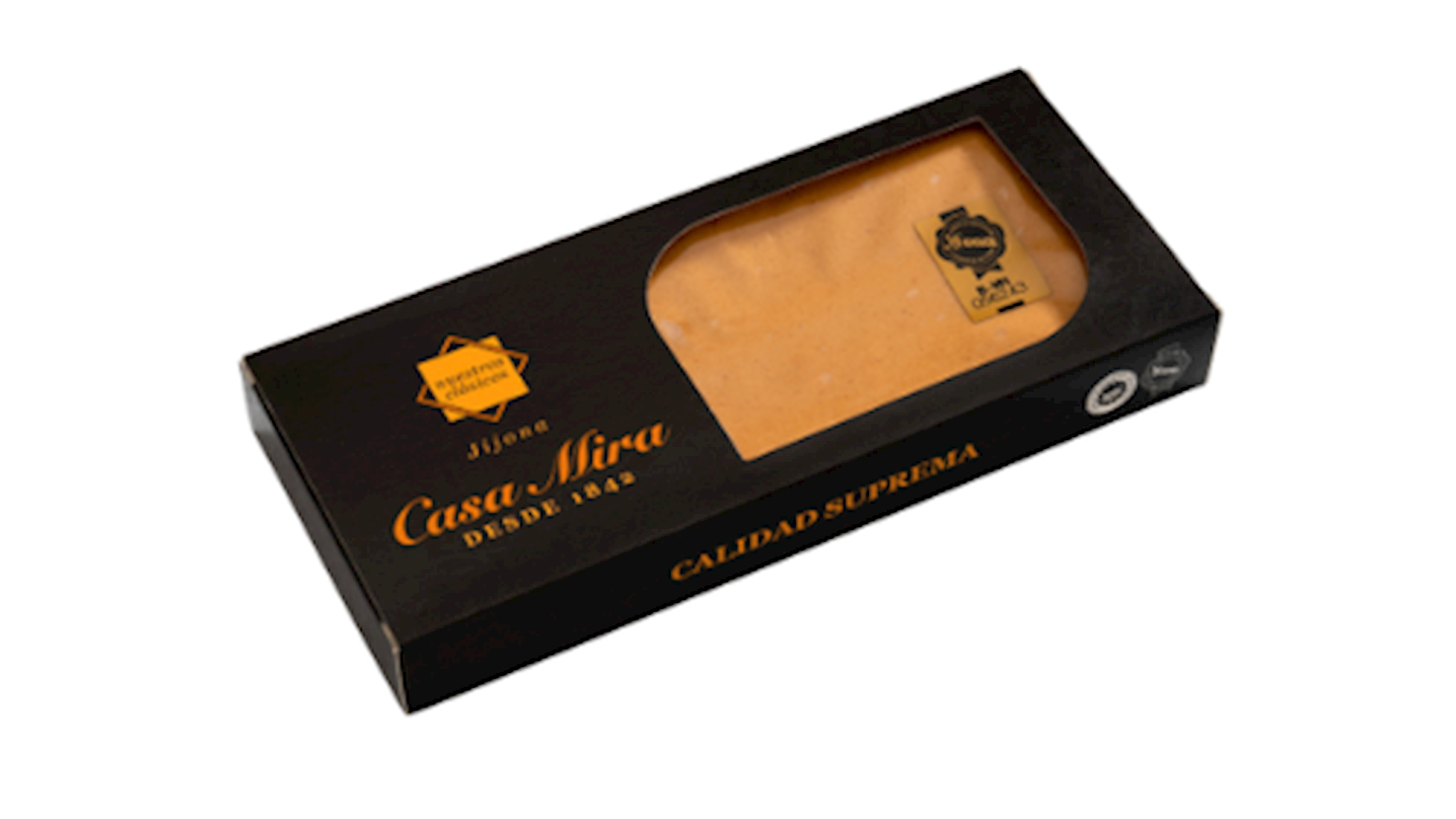
Casa Mira is a historic Spanish confectionery and turrón producer based in Madrid, founded in 1842 and considered one of the oldest specialized establishments of its kind in the country. The business was established by Luis Mira, who brought traditional Levantine turrón recipes to the capital, where the brand quickly gained recognition for the quality of its almonds, honey, and carefully controlled production methods. Its portfolio includes classic hard and soft turrón, chocolate variations, marzipan, candied fruits, and traditional Spanish seasonal pastries. Production continues to rely on artisanal techniques, avoiding industrial shortcuts that could compromise texture and flavor integrity. Particular attention is paid to the origin and selection of raw materials, especially almonds and natural honey, which define the structure and balance of sweetness. The flagship shop in central Madrid preserves its historic interior with wooden display cabinets, reinforcing the brand’s heritage identity. Over time, Casa Mira became known as a supplier to the Spanish royal household, further strengthening its reputation. Although closely associated with the Christmas season, its products are available year-round, including through online sales. Today, the company combines the preservation of traditional recipes with contemporary packaging and corporate gifting solutions. Casa Mira represents a long-standing example of Spanish confectionery heritage sustained through generations.
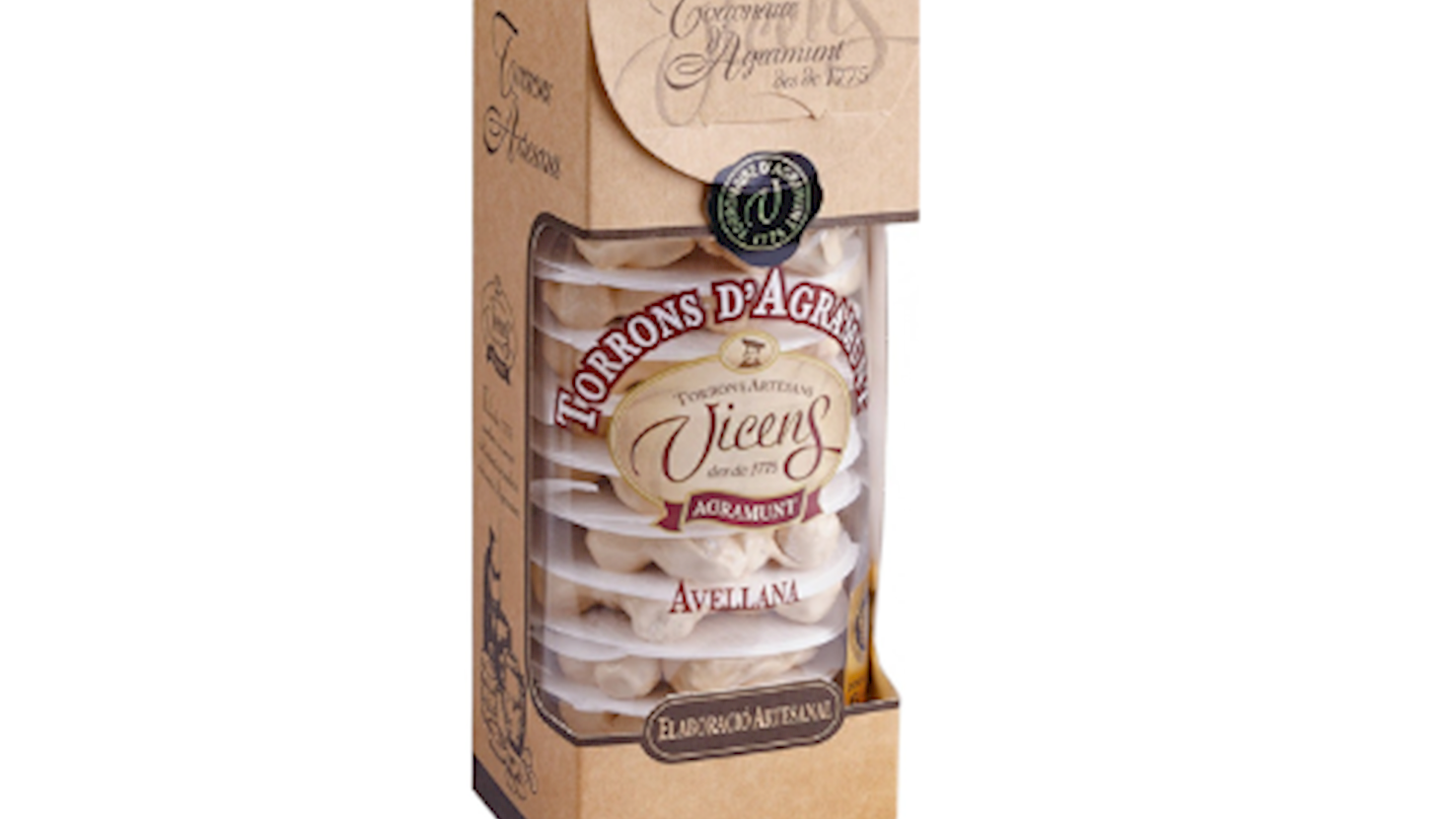
Torrons Vicens is a traditional Spanish producer of turrón and other confectionery products based in the town of Agramunt in Catalonia, a region with a long history of nougat production. The family company was founded in 1775 and has developed its production over generations based on traditional recipes and locally sourced ingredients. Their products are typically made from almonds or hazelnuts, honey, sugar, and egg whites, often placed between thin wafers typical of Torró d’Agramunt, one of the most recognized regional varieties of Spanish turrón. Over time the brand has expanded its range to include chocolate specialties, creamy nougat varieties, pralines, and other sweets. Torrons Vicens is known for combining traditional craftsmanship with a modern approach to product development, including collaborations with well-known Spanish chefs and pastry experts. Thanks to nearly three centuries of continuous production and a strong connection to the gastronomic heritage of Agramunt, the brand is considered one of the most recognized turrón producers in Spain.
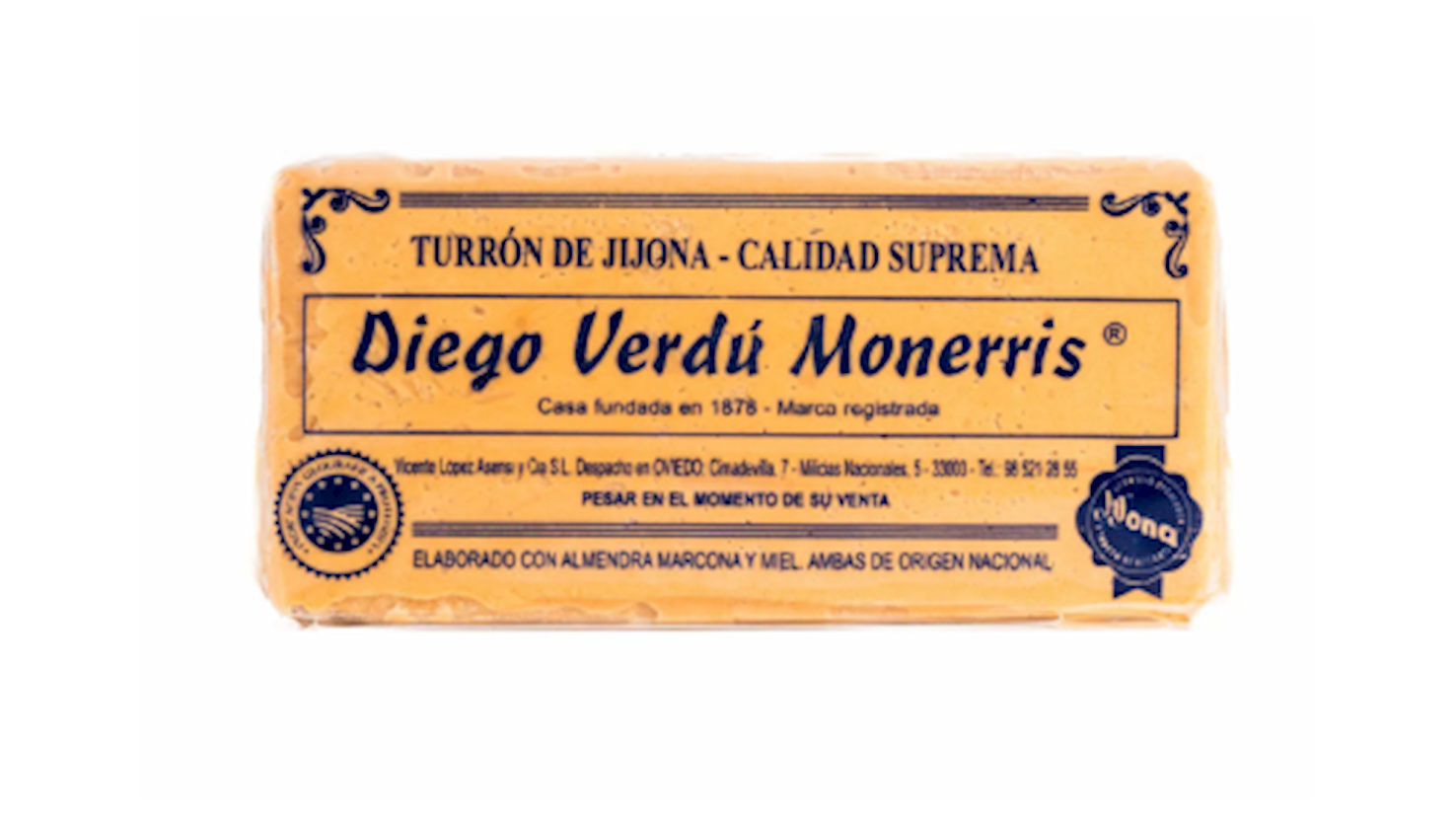
Diego Verdú Monerris is a traditional Spanish confectionery producer based in Oviedo, with origins dating back to 1878 when the founder from Jijona began crafting and selling handmade turrón and seasonal sweets. Over generations, the family business has maintained a strong focus on artisanal production and the preservation of traditional recipes, while gradually expanding its range. Today, the company offers a broad assortment that includes turrón, chocolates, candies, panettone, and ice cream, reflecting both heritage and adaptation to contemporary demand. A defining aspect of the brand is its transition from a purely seasonal activity into a year-round operation, achieved by diversifying into products such as ice cream and other confections. Its historic shop in the center of Oviedo remains a key part of its identity, known for its wide selection and long-standing reputation, particularly in the turrón category. Production relies on carefully selected ingredients such as almonds, honey, and sugar, combined with traditional techniques that shape the texture and flavor of the final products. Alongside its physical presence, the company has developed online sales, extending its reach beyond the local market while maintaining a clear connection to Spanish confectionery tradition.
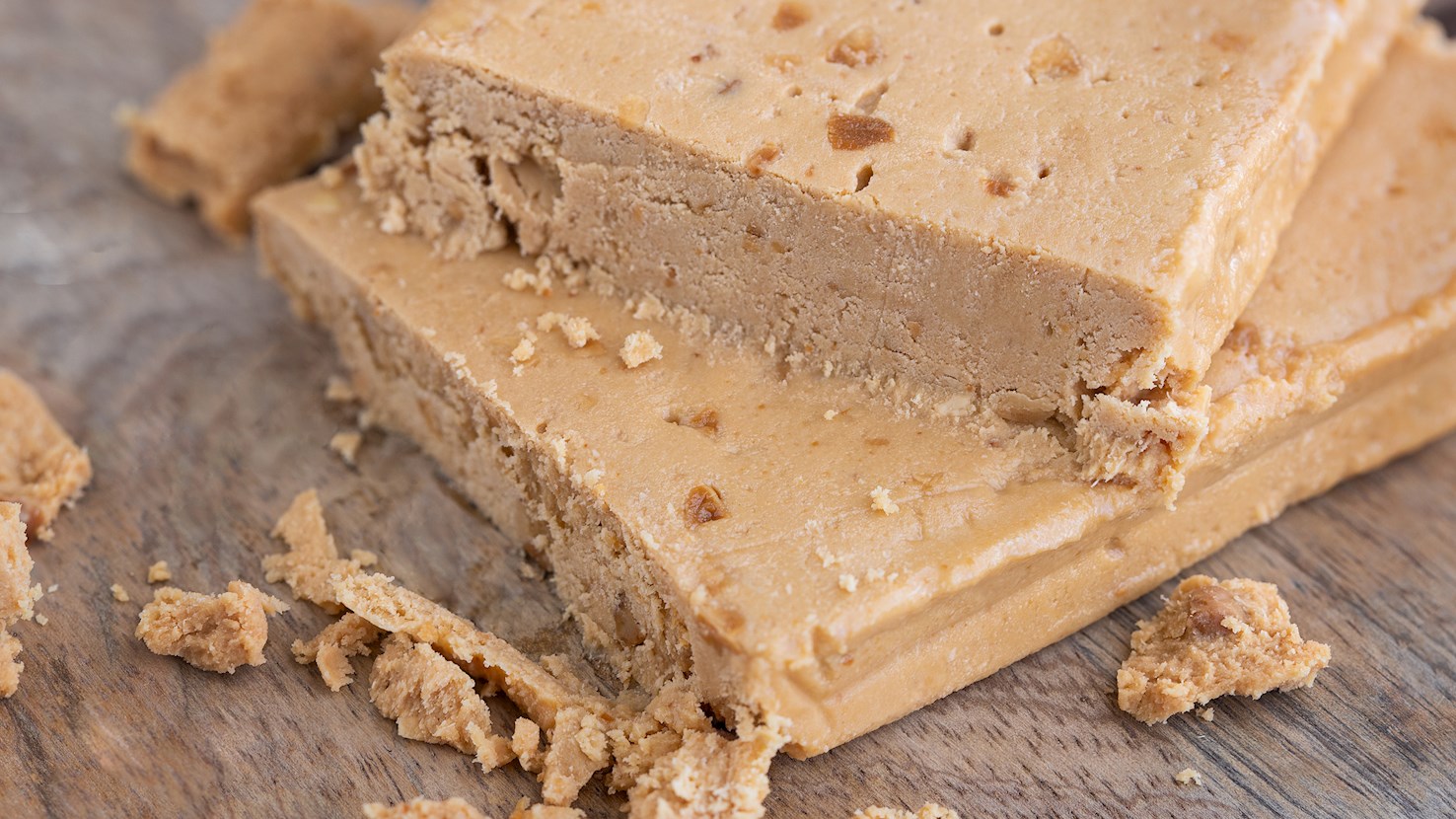
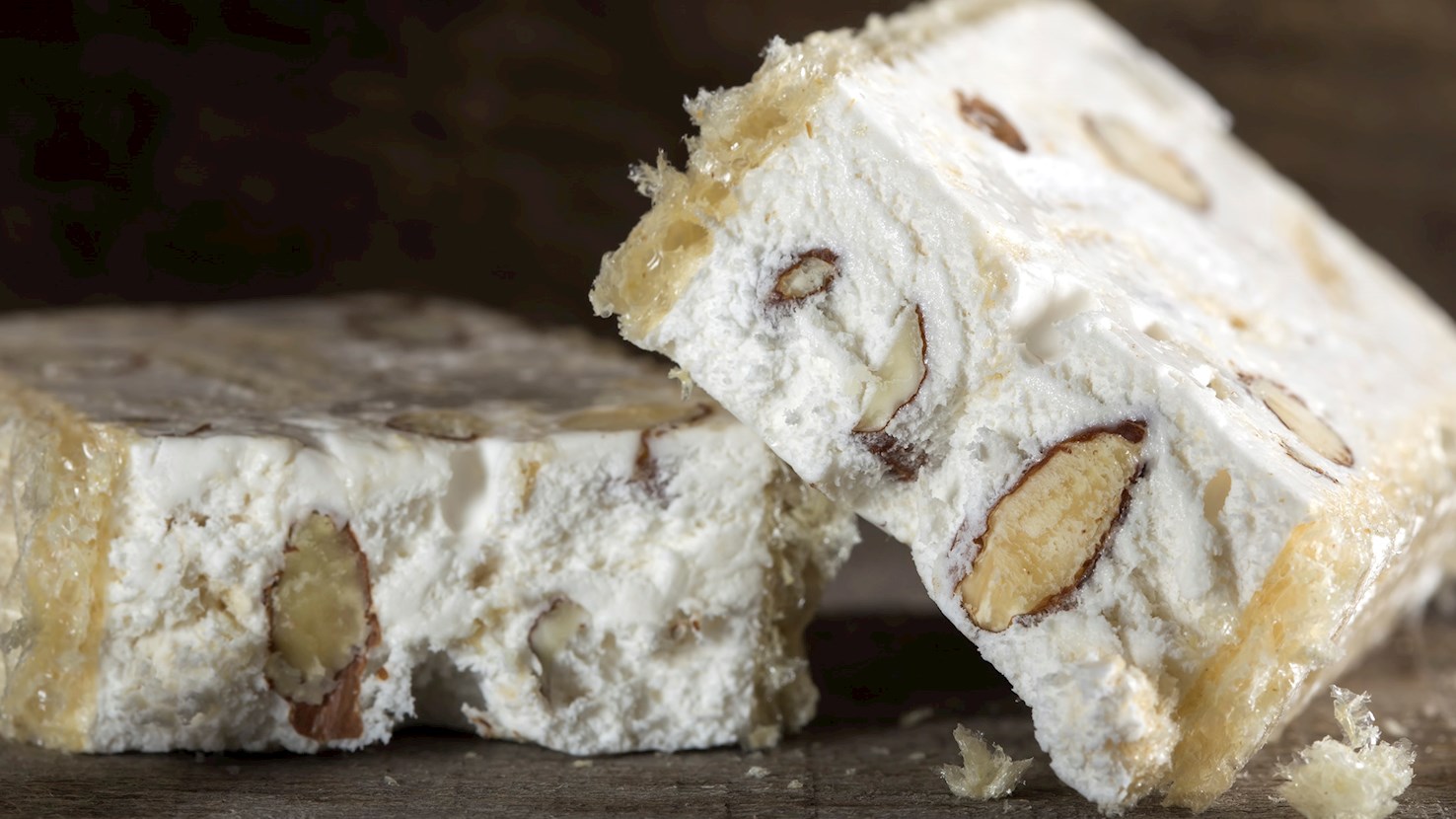
Turrón de Jijona is a soft nougat originating from the municipality of Jijona in Alicante. It is distinguished by its oily, ochre-colored paste, which is achieved by milling and emulsifying toasted almonds with honey, sugar, and egg whites. Unlike its hard counterpart, it is a Protected Geographical Indication (PGI) product that must be manufactured within the region to meet specific quality standards, including a minimum almond content of 64% for the "Supreme" grade. The item was developed in the 17th century as an evolution of harder nougats, utilizing new mechanical milling techniques to create a more tender consistency. The preparation involves first creating a hard nougat, which is subsequently ground into a fine powder. This powder is placed into a boixet, a specialized heated cauldron with an oscillating mechanical pestle that beats the mixture for several hours. This mechanical action forces the almonds to release their natural oils, transforming the dry grains into a fluid, homogeneous mass. The resulting paste is stabilized through a second cooking phase and then poured into rectangular molds to set for at least two days. A unique technical aspect of this turrón is the emulsion process; the specific movement of the boixet is essential to achieving the smooth, melt-in-the-mouth texture that defines the variety. It is served in thick slices or cubes and is primarily consumed during the Christmas season. Common beverage pairings include Fondillón, a semi-sweet wine from Alicante, Cava, or a strong Spanish espresso, which helps emulsify the rich almond oils on the palate.
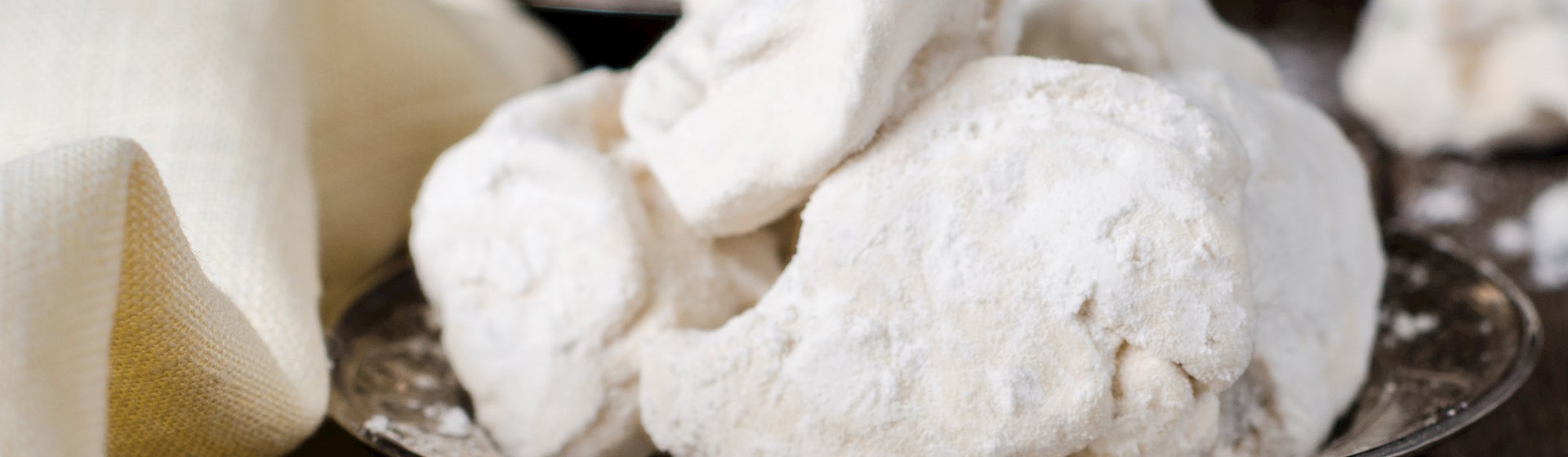
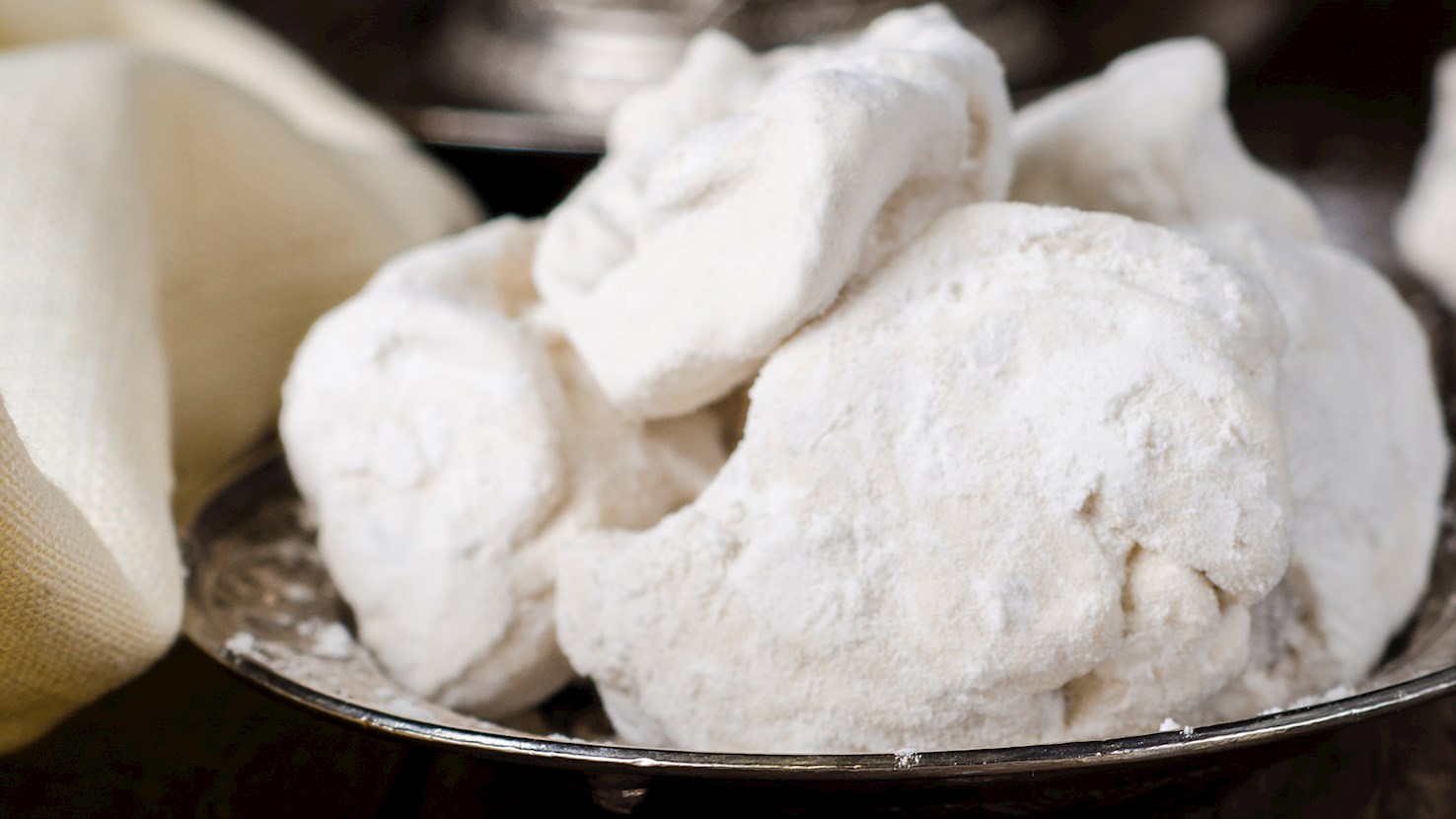
Gaz is a Persian confection known for its chewy texture and delicate sweetness, primarily produced in the city of Isfahan. It belongs to the broader family of nougat confections and is often considered a symbol of Isfahani hospitality and craftsmanship. Gaz is typically made by combining a syrup derived from the sap of a desert plant called angebīn (Tamarisk manna) or, in more modern recipes, glucose syrup, with egg whites beaten into a stiff foam. The history of gaz dates back several centuries, when the sap collected in the Iranian plateau was blended with local ingredients to create a sweet that could be stored for long periods. This reliance on manna, rather than only sugar, is a defining feature of authentic gaz and contributes to its distinct taste and texture. This base is enriched with pistachios or almonds and flavored with rosewater to create a distinctive aroma. The preparation of gaz involves heating the syrup to a precise temperature and then slowly folding it into the whipped egg whites to create a smooth, elastic mass. This mixture is stirred constantly to prevent sticking and to achieve the desired density and gloss. Once the nuts and flavorings are incorporated, the nougat is spread into molds dusted with flour or starch to prevent sticking and left to cool. When firm, it is cut into small rectangular or diamond-shaped pieces and sometimes wrapped in edible rice paper to keep the surface from becoming tacky. Gaz is traditionally served alongside tea and is popular as a gift during holidays and family gatherings. The flavor combines the floral notes of rosewater with the richness of nuts and the gentle sweetness of the manna syrup, which sets it apart from European nougat varieties. The confection’s pale, ivory color and tender consistency have made it one of Iran’s most recognizable sweets, with shops in Isfahan specializing exclusively in its production. Over time, producers have developed variations, including gaz with saffron or flavored with cardamom, though the classic version remains the most sought-after.
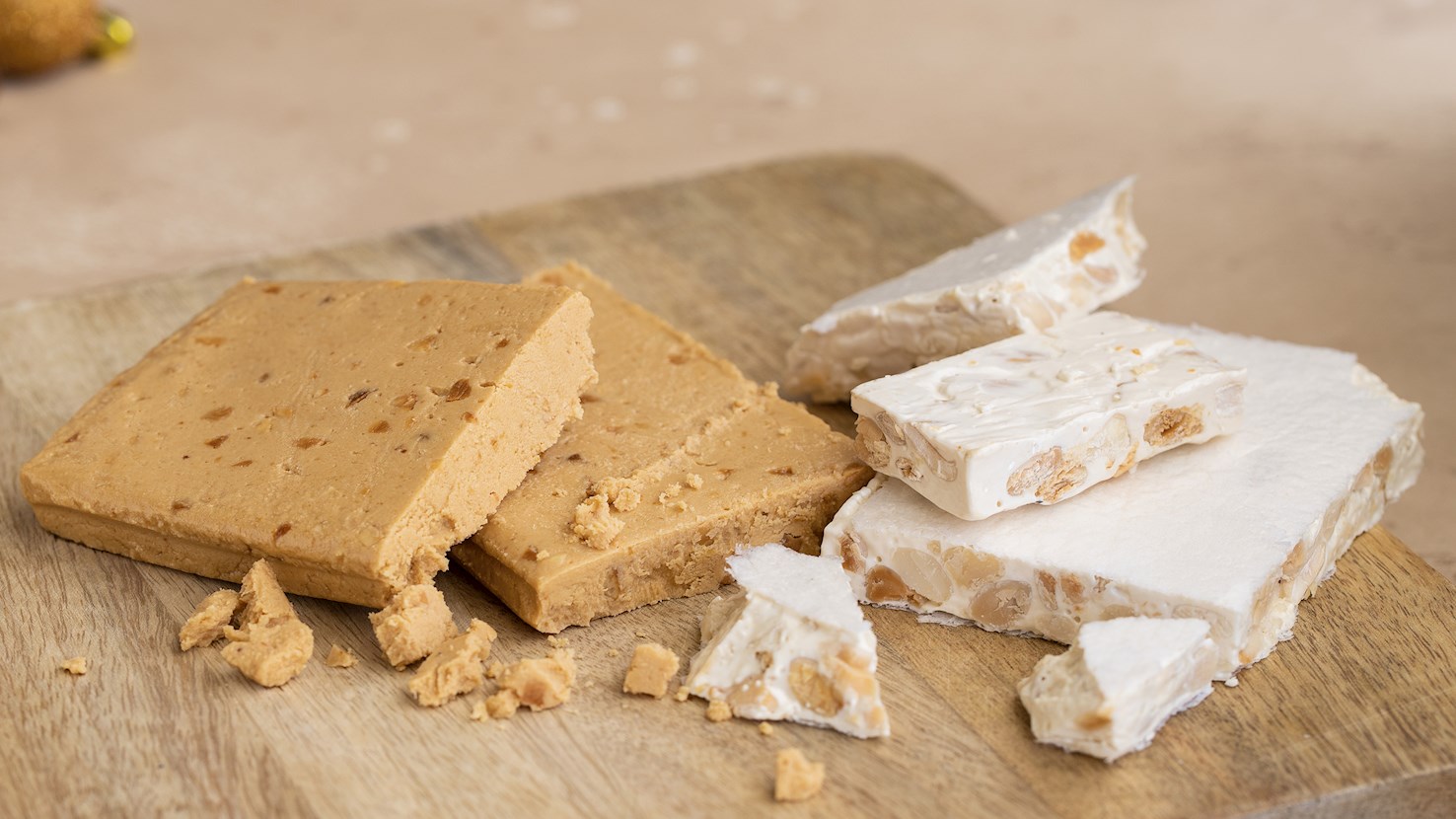
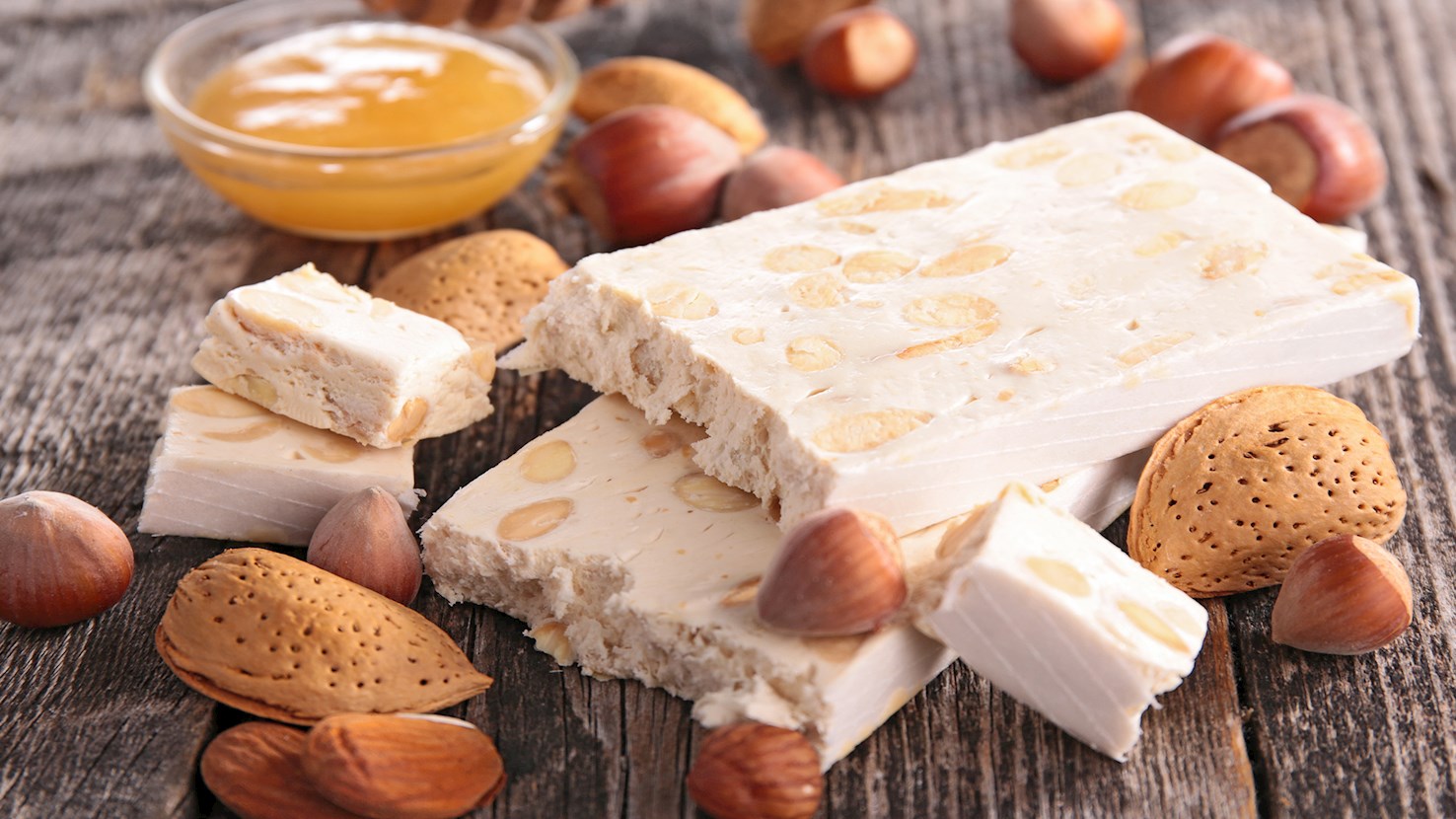
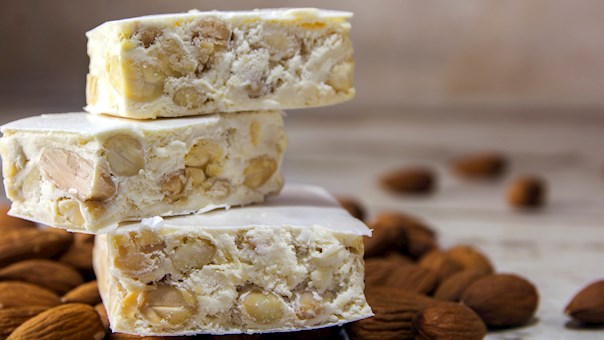
Turrón or torró, as it is known in the Catalan language, is the Spanish version of the world-famous confection called nougat. This sweet delicacy typically combines roasted nuts (usually almonds, but also other types of nuts such as hazelnuts or pistachios) with honey, sugar, and whipped egg whites. A staple Christmas treat, turrón is believed to have originated in the early Middle Ages during the Moorish invasion of Spain. The name of this sweet treat is thought to have been derived from the Catalan word torrar, which in turn comes from the Latin torrere, meaning charring or roasting, an apparent reference to the use of roasted nuts. There are numerous varieties of Spanish nougat nowadays, ranging from soft and chewy to hard and brittle, to those enhanced with flavors such as chocolate or coconut, or types that are made with egg yolks or without any eggs. The two most popular varieties of Spanish nougat include the soft variety referred to as turrón blando or turrón de Jijona and the hard variety called turrón duro or turrón de Alicante, hailing from the respective Spanish towns of Jijona and Alicante. This sweet treat is often found among various gifts contained in a caga tío, a type of 'pooping log' that is an indispensable part of Spanish Christmas traditions.
Mandolato is a white, nut-dense nougat originating from the Ionian Islands of Greece, with its primary production hub on the island of Zakynthos. It is physically defined by an opaque white matrix and a rigid, brittle structure containing a high concentration of toasted almonds. The item appeared in the Ionian region during the Venetian administration between the 15th and 18th centuries, serving as a regional adaptation of the Italian mandorlato. During this period, it was localized by the use of Greek honey varieties, transitioning from an aristocratic luxury to a staple of the local confectionery market. Preparation involves a long, low-temperature cook of honey and sugar until the mixture reaches a high viscosity. Egg whites are whipped into a stiff meringue and folded into the honey to create a light, aerated base that whitens and hardens as it dehydrates. Once the paste is stabilized, whole toasted almonds are manually integrated. The hot mass is spread over sheets of ostia (wafer paper), leveled to a uniform height, and topped with a second wafer sheet. The final slab is cut into rectangular bars using a heavy blade before it reaches its final, stone-hard state. A unique technical aspect of the Zakynthian variety is the integration of local thyme honey, which provides a distinct herbal profile compared to the more neutral syrups used in other European nougats. It is primarily eaten during the Carnival season and local religious festivals, though it is sold year-round. It is served in thin, broken shards to accommodate its hardness and is most frequently paired with Vinsanto, a sweet wine from Santorini, or Masticha, a resinous Greek liqueur. It is also commonly accompanied by a strong Greek coffee, where the bitterness provides a sharp contrast to the concentrated honey sweetness.
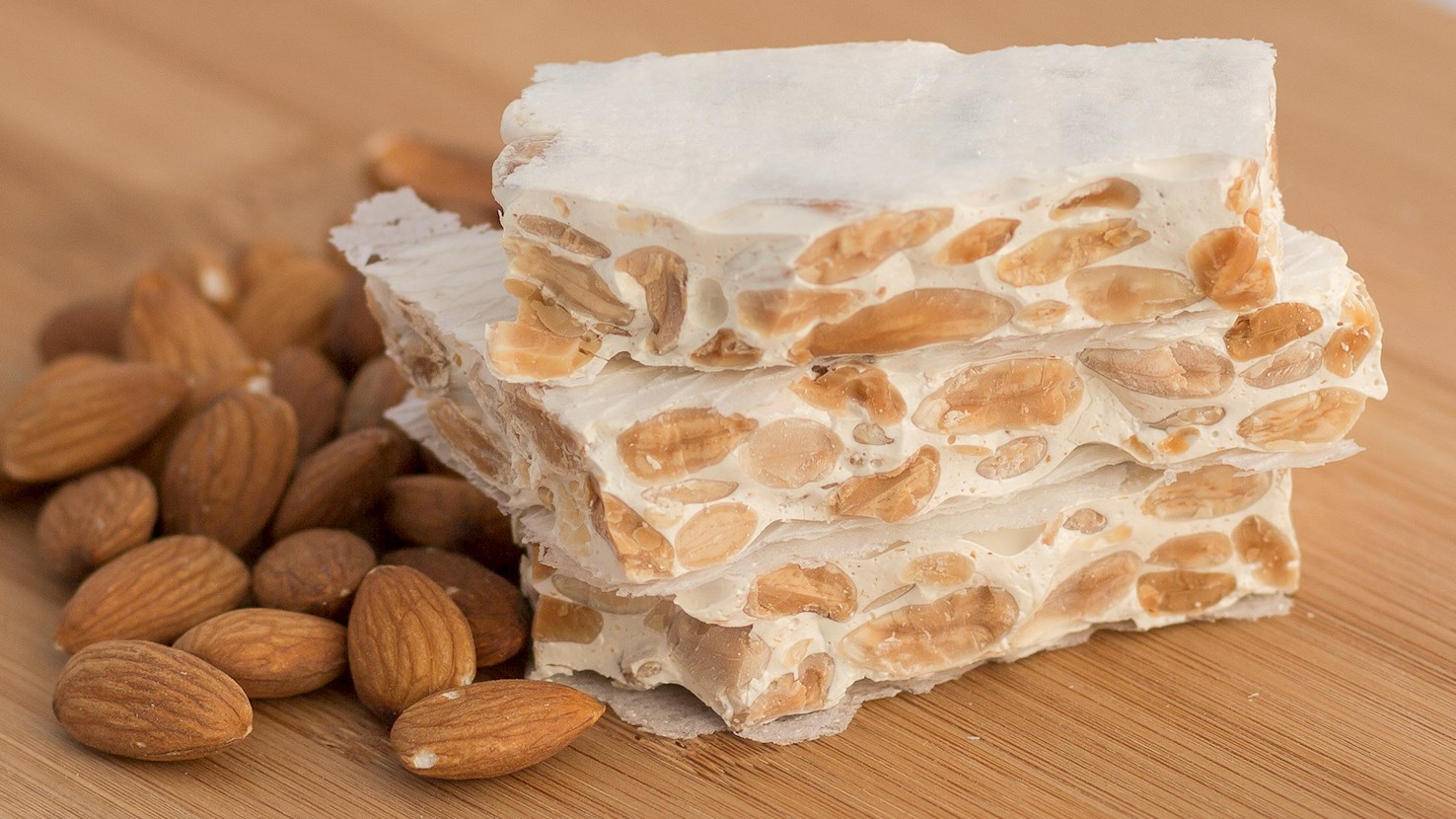
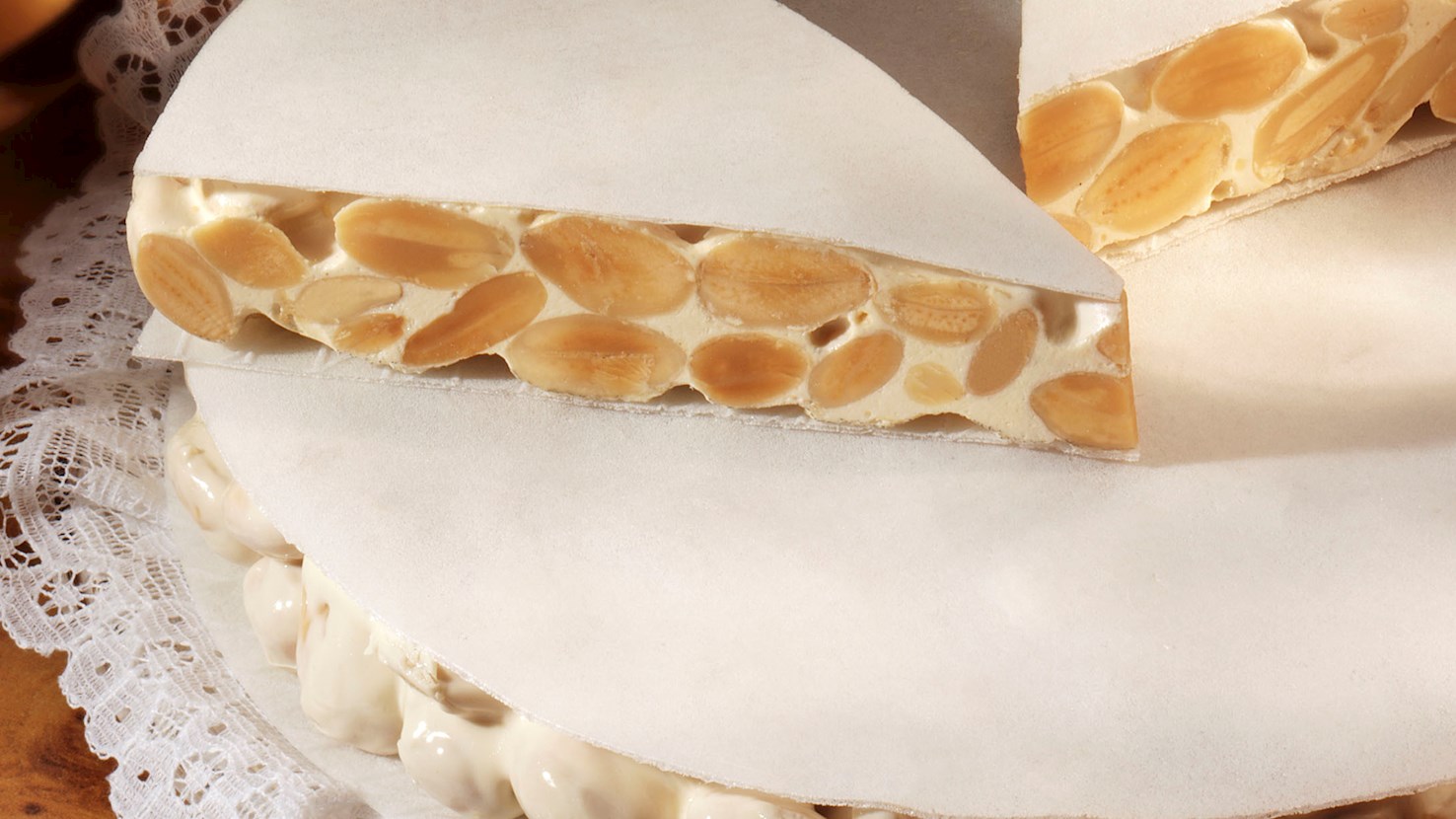
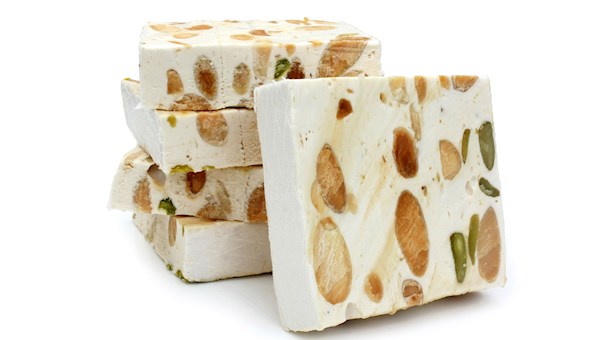
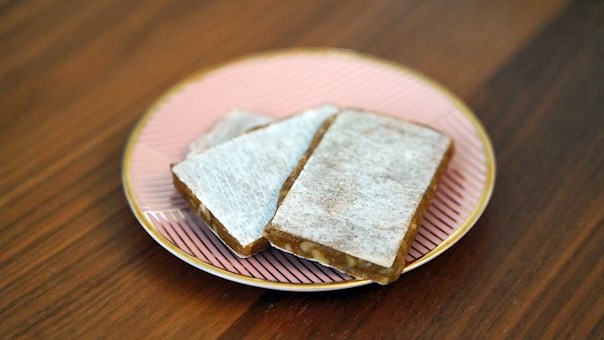
Turrón de Alicante is a dry, firm nougat, covered with a smooth wafer produced in the municipality of Jijona in Alicante province using raw ingredients coming from Alicante, Castellón and Valencia. It is of Arabic origin and traditionally made with peeled and toasted almonds, honey, egg whites and sugar. The key to preparing an authentic Alicante turrón is in the selection of raw materials and the correct manner of mixing the ingredients and choosing the right moment, 'el punto de la bola', when the mixture is ready to be rolled into a ball to become this extraordinary nougat. Due to the use of almonds, it is low in cholesterol, yet high in calories, and a good source of carbohydrates, fiber, fats, phosphorus, magnesium, calcium and vitamin E. Turron de Alicante can be classed as 'Supreme' and 'Extra'. It is a typical Christmas sweet enjoyed both in Spain and abroad due to the increase in sales and export each year, mostly to Cuba, Mexico, Switzerland and the United States of America.
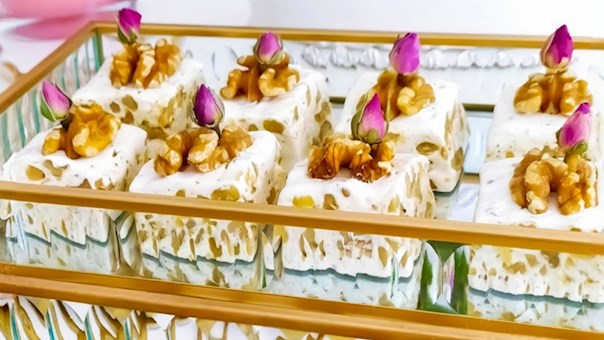
Nogha is a Persian confection made by folding toasted nuts into a chewy white nougat, known for its delicate sweetness and characteristic texture. It originates in Iran, particularly in cities like Tabriz and Qazvin, where it has long been prepared as a sweet accompaniment to tea or as a gift during celebrations. The word nogha is often used interchangeably with gaz in some regions, though in practice nogha typically emphasizes the inclusion of nuts such as pistachios or walnuts, encased in sheets of rice paper or cut into neat rectangles. The history of nogha reflects Iran’s long-standing tradition of confectionery that uses local nuts and natural sweeteners. Recipes for similar nougat-like sweets appear in Persian culinary records dating back several centuries, showing that confectioners adapted techniques brought along trade routes and refined them with regional ingredients. The evolution of nogha was influenced by access to high-quality honey and the widespread cultivation of pistachios in central Iran. Over time, it became a recognizable part of Iranian hospitality, prized for its soft bite and the balance of nuts and sweetness. Preparation begins by boiling sugar, honey, and sometimes glucose syrup into a thick syrup. Egg whites are whipped separately until stiff, and the hot syrup is slowly poured in while continuing to beat the mixture to create a glossy, aerated mass. Once the nougat reaches the right consistency, it is removed from the heat, and generous amounts of roasted nuts are folded in. The mixture is then spread onto a layer of edible rice paper or oiled trays, pressed evenly, and covered with another sheet of rice paper. After cooling and firming, nogha is cut into rectangular or diamond-shaped pieces. Each piece shows the cross-section of nuts suspended in the pale nougat. Nogha is usually served alongside black tea, and in many households, it appears on tables set out for guests. In confectionery shops, it is packaged in boxes lined with wax paper, and sold by weight. Throughout Iran, nogha is enjoyed during Nowruz celebrations, weddings, and other social gatherings, shared as a gesture of welcome. It is eaten slowly, often broken into small pieces by hand and paired with warm tea.
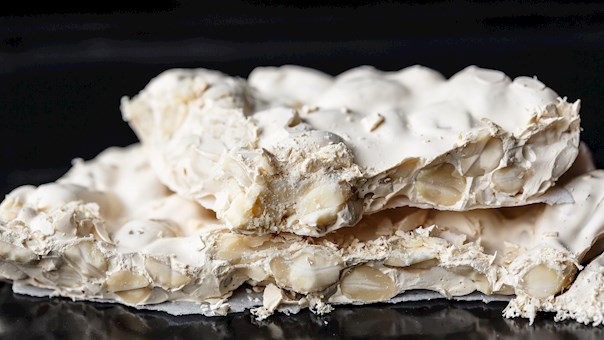
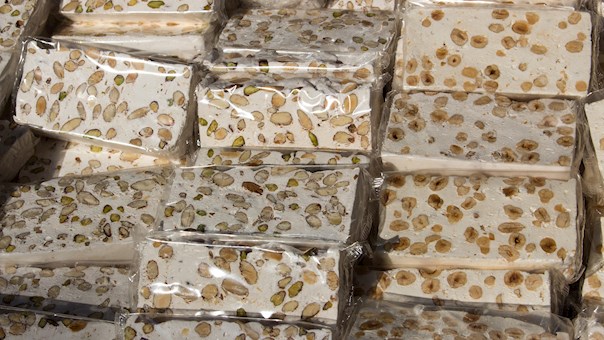
Torrone is a dense, aerated confection composed of honey, sugar, egg whites, and toasted nuts, predominantly produced across the Italian peninsula. The product is identified by its white or ivory matrix and is traditionally encased between two thin sheets of ostia (wafer paper), which prevents the sticky paste from adhering to surfaces. The development of this confection in Italy is primarily linked to two historical centers: the southern regions influenced by Arab culinary technology, and the city of Cremona in Lombardy. In Sicily and Calabria, the preparation arrived via the Arab turun, a honey-and-nut paste that utilized the high concentration of local almond groves. In the north, the confection's history is formally documented in 1441 at the wedding of Bianca Maria Visconti and Francesco Sforza in Cremona; the chefs shaped the sweet to resemble the city's bell tower, the Torrazzo, from which the name torrone is said to be derived. Preparation of Italian torrone involves the slow heating of honey in a copper cauldron (caldaia) or a double boiler (bagnomaria). Egg whites are whipped to stiff peaks and incorporated into the warm honey to create a light, stable foam. The cooking duration determines the final technical classification: torrone friabile (hard/crunchy) is cooked for up to ten hours until the sugars crystallize and the water content is nearly eliminated, while torrone morbido (soft/chewy) is cooked for as little as three hours, retaining a pliable, marshmallow-like consistency. Once the desired density is reached, whole toasted almonds, hazelnuts (specifically the Nocciola del Piemonte in northern varieties), or pistachios are folded into the mass. A specific technical attribute of the Sardinian variety from Tonara is the total absence of added sucrose, relying exclusively on high-quality regional honey. In contrast, the Abruzzese version from L'Aquila is distinguished by its chocolate-flavored matrix. The finished paste is pressed into wooden or metal molds, leveled, and allowed to solidify before being cut into rectangular bars or small cubes known as torroncini. Torrone is eaten across Italy primarily during the winter festivities, specifically between All Saints' Day in November and Epiphany in January, though it is sold year-round at regional festivals. It is served by slicing the large blocks with a heavy blade or hammer into individual portions. Food and beverage pairings focus on balancing the intense sweetness and viscosity of the honey. It is most frequently paired with a structural Italian espresso or fortified dessert wines such as Vin Santo from Tuscany or Passito di Pantelleria from Sicily. The high sugar content is also effectively balanced by the herbal bitterness of a Barolo Chinato or the floral acidity of a Moscato d’Asti.
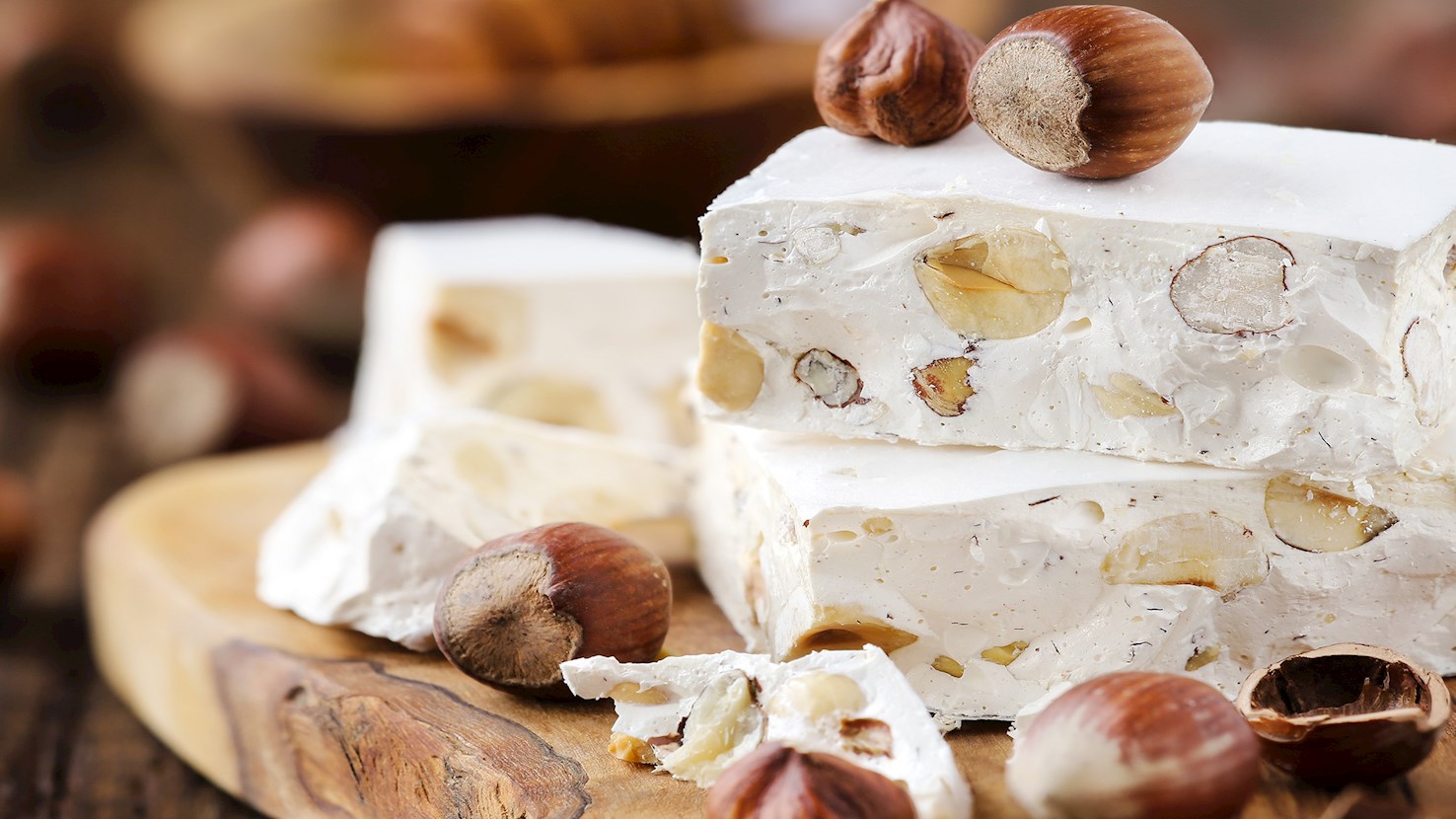
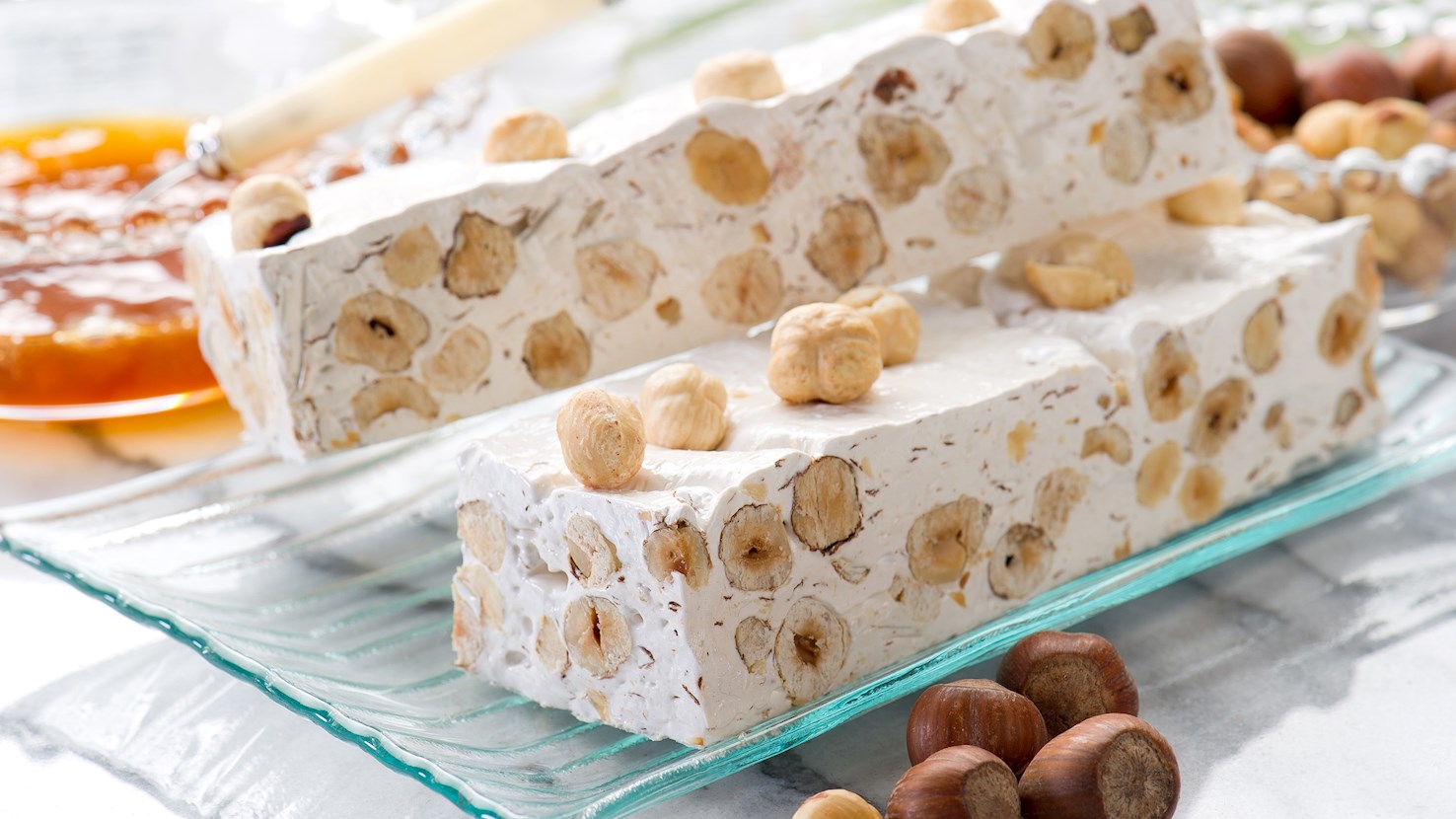
Torrone di nocciole is an Italian nouget made with honey, egg whites, and toasted hazelnuts, specifically originating from the Piedmont region in northwestern Italy. It is distinguished from other varieties of nougat by the exclusive or primary use of the Nocciola del Piemonte hazelnut, a variety protected by the IGP (Indicazione Geografica Protetta) status. The development of this hazelnut-centric variety is attributed to the 19th-century confectioner Giuseppe Sebaste in the city of Alba. During this period, the high cost and logistical difficulty of importing almonds led Sebaste to utilize the abundant local hazelnut crops of the Langhe hills as a technical substitute. This substitution resulted in a product with a distinct aromatic profile characterized by the intense, oily scent of toasted hazelnuts rather than the more neutral sweetness of almond-based versions. Preparation of torrone di nocciole involves a labor-intensive heating process. The base consists of honey, typically acacia or millefiori, which is combined with sugar and glucose syrup and melted in a large bain-marie or copper cauldron. Once the sweeteners reach a liquid state, egg whites whipped to stiff peaks are folded in to create a white, stable foam. The mixture undergoes a prolonged cooking phase that can last between eight and eleven hours at a low, controlled temperature. This extended evaporation period is what defines the final texture; a longer cook time results in the friabile (brittle) variety, which shatters when bitten, while a shorter duration produces the morbido (soft) version. The hazelnuts are toasted separately to remove their skins and develop their essential oils before being folded into the hot paste at the very end of the cooking process. The resulting mass is poured into wooden molds lined with thin sheets of ostia (wafer paper made of potato starch), leveled, and allowed to solidify. A unique technical feature of torrone di nocciole is its high nut-to-nougat ratio, often exceeding 50% by weight, which provides structural integrity to the brittle varieties. Because the hazelnuts contain a higher oil content than almonds, the toasting process must be precise to prevent the oils from separating and destabilizing the egg-white foam during mixing. The confection is primarily eaten as a dessert or a midday snack throughout Italy. It is served by breaking or cutting the blocks into rectangular bars or bite-sized pieces known as torroncini. In the Piedmont region, it is frequently served at the end of a meal alongside other hazelnut-based pastries. Food and beverage pairings for torrone di nocciole are selected to complement the toasted notes of the nuts and the floral sweetness of the honey. It is most frequently paired with Moscato d'Asti, a sparkling, low-alcohol white wine from the same region, whose acidity and fine bubbles help cleanse the palate of the honey’s viscosity. For the harder, more caramelized varieties, a fortified wine such as Vin Santo or a glass of Barolo Chinato. Additionally, the savory-sweet profile allows it to be served alongside aged cheeses such as Pecorino or Parmigiano Reggiano, where the saltiness of the cheese contrasts with the sugar content of the nougat.
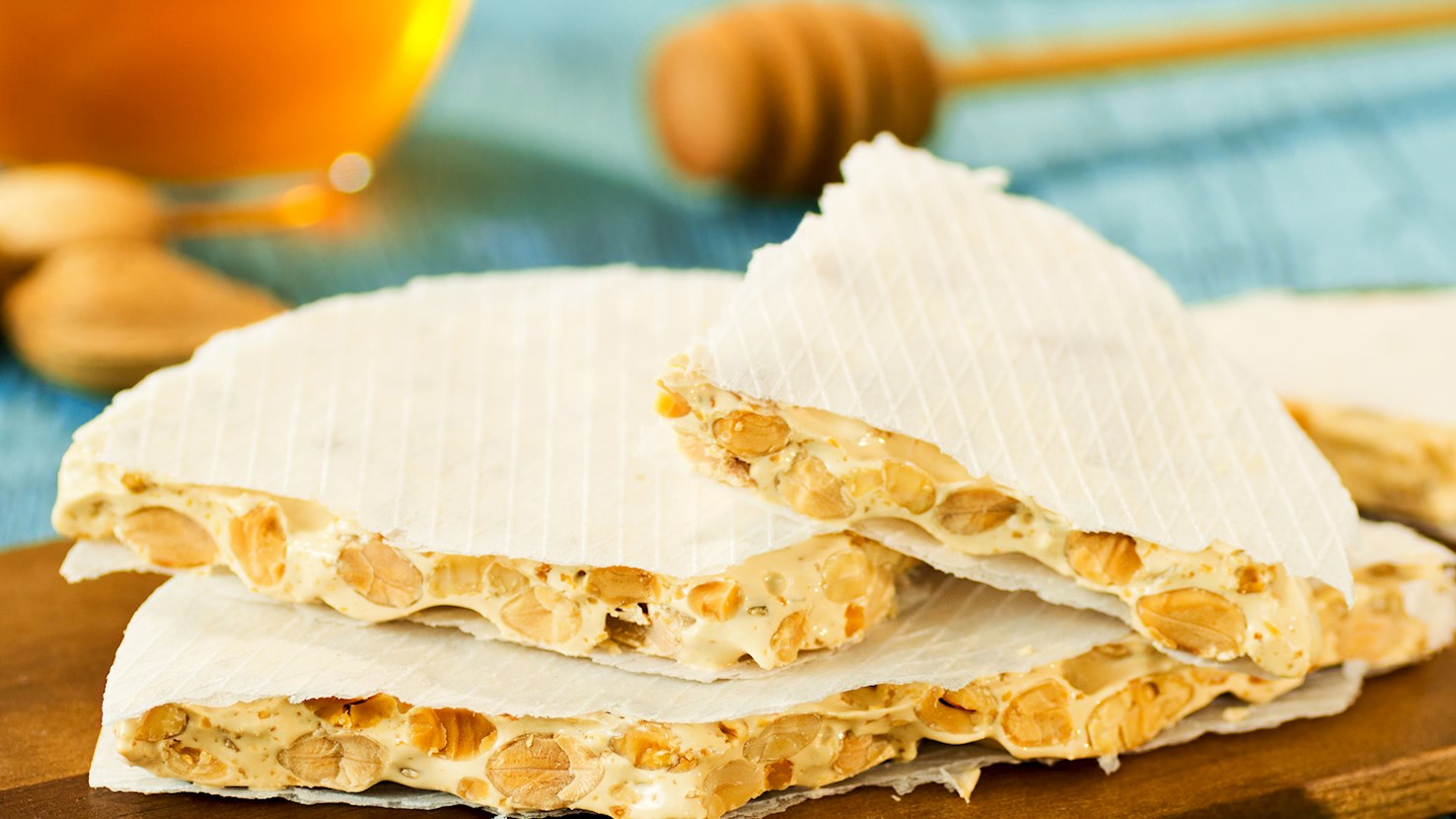
Turrón de Agramunt is the nougat made in the municipality of Agramunt in the Catalan district of Urgell in the Province of Lérida. It is produced using honey, peeled and roasted almonds or hazelnuts, sugar, egg whites and covered in wafers. It has a firm and crunchy texture, yet melts in the mouth. In order to prepare this sweet nougat, the old nougat-makers used to roast the hazelnuts before mixing them with the honey and stirred the mixture until it became homogeneous. Today, it is still a hand-made delicacy prepared following the traditional recipe. Production of Turron de Agramunt has increased each year leading to higher employment rates and economic growth. Since it is one of the best known products of the region, starting from 1989, the Feria del Turrón de Agramunt (Agramunt Nougat Fair) has been organized every year in October attracting many locals and visitors.
Mandulat is a white, hard-crack nougat originating from the Dalmatian coast of Croatia, most notably associated with the city of Split. It is physically defined by a rigid, brittle opaque matrix containing a high volume of toasted almonds, encased between two thick, neutral wafer sheets known as oblatne. The item appeared in the Adriatic region during the Venetian administration between the 15th and 18th centuries, serving as a regional adaptation of the Italian mandorlato. It localized the recipe by utilizing the specific sage and wildflower honey varieties native to the Croatian karst landscape. Preparation requires a prolonged cooking of honey and sugar at low temperatures to ensure the evaporation of moisture without scorching. Stiffly beaten egg whites are folded into the syrup to create an aerated, white base that is stirred continuously for up to two hours until it reaches a brittle state. Whole toasted almonds are added at the end of the process, and the hot mass is pressed between wafer sheets to a thickness of two centimeters. The slab is weighted during the cooling phase to ensure a dense, uniform structure before being cut into rectangular bars. A unique aspect of mandulat is its structural reliance on the oblatne wafers, which prevent the sticky honey surface from adhering to fingers while providing a secondary texture. It is consumed as a festive sweet during the winter months and local religious holidays. Common beverage pairings include Prošek, a local dessert wine made from dried grapes, or a strong espresso, which helps balance the high sugar content and the intensity of the roasted almonds.
TasteAtlas food rankings are based on the ratings of the TasteAtlas audience, with a series of mechanisms that recognize real users and that ignore bot,
nationalist or local patriotic ratings, and give additional value to the ratings of users that the system recognizes as knowledgeable.
For the “Top 19 Nougats in the World” list until June 24, 2026, 1,019 ratings were recorded, of which 763 were recognized by the system as legitimate.
TasteAtlas Rankings should not be seen as the final global conclusion about food. Their purpose is to promote excellent local foods,
instill pride in traditional dishes, and arouse curiosity about dishes you haven’t tried.
The initial list of top producers was compiled based on available reviews, awards, local recommendations, media and blog coverage, and consumer reviews.
The list will be updated with ratings from TasteAtlas local ambassadors and TasteAtlas users.