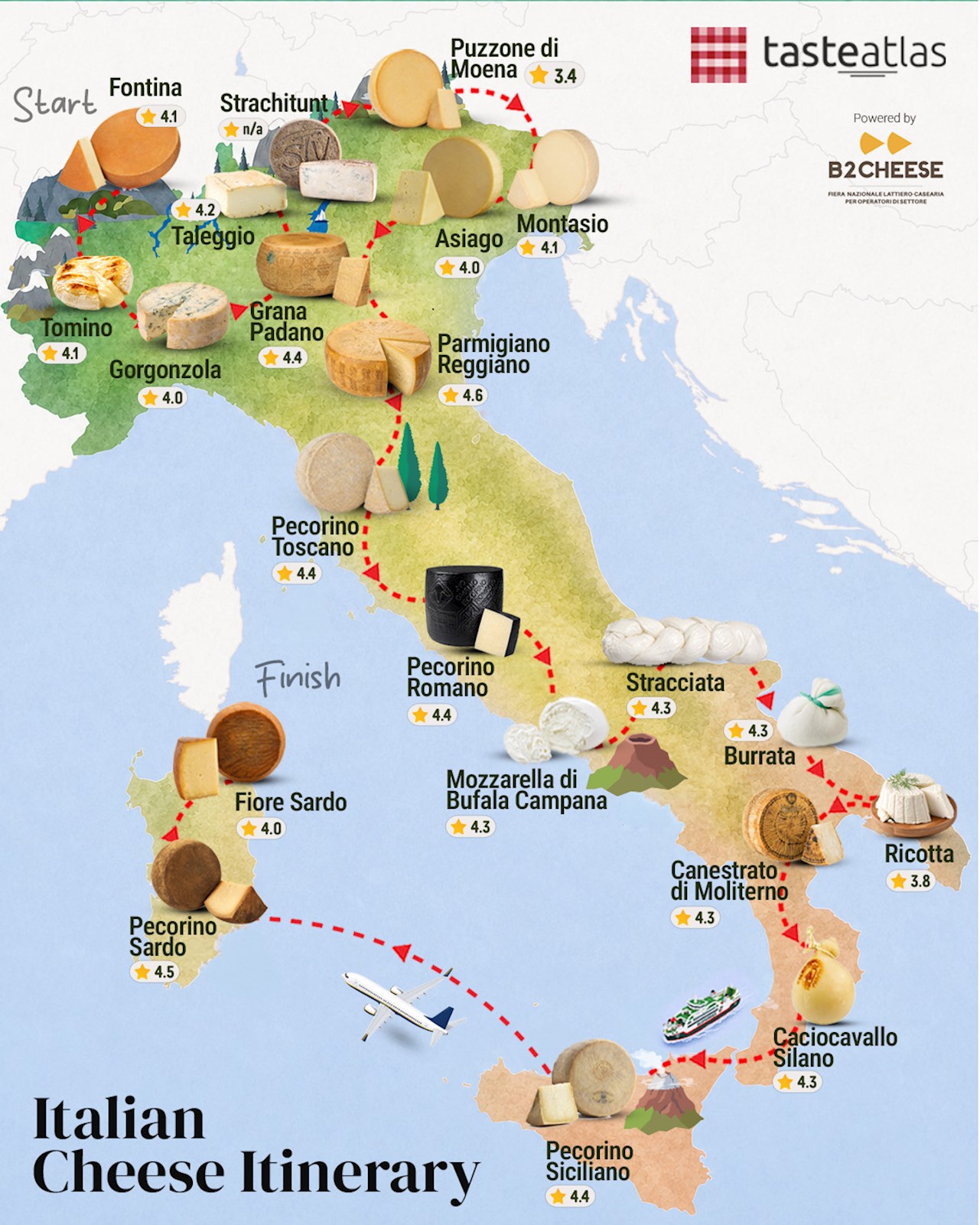
Cheesemaking on the Italian peninsula reaches back to antiquity, while many cheeses associated with Italy today took recognizable form during the Middle Ages and early modern period. In northern Italy, agricultural expansion and the need to preserve surplus milk encouraged the development of large, long-aged cheeses. Written evidence for caseus parmensis, cheese from Parma, appears as early as 1254, while references to Parmigiano were well established by the 14th century. Elsewhere, Alpine grazing systems, southern sheep farming, Campanian buffalo breeding, and local agricultural conditions produced very different cheese styles. Long before modern protected designations, geographical origin was already central to how many cheeses were produced and traded.
One of the most historically important concentrations of cheesemaking developed in the Alpine and pre-Alpine valleys around Bergamo and the neighboring territories of Lecco, Sondrio, and Brescia, an area now promoted collectively through the Cheese Valleys. Centuries of mountain pastoralism, seasonal movement of cattle, and specialized milk processing produced an unusually diverse cheese culture, encompassing hard alpine cheeses, soft stracchini, washed-rind cheeses, and naturally blue-veined varieties. Valsassina and Val Taleggio became particularly important centers for the stracchino family. Taleggio developed from this culture of soft square stracchini, while Strachítunt, whose documented history in Val Taleggio reaches back to at least the 14th century, preserves the older two-curd technique associated with the development of Lombardy’s blue cheeses and is often regarded as a historical precursor or close relative of Gorgonzola.
Industrialization, refrigeration, modern transport, and European quality regulations later transformed the scale of the industry. Products that were once strongly regional became national and international staples, while PDO and other geographical-indication systems formally protected the link between specific cheeses and their production areas. Today, large dairy companies operate alongside small specialist producers and affineurs, combining industrial reach with regional identity.
Italian cheese now has considerable global commercial importance. In 2025, Italian cheese exports approached 680,000 tonnes and exceeded €6 billion in value for the first time. Parmigiano Reggiano and Grana Padano remain major international references, while mozzarella, burrata, and other fresh cheeses have also become increasingly important abroad. Italian cheeses are now present throughout international retail, foodservice, specialist shops, and professional gastronomy.
Within Italy, Bergamo occupies an exceptional position in this landscape. The city has been part of the UNESCO Creative Cities Network as a Creative City of Gastronomy since 2019, with its application closely linked to the dairy culture of the surrounding Cheese Valleys. Nine PDO cheeses are produced within the province, a concentration that has led Bergamo to promote itself as the European Cheese Capital. Across Lombardy, the number rises to 14 PDO cheeses, illustrating the wider importance of the region within Italian cheesemaking.
Bergamo has also developed a series of events around this identity. The FORME project, launched in 2015, created an annual program aimed at bringing cheese culture to a wider public through tastings, exhibitions, workshops, competitions, and meetings with producers. In 2026, this public-facing program develops further under the World Cheese Capital format, bringing Italian and international cheeses, cheesemakers, affineurs, specialists, and cheese organizations into Bergamo.
Alongside it is B2Cheese, created in 2019 as the professional, business-to-business counterpart to the city’s broader cheese activities. It is Italy’s international B2B trade fair dedicated specifically to the dairy and cheese sector. It brings together producers and affineurs with importers, wholesalers, retailers, distributors, food brokers, HoReCa operators, and specialist shops, as well as companies working in packaging, machinery, logistics, quality control, technology, and consulting.
Its role extends beyond showcasing cheese. B2Cheese is designed to create direct business connections, encourage exports, introduce technological solutions, and provide a forum for discussing the issues shaping the sector. Business matching connects producers with national and international buyers, while conferences, workshops, tastings, and masterclasses examine subjects ranging from affinage and professional cheese evaluation to retail, market trends, artificial intelligence, quality control, and international trade.
The next edition will take place at Fiera di Bergamo on 23 and 24 September 2026. Its program includes the World Cheese Capital masterclasses, bringing together cheesemakers, affineurs, cheesemongers, and specialists from Italy and abroad, alongside conferences devoted to retail, technology, market data, European policy, and the future of the dairy industry.
For Italian cheese, B2Cheese represents the point where centuries of regional expertise meet the realities of a modern international market. Its location in Bergamo is particularly fitting: the city stands at the center of one of Italy’s most historically significant cheesemaking territories and today connects that heritage with buyers, technologies, distribution networks, and professional knowledge that will help determine how Italian cheese develops in the years ahead.
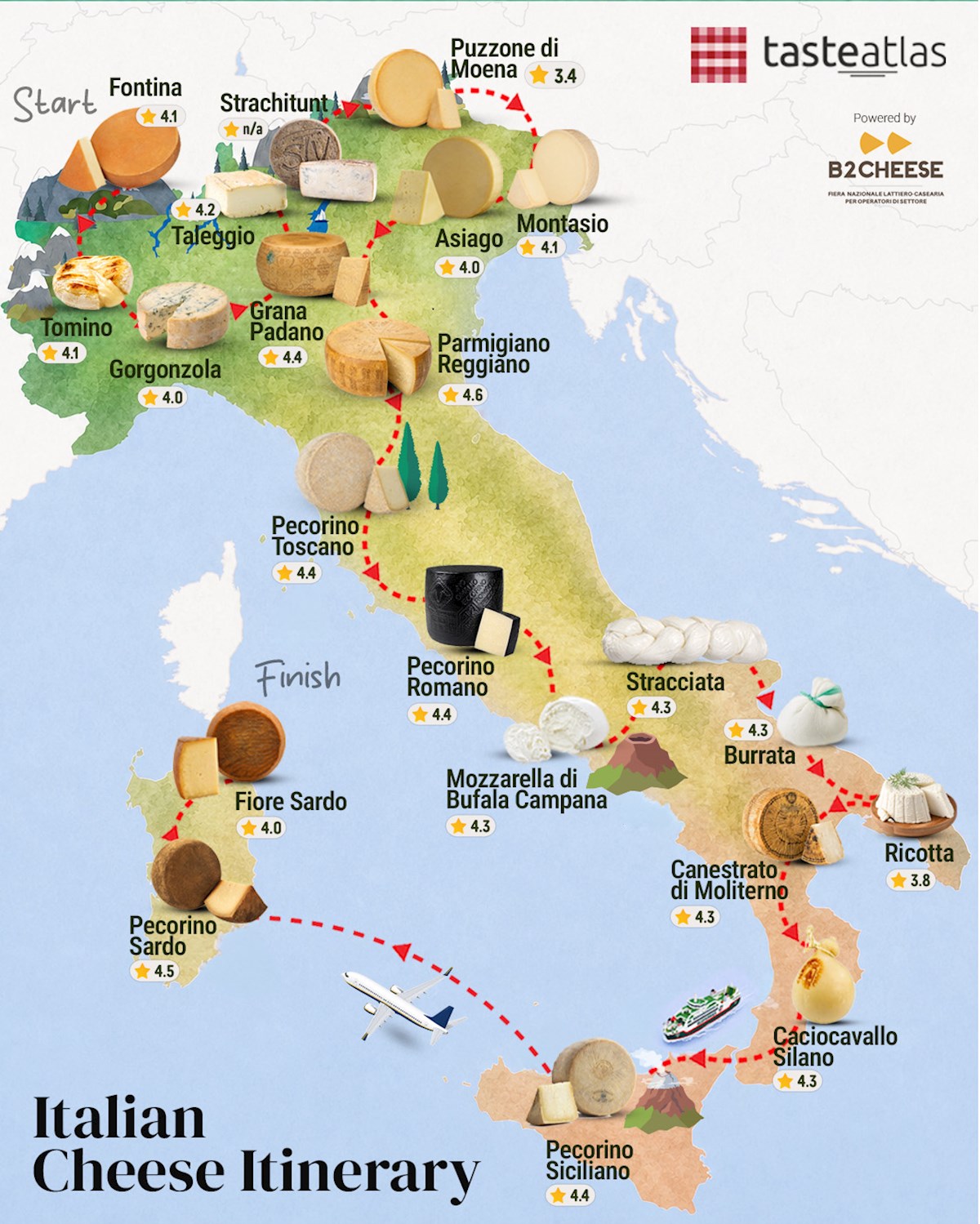
With that broader picture in mind, we take a closer look at a B2Cheese selection of some of Italy’s most famous and highly regarded cheeses, each representing a distinct part of the country’s cheesemaking heritage.
GORGONZOLA
 @fusqueijao
Gorgonzola is one of Italy’s most recognizable blue cheeses and one of the defining cheeses of northern Italy. Its production is historically associated with Lombardy, where cow’s-milk cheesemaking developed alongside the rich agricultural economy of the Po Valley. References to cheeses associated with Gorgonzola stretch back to the Middle Ages, although the exact circumstances in which the modern cheese developed are difficult to establish. What is clear is that blue veining gradually became its defining feature, transforming what belonged broadly to the northern Italian family of soft stracchino-type cheeses into a distinctive product in its own right.
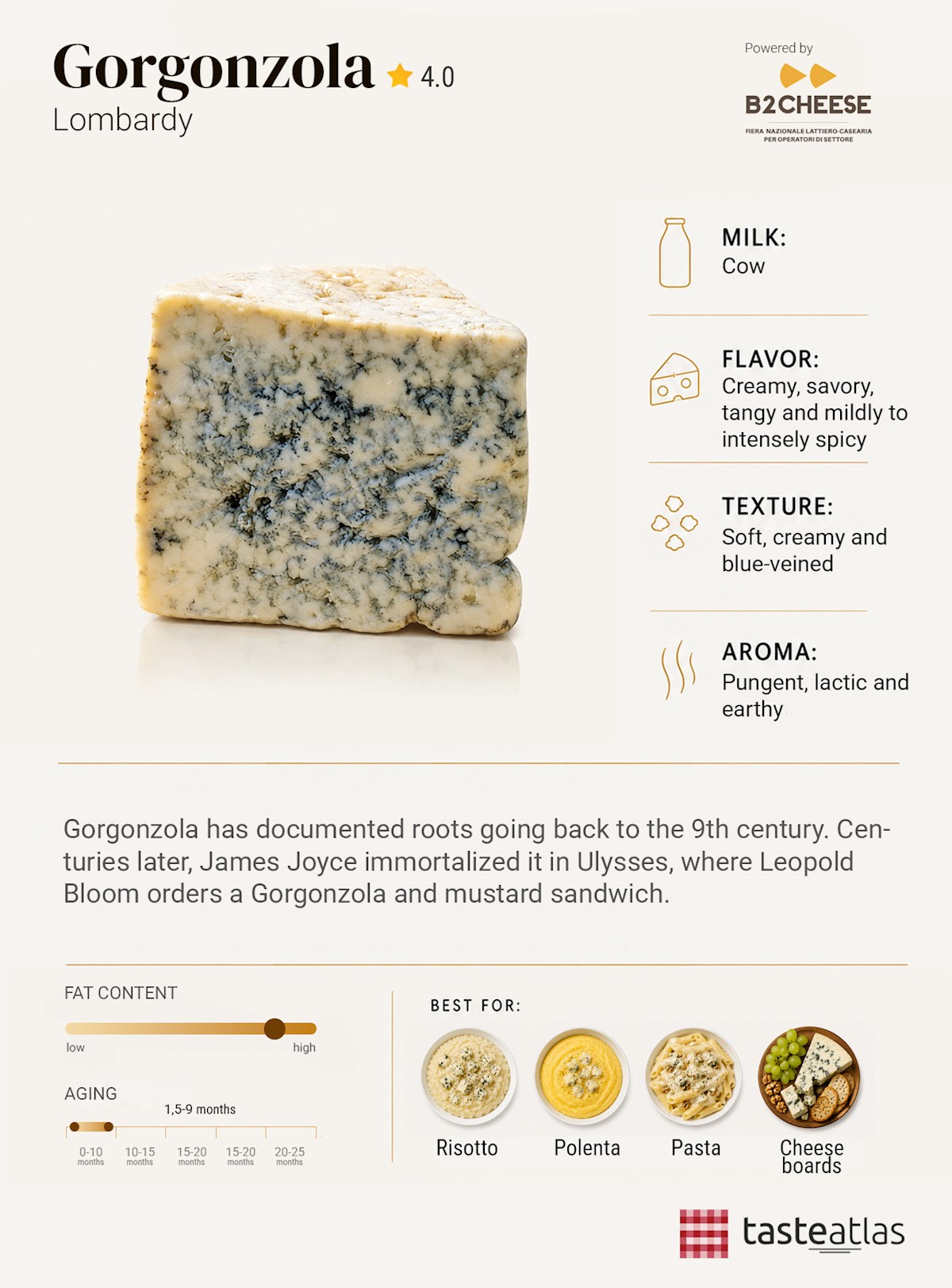
Gorgonzola is made from cow’s milk and inoculated with cultures that allow characteristic blue-green veins to develop inside the cheese. During maturation, the wheels are pierced so that oxygen can enter and encourage the growth of the mould within the paste. Two major expressions dominate the market. Gorgonzola Dolce is softer, creamier and generally milder, with a buttery, lightly sweet character balanced by the blue mould, while Gorgonzola Piccante is firmer, more crumbly and considerably more intense. Under the production rules, Dolce matures for roughly 50 to 150 days and Piccante for 80 to 270 days. This range makes Gorgonzola unusually versatile: younger versions can almost be spoonable, while longer-aged examples develop a pronounced pungency and sharper finish.
GRANA PADANO
 @wherechefsshop
Grana Padano developed in the Po Valley as a practical answer to one of medieval agriculture’s central problems: how to preserve large quantities of surplus milk. Its beginnings are generally traced to monastic communities in northern Italy around a thousand years ago, where milk was cooked, curdled, salted and matured into large wheels capable of lasting far longer than fresh cheese. The resulting hard cheese became known as grana, a reference to its characteristically granular paste. Over the following centuries, production spread across much of the Po Valley and became an important part of the region’s dairy economy.
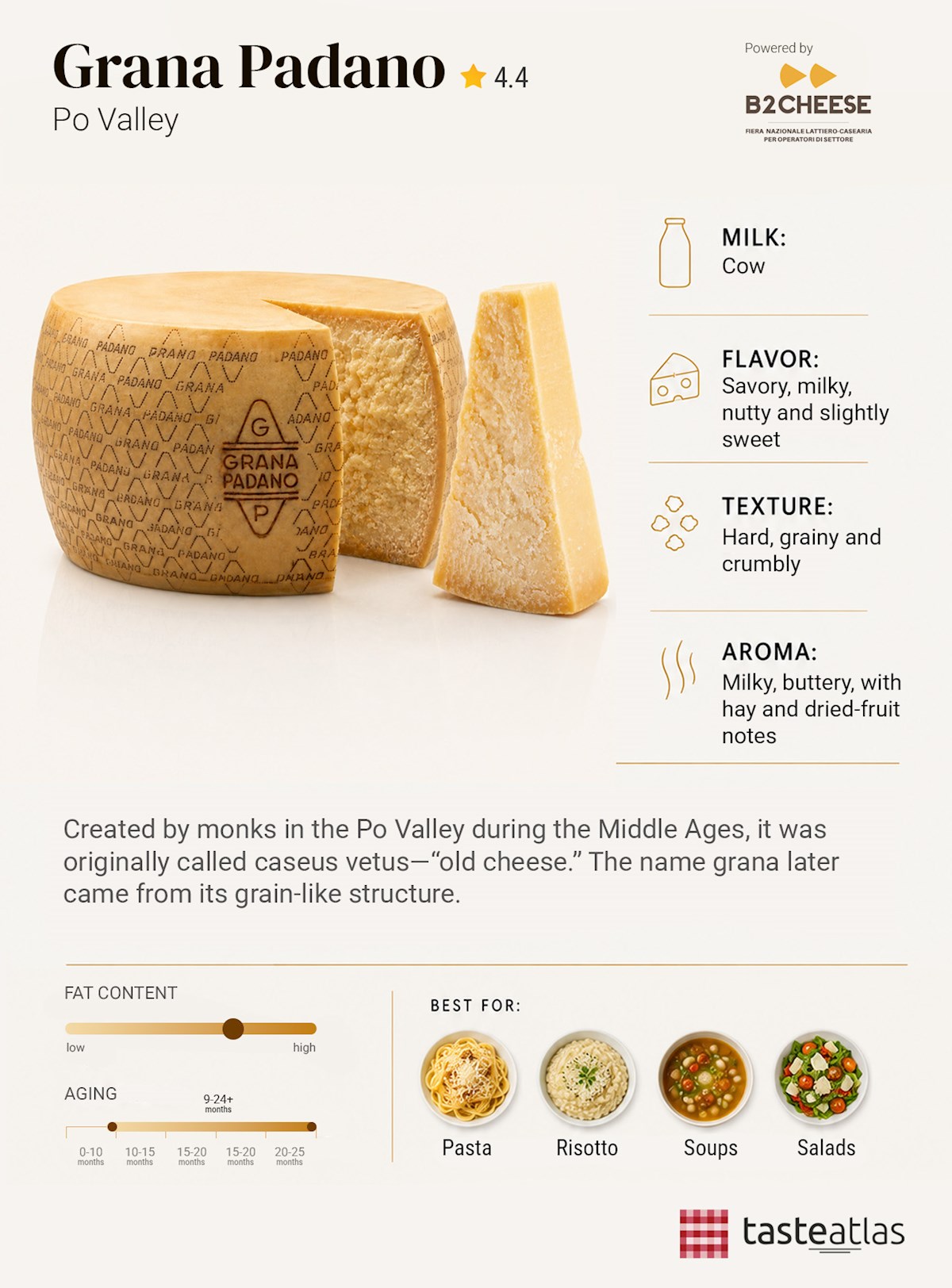
It is produced from cow’s milk and undergoes a long maturation that progressively transforms its initially delicate dairy character into something firmer, more granular and more complex. Grana Padano can enter the market after a minimum of nine months, when it remains relatively mild and milky. At around 16 to 18 months, the paste becomes more distinctly grainy and crumbly, with increasingly evident notes of butter, hay and dried fruit. Wheels qualifying as Grana Padano Riserva must mature for more than 20 months and pass an additional quality inspection; considerably older examples can also be found. With age, the texture becomes increasingly friable and crystalline and the flavor more concentrated. This combination of long keeping quality, versatility and relatively large-scale production has made Grana Padano one of the most widely consumed and internationally important Italian cheeses.
TALEGGIO
 @carozziformaggi
Taleggio is a soft, washed-rind cow’s-milk cheese whose identity is closely connected with the valleys of Lombardy and particularly the Val Taleggio in the province of Bergamo. It belongs to the old northern Italian family of stracchini, cheeses historically associated with cattle returning from seasonal mountain pastures. Over time, the cheese that became known as Taleggio acquired a more clearly defined production method and geographical identity, eventually spreading from its Alpine and pre-Alpine homeland into a larger dairy production area in northern Italy. Its square shape, thin reddish-pink rind and soft paste make it immediately recognizable, while PDO status has protected the designation at European level since 1996.
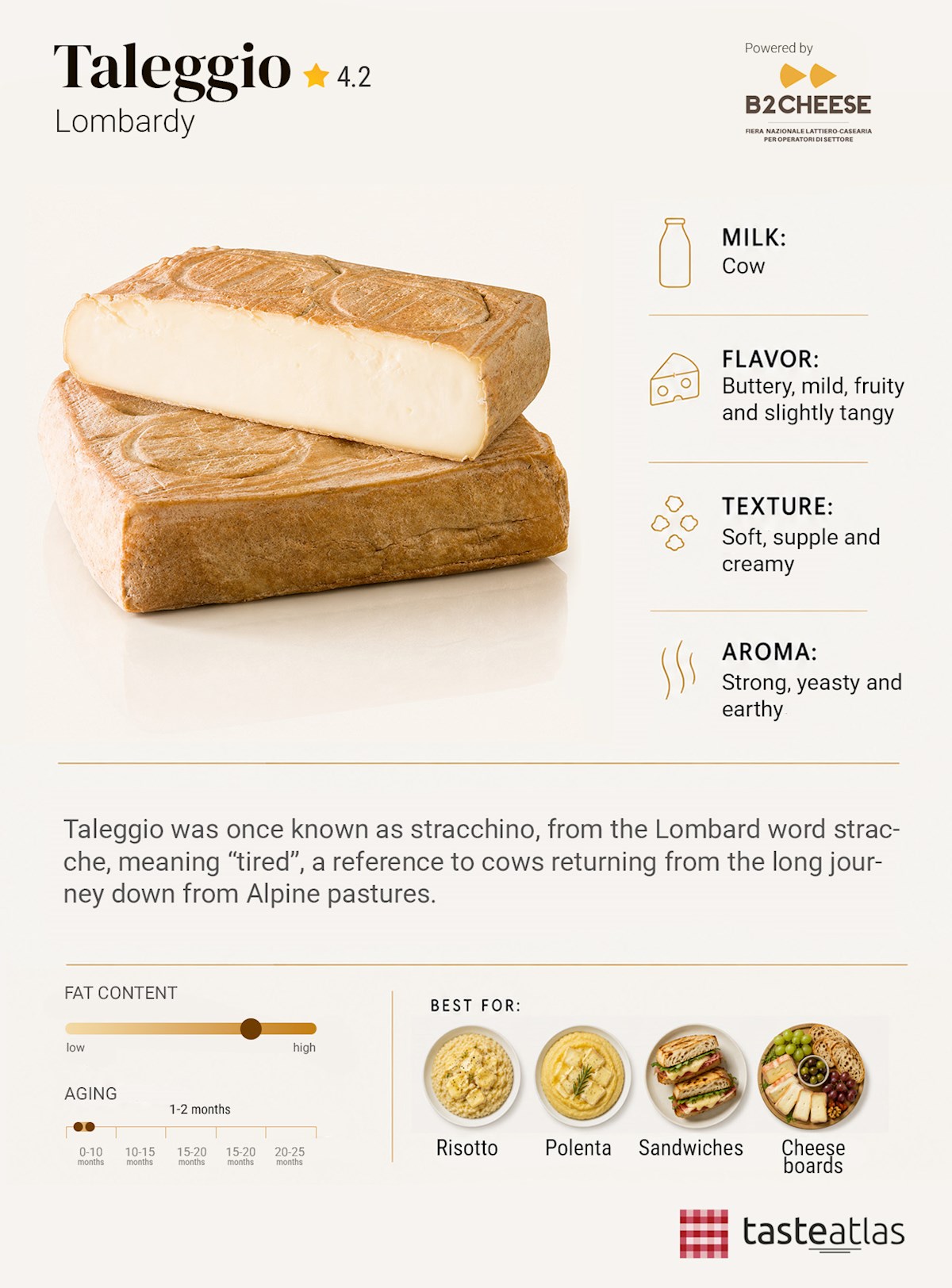
The cheese develops much of its character from the surface inward. During maturation, its rind is repeatedly treated and managed under humid conditions, encouraging the surface microflora responsible for its distinctive aroma and color. Taleggio must mature for at least 35 days, during which proteolysis gradually softens the paste beneath the rind before progressing toward the center. A ripe Taleggio consequently has an especially supple, sometimes almost creamy outer paste surrounding a firmer heart. Its aroma can be noticeably stronger than its flavor suggests: the taste is generally mild, buttery and slightly tangy, becoming more savory and complex as it matures. That contrast between pungent rind and relatively approachable paste is one reason Taleggio has remained both an important regional cheese and one of Italy’s best-known washed-rind styles.
STRACHÍTUNT
 @strachituntdop_valtaleggio
Strachítunt is one of the more unusual cheeses of Lombardy and a particularly distinctive product of the Val Taleggio. Its name comes from the Bergamasque expression for a “round stracchino,” reflecting its connection with the same family of cheeses from which Taleggio emerged. Unlike Taleggio, however, Strachítunt is a blue-veined cheese, produced from whole raw cow’s milk and made using an old two-curd technique. Its production remains geographically restricted and comparatively limited, giving it a very different profile from internationally established Italian blues such as Gorgonzola. Its PDO specification preserves a method closely connected with the mountain dairy culture of the Bergamo valleys rather than adapting the cheese to standardized industrial blue-cheese production.
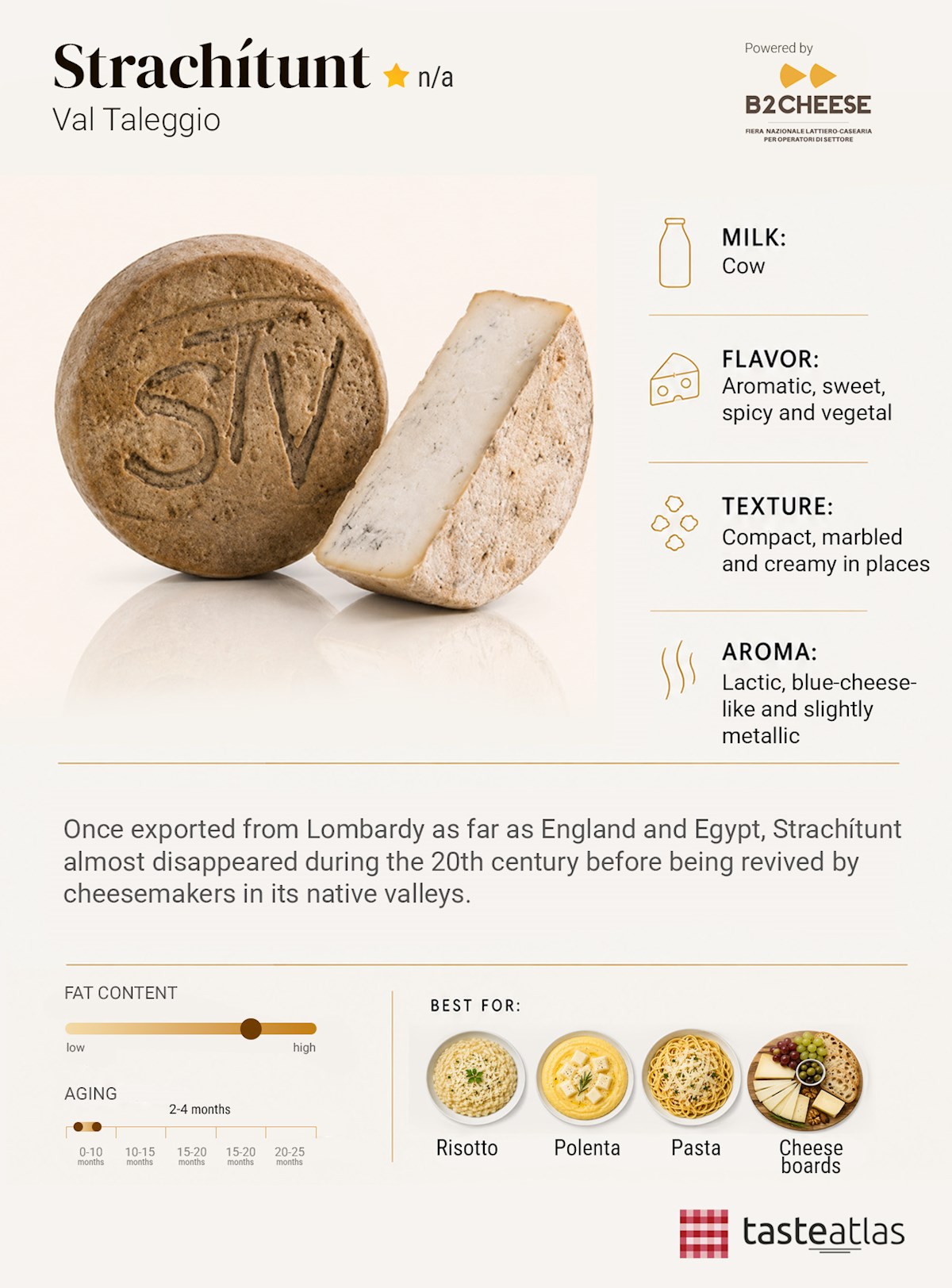
The defining technique is known as due paste, or two curds. The curd from the evening milking is left to drain for at least 12 hours and is then layered with the fresher curd produced the following morning. The different structures of these curds create small internal spaces, and during the minimum 75-day maturation the wheels are pierced to introduce air. Crucially, no Penicillium culture is intentionally added to produce standardized blue veins; the moulds develop from microorganisms naturally present in the cheese and its environment. For this reason, the blueing may be irregular and considerably different from one wheel to another. The paste can range from creamy to compact, while the flavor moves from relatively sweet and aromatic toward a more assertive, spicy character as the cheese ages, often retaining a distinctive vegetal finish.
ASIAGO
 @formaggioasiagodop
Asiago takes its name from the Asiago Plateau in the Veneto, an Alpine area with a long history of livestock farming and cheesemaking. Sheep initially played a significant role in the local pastoral economy, but over the centuries cattle increasingly became dominant, and Asiago developed into the cow’s-milk cheese recognized today. Its protected production territory now extends beyond the plateau itself, encompassing the provinces of Vicenza and Trento and designated areas of Padua and Treviso. Rather than referring to one narrowly defined texture, however, Asiago PDO encompasses substantially different expressions, ranging from soft, youthful cheese to firm wheels matured for well over a year. This breadth is an essential part of understanding Asiago, particularly because the fresh version exported widely today differs considerably from older Alpine forms of the cheese.
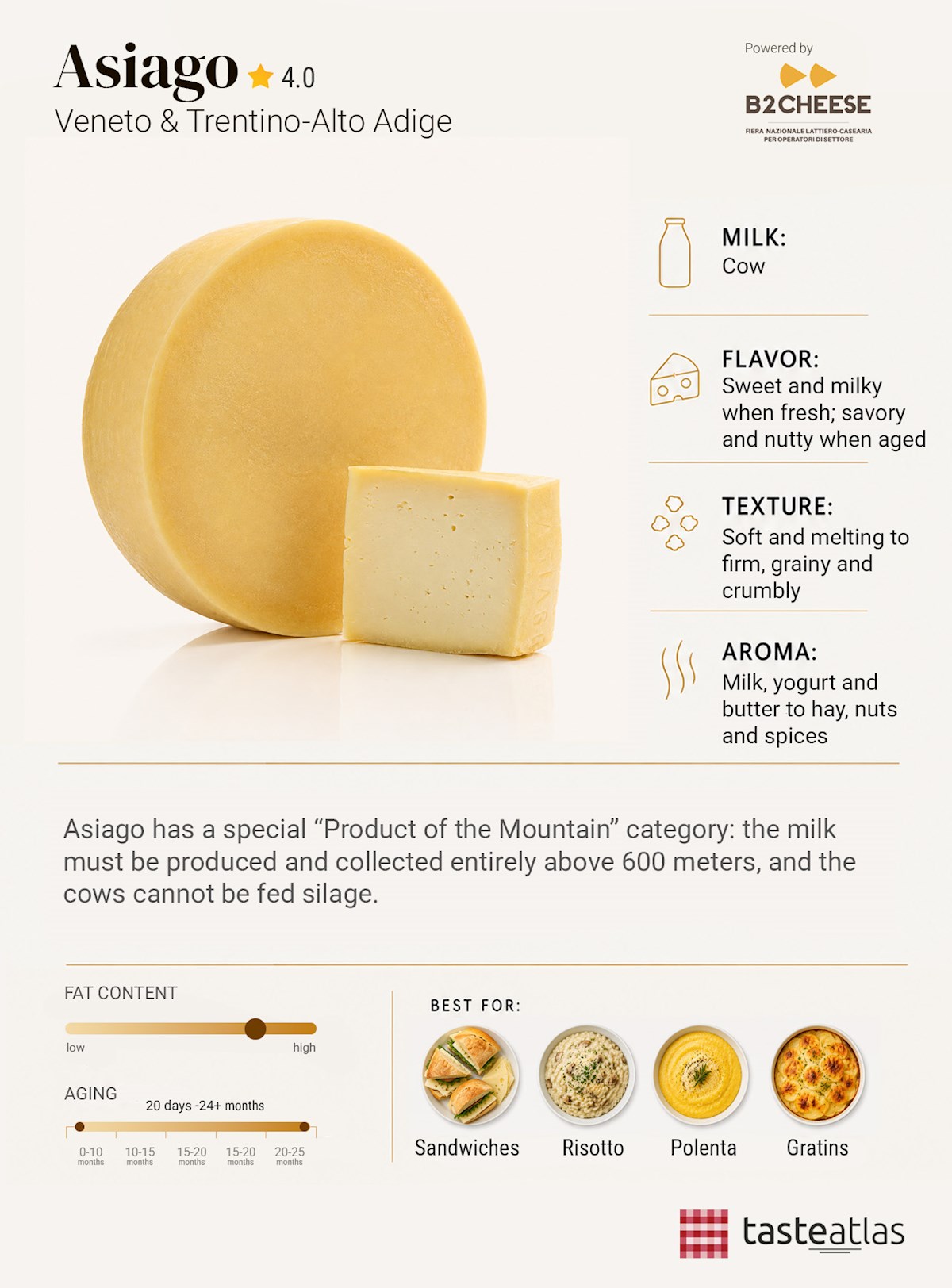
Asiago Fresco is made from whole cow’s milk and is soft, elastic, moist and gently milky, with relatively large and irregular holes in the paste. Aging changes the cheese dramatically. Mature Asiago becomes progressively firmer, drier and more granular, with more concentrated aromas and a flavor that can develop notes of dried grass, nuts and spices. Official aging categories for mature Asiago extend from medium-aged forms through Vecchio, generally matured around 10–15 months, to Stravecchio, matured for more than 15 months. At this stage the paste is compact, grainy and crumbly and the flavor is considerably more persistent than that of Asiago Fresco. Few famous Italian cheeses demonstrate quite so clearly how maturation can turn essentially the same regional cheese identity into two very different eating experiences.
PECORINO TOSCANO
 @Rocca Toscana Formaggi
Pecorino Toscano represents Tuscany’s long relationship with sheep farming and differs noticeably from the stronger, saltier character that many consumers associate with Italian pecorino. Sheep’s-milk cheeses were already important in the region in antiquity, and Pliny the Elder referred to a large and highly regarded cheese from the area around ancient Luni. By the 15th century, Tuscan sheep’s cheese was known as cacio marzolino and had acquired considerable prestige; writings from the period place it among the most highly regarded cheeses in Italy. Modern Pecorino Toscano PDO is produced throughout Tuscany as well as in a small number of neighboring municipalities in Umbria and Lazio, with sheep raising, milk production, cheesemaking and maturation all tied to the defined geographical area.
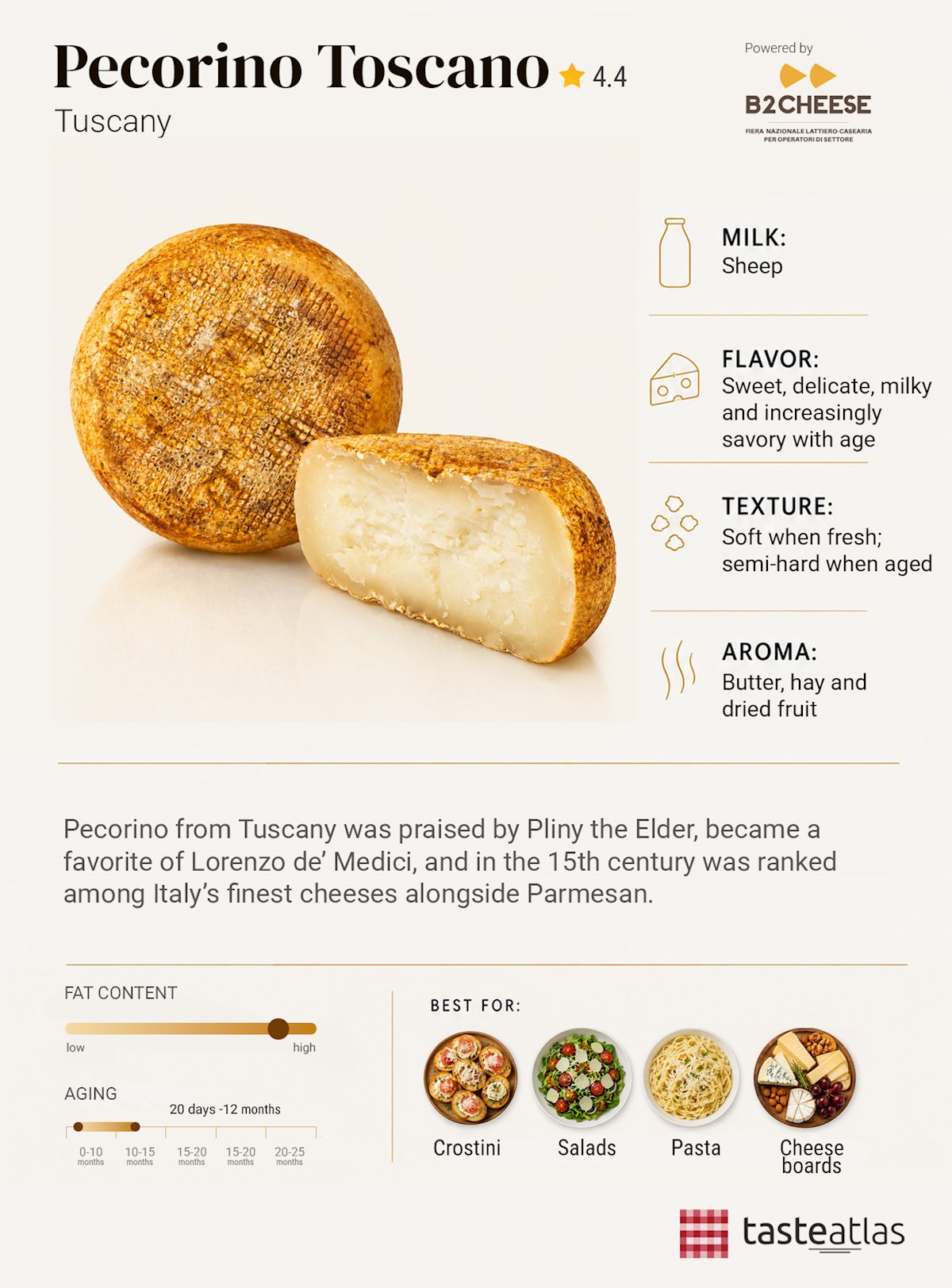
It is made entirely from sheep’s milk but is generally gentler than Pecorino Romano. The PDO exists in both fresh and aged forms. Pecorino Toscano Fresco matures for at least 20 days and retains a soft texture, milky aroma and notably sweet, clean flavor. The aged version must mature for at least four months and can continue for around a year, becoming firmer and developing more structured aromas of hay and dried fruit while usually avoiding the aggressive saltiness or pronounced piquancy found in some other aged sheep’s cheeses. The use of calf rennet rather than lamb rennet also distinguishes its production from Pecorino Romano. This combination of sheep’s-milk richness and relative delicacy gives Pecorino Toscano an unusually broad range of uses, from a straightforward table cheese when young to a firmer and more aromatic cheese when matured.
Learn more about Pecorino Toscano
PECORINO ROMANO
 @pecorinoromanodop
Pecorino Romano is among the oldest continuously documented cheese types associated with Italy. Sheep’s-milk cheeses were firmly established around ancient Rome, and Roman agricultural writers described methods of curdling, draining and salting cheese that have clear connections with later pecorino production. Its durability and high salt content made hard sheep’s cheese particularly useful in a world without refrigeration, and historical sources associate it not only with elite Roman dining but also with the provisions supplied to soldiers. Despite its name and Roman roots, modern production is no longer centered exclusively around Rome: under the PDO specification, Pecorino Romano can be produced in Lazio, Sardinia and the province of Grosseto in Tuscany, with Sardinia today accounting for the great majority of production.
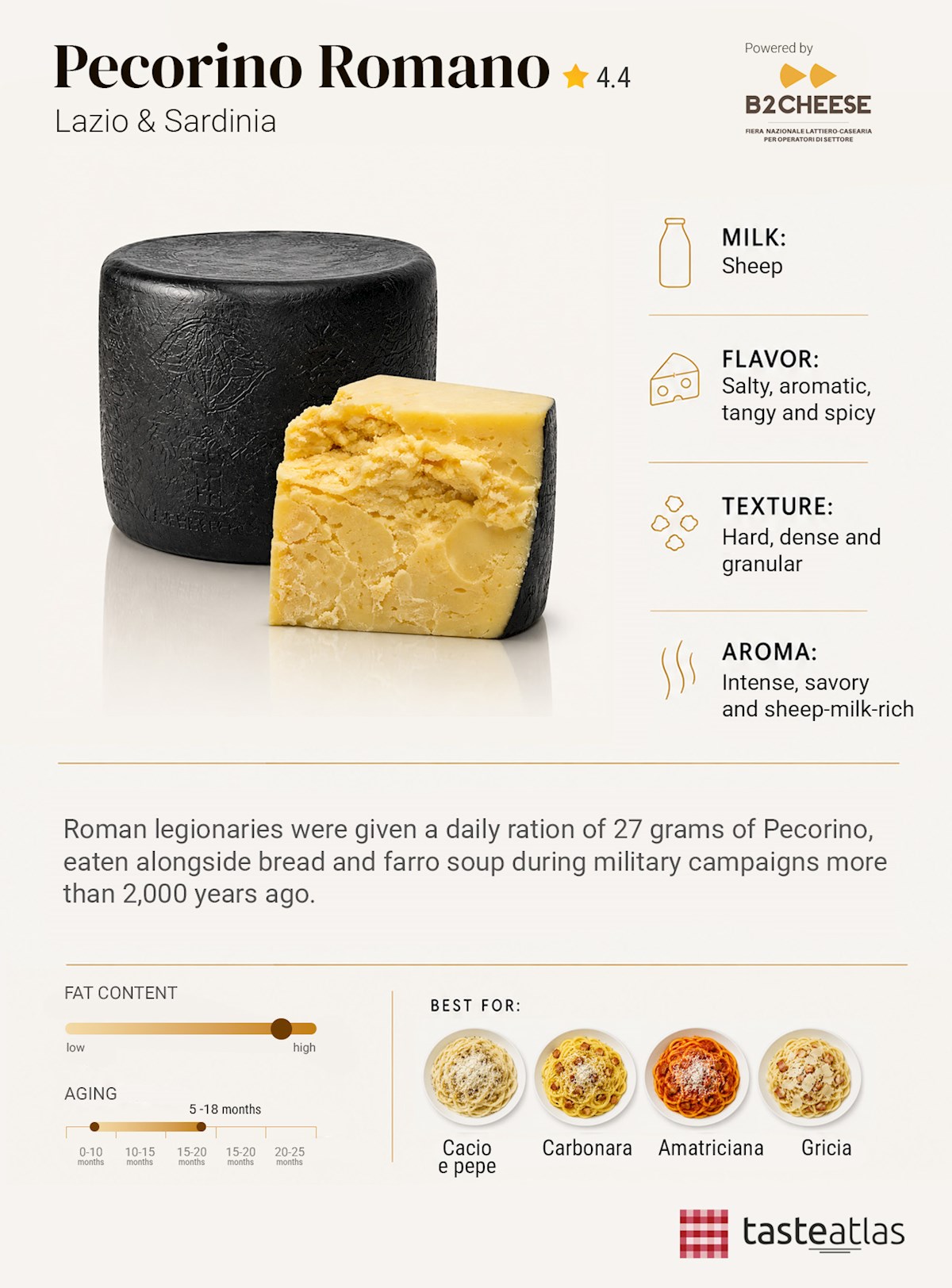
The cheese is made from whole sheep’s milk and uses lamb’s rennet along with a characteristic local starter culture. The curd is broken very finely, producing the dense structure required of a hard cheese intended for extended maturation and grating. Pecorino Romano can be marketed after a minimum of five months when intended as a table cheese and eight months when intended for grating. Even at the younger end it is markedly savory, aromatic and tangy; with greater age it becomes harder, more concentrated and distinctly piquant. Its pronounced saltiness is not incidental but fundamental to the cheese’s identity and historical keeping qualities. In modern Italian cooking, that intensity makes Pecorino Romano especially valuable as a grating cheese, where comparatively small quantities can contribute substantial flavor to a dish.
Learn more about Pecorino Romano
MOZZARELLA DI BUFALA CAMPANA
 @Mozzarella di Bufala Campana DOP
Mozzarella di Bufala Campana is one of the most important fresh cheeses of southern Italy and one of the clearest examples of a cheese whose identity depends as much on its milk as on its technique. Its development is inseparable from the presence of water buffalo in southern Italy, particularly in the low-lying areas of Campania. Documents from the 12th century describe monks at San Lorenzo in Capua offering pilgrims a cheese called mozza or, when smoked, provatura, while the word mozzarella itself appears in a culinary text by Bartolomeo Scappi in 1570. Production and trade expanded particularly around Caserta, Naples and Salerno, eventually turning what had once been a highly local and perishable product into one of Italy’s internationally recognizable cheeses.
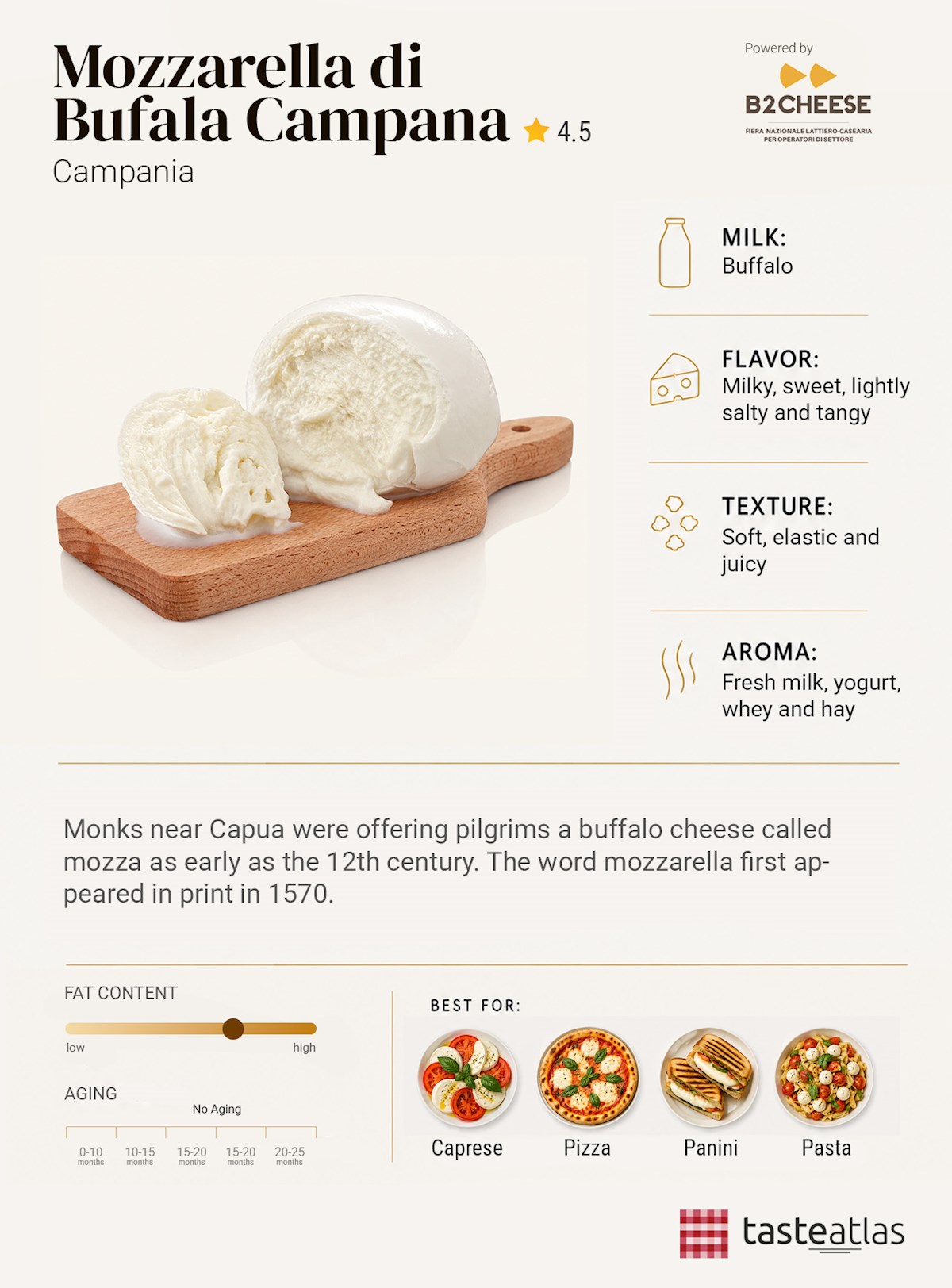
Authentic Mozzarella di Bufala Campana DOP is made from the milk of Italian Mediterranean buffalo and belongs to the pasta filata, or stretched-curd, family. After coagulation and acidification, the curd is worked with hot water until it becomes elastic enough to stretch and shape. The name itself is linked to mozzare, “to cut off,” referring to the action traditionally used to separate portions of stretched curd. The finished cheese has a thin, smooth skin surrounding a moist, elastic interior that releases milky whey when cut. Its flavor combines fresh dairy sweetness with a mild acidity and the particular richness of buffalo milk. Although Campania remains its symbolic center, the PDO territory also includes defined areas of Lazio, the province of Foggia in Puglia and Venafro in Molise. Unlike aged cheeses, its character depends heavily on freshness, and it is generally at its best shortly after production.
Learn more about Mozzarella di Bufala Campana
PECORINO SARDO
 @macelleriapiazzabrugherio
Pecorino Sardo is rooted in Sardinia, where sheep raising has been central to rural life for millennia. Archaeological and historical evidence connects pastoral activity on the island with the Nuragic period, making sheep’s-milk cheesemaking one of Sardinia’s longest-standing food practices. Unlike Pecorino Romano, which is now also produced predominantly on Sardinia but retains a distinct specification and historical identity, Pecorino Sardo developed specifically as a Sardinian cheese. Its characteristics are closely connected with the island’s sheep farming, natural pastures and milk supply, and PDO regulations require the use of whole sheep’s milk produced within Sardinia. It therefore represents a separate branch of the island’s dairy culture rather than simply a less-aged version of Pecorino Romano.
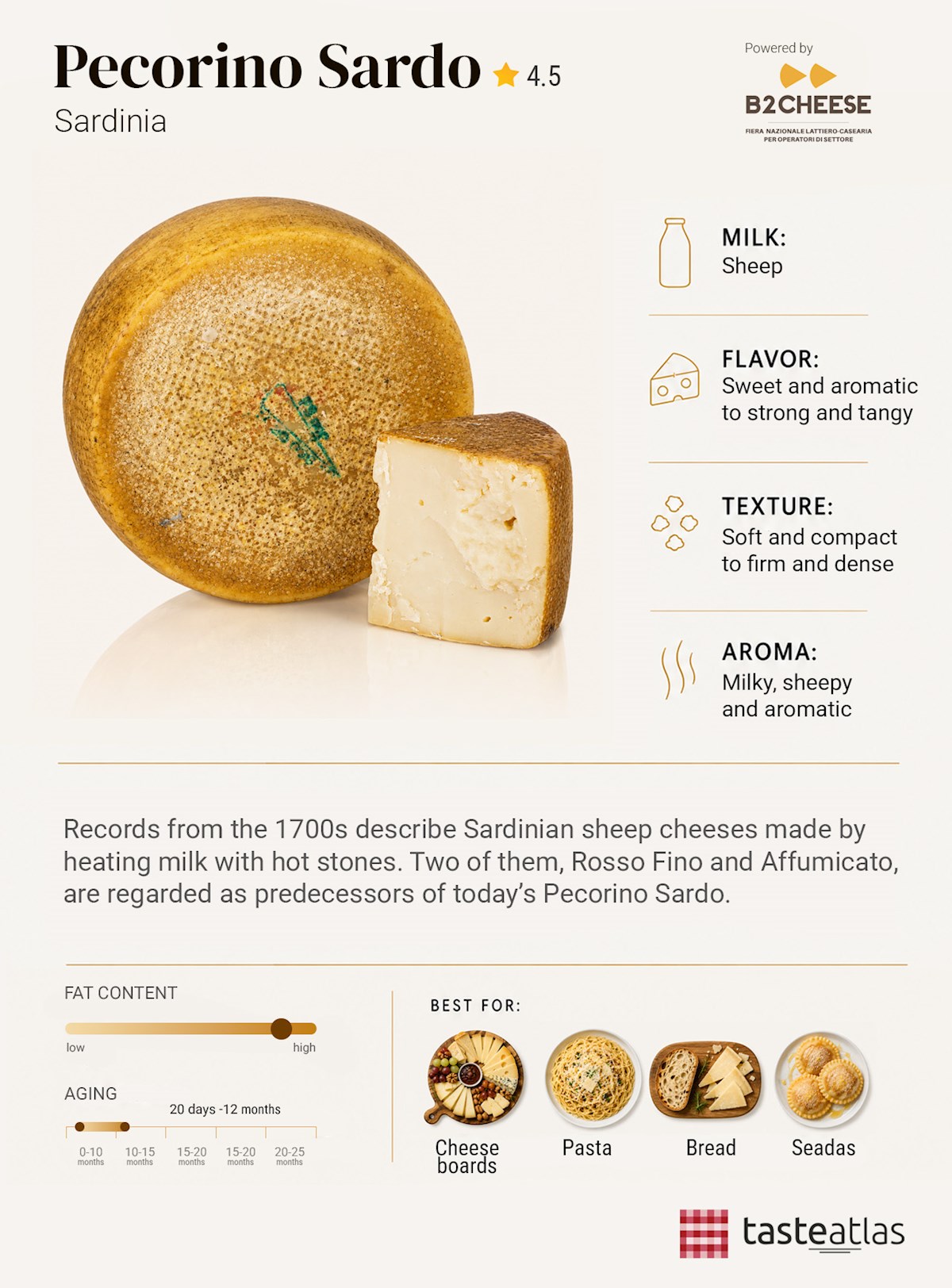
The PDO recognizes two distinct types: Pecorino Sardo Dolce and Pecorino Sardo Maturo. Dolce is matured for approximately 20 to 60 days and is relatively small, soft and pale, with a sweet, aromatic flavor and gentle sheep’s-milk character. Maturo is aged for at least two months but can continue maturing considerably longer; its paste becomes firmer and more straw-colored while the taste grows stronger, more savory and pleasantly tangy. Production also differs between the two versions: the curd is broken into larger pieces for Dolce and finer granules for Maturo, contributing to their different moisture levels and textures. The contrast makes Pecorino Sardo unusually useful for understanding Sardinian sheep’s cheese as a spectrum: the young version highlights the richness and sweetness of the milk, while extended maturation reveals its capacity for firmness, concentration and complexity.
Learn more about Pecorino Sardo
Complete list of Italian cheeses