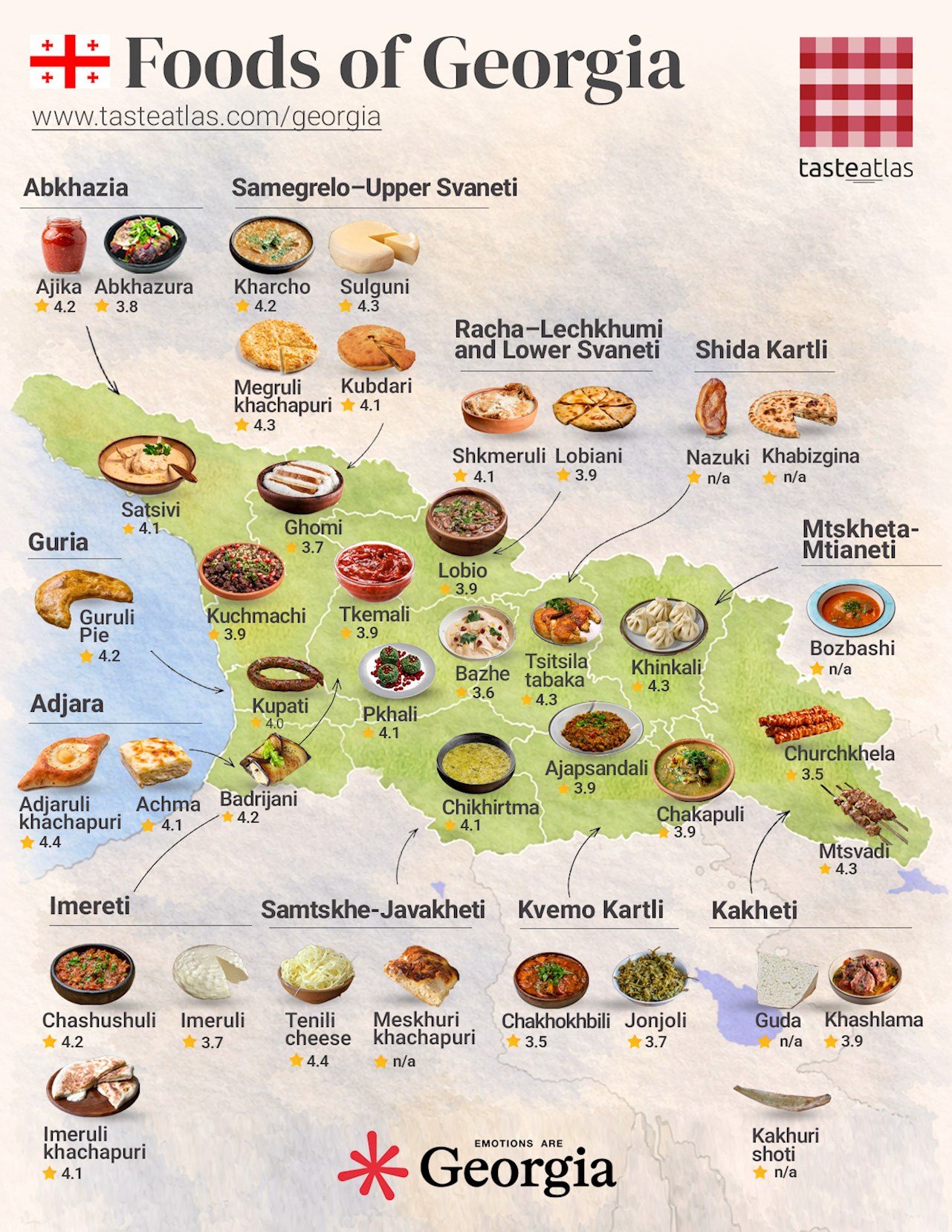
Georgia, the small but culturally immense country in the South Caucasus, sits at a crossroads between Europe and Asia. That position has shaped its history, language, trade routes, and, above all, its food. Georgian cuisine is often considered one of the world’s great culinary traditions because it has developed a highly distinctive and coherent flavor system of its own, built around bread, cheese, walnuts, herbs, stone fruits, and wine. What makes it especially notable is the way these ingredients recur across many different dishes and forms, creating a cuisine that is immediately recognizable, historically deep, and unusually balanced between richness, acidity, freshness, and texture.
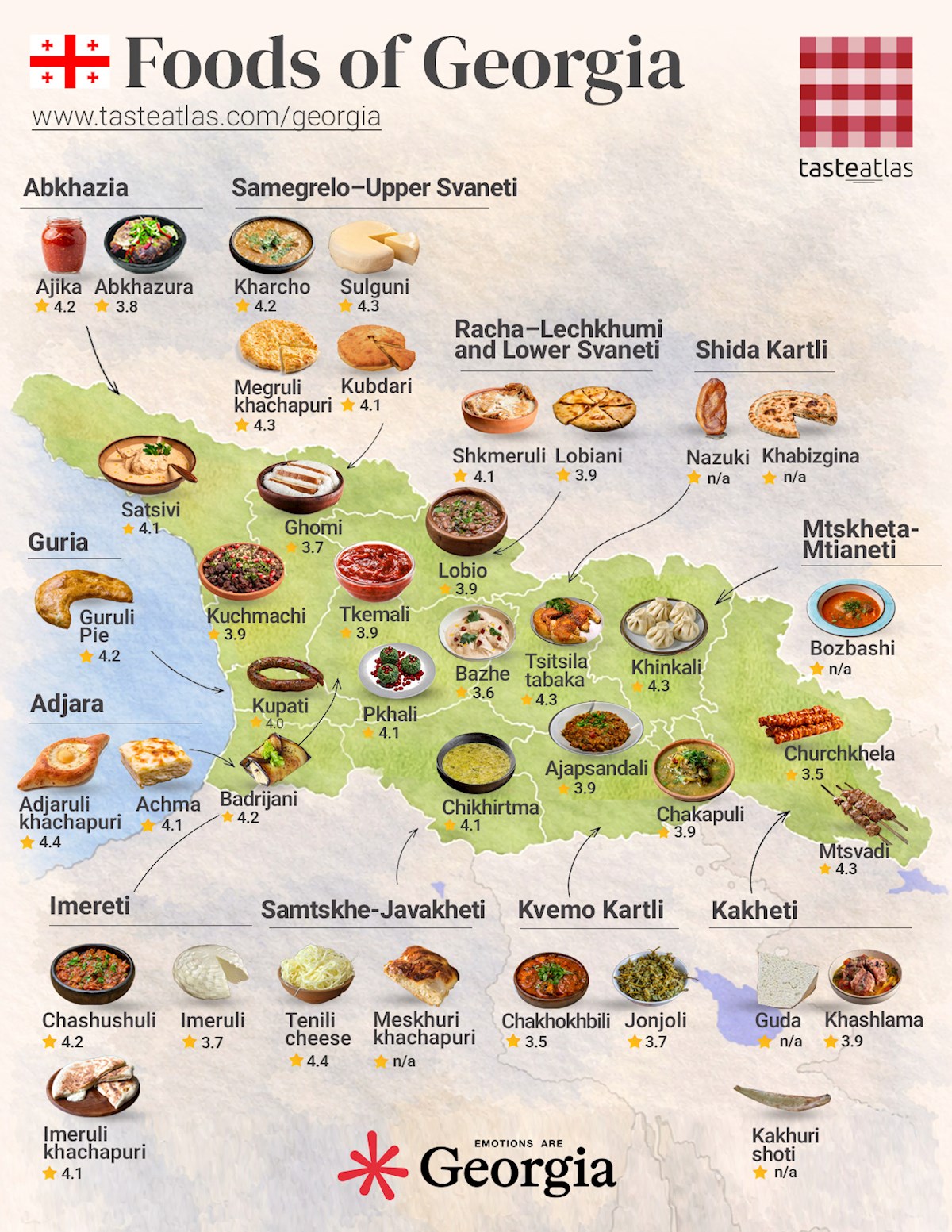
To understand Georgian gastronomy, it helps to think of it not as a single uniform cuisine but as a family of regional food traditions. Western Georgian cooking tends to be more herbaceous and sometimes spicier, while eastern Georgian food is often associated with bread ovens, meat dishes, and the country’s ancient winemaking culture. Across the whole country, however, a few themes appear again and again: the central place of the shared table, the importance of seasonal produce, the skillful use of nuts and fresh herbs, and a remarkable ability to turn simple ingredients into dishes of great character. Georgian cuisine is also closely tied to the supra, the traditional feast, where eating is accompanied by ritual toasts, conversation, and a strong sense that food is a social bond rather than merely sustenance.
One cannot talk about Georgian gastronomy without mentioning wine. Georgia is widely associated with one of the oldest winemaking traditions in the world, and the country’s famous qvevri method involves fermenting and aging wine in large egg-shaped clay vessels buried underground. UNESCO has recognized this ancient Georgian qvevri winemaking method as part of the world’s intangible cultural heritage, and it is rightfully one of the country's most prominent gastronomical calling cards.
In what follows, we will look at some of the most legendary Georgian dishes, as well as several of the iconic ingredients, products, and wines that define the country’s gastronomic identity. Together, these foods help explain why Georgian cuisine was placed 21st in the TasteAtlas Best Cuisines in the World 25/26 ranking, with signature items such as khachapuri and mtsvadi also appearing in TasteAtlas’s global dish rankings.
Legendary Georgian Dishes
KHACHAPURI - 4.3
 @shutterstock
Among Georgia’s most legendary foods, khachapuri is surely the best known. At its core, khachapuri is a cheese-filled bread, but that simple description barely captures its cultural significance or regional variety. In some regions it appears as a round pie with cheese sealed inside, while in others it is topped with extra cheese or shaped into a striking open boat.
The best-known version abroad is often Acharuli or Adjaruli khachapuri, from the Adjara region, where the bread is formed into a boat and filled with melted cheese, butter, and an egg yolk stirred in at the table. Other famous forms include Imeruli, a round cheese pie, and Megruli, which adds cheese on top as well.
KHINKALI - 4.3
 @zakharzakharichi
Another pillar of Georgian cuisine is khinkali, the country’s famous dumplings. They are robust, satisfying, and deeply associated with the mountain and inland culinary traditions of the country. These pleated dumplings are usually filled with meat and broth, though modern and regional variations may include mushrooms, cheese, or potatoes.
What makes khinkali especially memorable is not only their flavor but the way they are eaten: ideally by hand, beginning with a careful bite that lets the eater sip the hot broth inside before continuing with the rest.
MTSVADI - 4.3
 @giuaaniwinery
Mtsvadi is one of the clearest expressions of Georgian cooking at its most simple, rustic, and communal. These skewers of marinated or lightly seasoned meat, traditionally cooked over open coals, are prized not for complicated preparation but for the purity of their flavor and the skill with which they are grilled.
Pork is especially common, though beef, lamb, and other meats are also used depending on the region and occasion. The smoky aroma, tender interior, and lightly charred exterior make mtsvadi a favorite at family gatherings, outdoor celebrations, and traditional feasts. It is often served with fresh onions, herbs, bread, and sauces or condiments that complement the richness of the meat.
TSITSILA TABAKA - 4.3
 @annavoloshynacooks
Tsitsila tabaka consists of a young chicken that is flattened and cooked under pressure, traditionally in a special heavy pan, until the skin becomes beautifully crisp and golden while the meat stays juicy and tender. The dish is usually seasoned with garlic, salt, and aromatic spices, giving it a savory depth without overwhelming the natural taste of the chicken.
Tsitsila tabaka is often served hot with fresh herbs, vegetables, or tangy sauces, and it is appreciated for both its satisfying texture and its comforting simplicity. Like many classic Georgian foods, it feels at once rustic and refined, making it popular in both everyday meals and more festive settings.
Learn more about Tsitsila tabaka
KHARCHO - 4.3
 shutterstock
Kharcho is a classic Georgian dish celebrated for its deep, hearty flavor and comforting richness. Most commonly prepared as a soup or thick stew, it is traditionally made with meat, rice, tomatoes or tart fruit elements, and a fragrant blend of herbs and spices that give it its distinctive depth.
Walnuts are also often associated with Georgian flavor traditions and can contribute extra body and complexity in some versions. Warm, filling, and aromatic, kharcho is especially valued as a satisfying meal in cooler weather.
BADRIJANI - 4.2
 @bybrianlevy
Badrijani is one of those dishes that says a lot about Georgian cooking with very little. At first glance it is simple: slices of eggplant wrapped around a walnut filling. But once you taste it, you immediately notice how much is going on. The eggplant is soft and mellow, the walnut paste is dense and savory, and the garlic, herbs, and slight acidity give it a sharpness that keeps it from feeling heavy.
Pomegranate seeds are often added on top, which makes sense not only visually but also in flavor, because they bring a small burst of sweetness and freshness. It is usually served as a starter, but it leaves a stronger impression than many more elaborate dishes because it brings together the flavors that define so much of Georgian cuisine in a very clear way.
ELARJI - 4.2
 Shutterstock
Hailing from the lush, subtropical region of Samegrelo, Elarji is a spectacularly decadent dish that elevates simple cornmeal into a theatrical, cheese-pull masterpiece. The foundation of the dish begins much like gomi, with coarse white cornmeal and corn flour slowly simmered in water until thick and smooth. The real magic happens at the very end of cooking, when enormous quantities of fresh, elastic Sulguni cheese (or pickled Imeretian cheese) are vigorously folded into the boiling pot.
Chefs must energetically beat the mixture with a wooden paddle until the cheese completely liquefies and merges with the cornmeal base. This strenuous stirring creates an exceptionally elastic, stringy texture that can be stretched high into the air without breaking. Ideally served piping hot in thick, comforting scoops, it is traditionally paired with rich, spicy bazhe (walnut sauce) or hearty meat stews to cut through the ultimate dairy indulgence.
PKHALI - 4.1
 Shutterstock
Pkhali is a traditional, plant-forward appetizer that holds a prized place in the culinary heritage of Georgia. The core of the dish relies on minced or puréed vegetables, most commonly spinach, beetroot, cabbage, or green beans. What truly defines pkhali is its rich binding paste made from ground walnuts, garlic, vinegar, and fragrant herbs like cilantro.
This mixture is uniquely seasoned with regional Georgian spices, such as blue fenugreek and dried marigold petals. Chefs typically mold the paste into bite-sized balls or smooth it onto plates, often garnishing the top with vibrant pomegranate seeds. Naturally vegan and gluten-free, it is famously served cold as part of a traditional supra feast alongside warm Georgian flatbread.
SATSIVI - 4.1
 @usakhelouri_tbilisi
Satsivi is a Georgian dish made with poultry, most commonly chicken or turkey, served in a thick walnut sauce. The sauce is prepared from ground walnuts combined with garlic, spices, and sometimes vinegar or other souring ingredients, which give it a dense texture and a slightly tangy flavor.
Unlike many meat dishes, satsivi is usually served cold or at room temperature rather than hot. It is especially associated with festive meals and holiday tables, where it is considered one of the standard traditional dishes. Satsivi is also a good example of the central role that walnuts play in Georgian cuisine, not only as an ingredient in fillings and appetizers but also as the base of substantial sauces.
SHOTIS PURI - 4.1
 shutterstock
Shaped like a rustic canoe or crescent moon, shotis puri is Georgia's quintessential daily bread that defines the comforting aroma of local neighborhoods. This yeast dough is made from an incredibly simple foundation of wheat flour, water, yeast, and salt. To bake it, professional bakers slap the elongated dough directly onto the glowing, curved inner brick walls of a deep, cylindrical clay oven called a tone. A small hole is poked into the center of each loaf before baking to prevent the dough from bubbling up and falling off the wall into the embers below.
Once gravity and intense radiant heat have done their work, the baker uses long metal hooks to peel the crisp, golden loaves away from the clay. The result is a spectacular texture play: shatteringly crisp at its pointed tips, satisfyingly chewy in the middle, and deeply infused with a smoky, wood-fired char.
KUPATI - 4.0
 @usakhelouri_tbilisi
Kupati is a traditional Georgian sausage made mainly from pork, although some versions also include beef or offal depending on local practice. It is prepared as a fresh sausage rather than a cured one, and the meat is usually mixed with garlic, pepper, onions, and other spices before being stuffed into casings.
After that, kupati is typically grilled over open fire or fried, which gives it a browned exterior while keeping the inside juicy and strongly flavored. It is especially popular in western Georgia, where richer and more highly seasoned meat dishes are common. Kupati is often served hot with bread, fresh herbs, onions, sauces, or vegetable sides.
LOBIO - 3.9
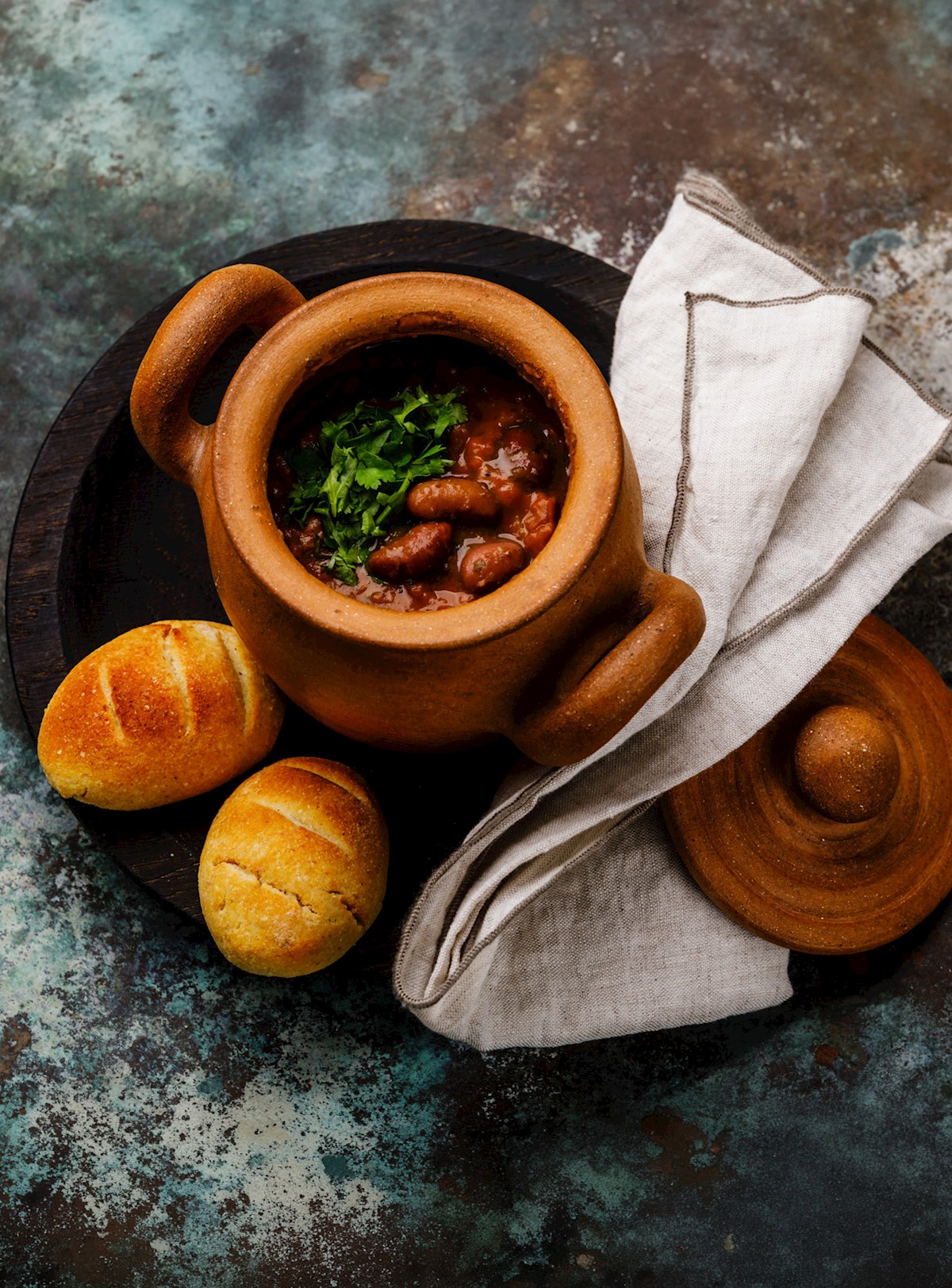
Lobio is one of the defining bean dishes of Georgian cuisine, built around slowly cooked beans, most often red beans, seasoned with onions, garlic, herbs, and spices. Its character comes not from complexity of technique, but from the way a few strong ingredients are brought into balance: the beans give it weight and softness, while the seasonings add earthiness, warmth, and depth. Some versions are thick and almost spread-like, others closer to a stew, but the dish always feels substantial and grounded.
It is often served with mchadi or bread, which makes it feel like the kind of food built for everyday life, yet it also reflects something central to Georgian cooking: the ability to give ordinary staples real flavor, structure, and presence.
JONJOLI - 3.7
 Shutterstock
A hyper-regional delicacy, jonjoli consists of pickled, unblown flower buds harvested from the wild Caucasian bladdernut shrub. These delicate clusters are hand-picked in early spring just before they bloom, requiring painstaking forage work in the Georgian hillsides. Once gathered, the buds are packed into jars with salt and left to ferment naturally for several weeks.
When ready to serve, the cured buds are gently tossed with thin slivers of raw onion and drizzled with unrefined, aromatic sunflower oil. The resulting flavor profile is highly unique—tangy, slightly bitter, and reminiscent of a cross between capers and green olives. Jonjoli is prized as a bright palate cleanser on the supra table, and it is traditionally paired alongside piping hot pots of lobio (kidney bean stew) and mchadi.
CHURCHKHELA - 3.5
 Shutterstock
Often dubbed "Georgian Snickers," churchkhela is a deeply historic, candle-shaped confectionery that showcases the country's mastery over the autumn harvest. Chemical analyses of ancient clay vessels unearthed during archaeological excavations prove that this sweet treat has been crafted in Georgia since antiquity. Due to its dense caloric profile and ability to be stored for extended periods without any special preservation conditions, ancient Georgian warriors famously carried churchkhela as a highly efficient, hunger-satisfying ration on the road.
The delicacy is traditionally prepared right after Rtveli (the grape harvest), utilizing freshly squeezed grapes that are boiled with wheat flour to create a sweet, thickened reduction called tatara. Strung nuts are repeatedly dipped into this warm mixture to build up a chewy exterior layer, resulting in the highly popular Kakhetian version made with walnut halves, or the Western Georgian variant known as janjukha. Today, these colorful strings hang proudly in local markets, offering a perfect, portable bite of Georgia's rich agricultural legacy.
MCHADI - 3.4
 @cafegalaktion
Steeped in centuries of Western Georgian tradition, mchadi is an ultra-minimalist cornbread that acts as the ultimate edible vessel for melted cheese and hearty stews. Unlike Western cornbread, it is made with a remarkably simple dough consisting only of cornmeal, water, and a pinch of salt. It is traditionally shaped by hand into dense, flattened oval patties and fried in a special clay pan called a ketsi.
The result is a delightful contrast of textures, featuring a golden, crunchy exterior and a soft, dense interior. It is almost always served piping hot, specifically designed to be split open so a thick slice of salty Sulguni cheese can melt inside. Because it is naturally gluten-free and vegan on its own, it is a versatile accompaniment that perfectly balances the rich, saucy dishes of a Georgian feast.
Iconic Georgian Food Products and Wines
GEORGIAN AMPHORA WINE - 4.4
 shutterstock
Georgian amphora wine, more accurately wine made in qvevri, is linked to one of the oldest continuous winemaking traditions in the world. For centuries, and likely much longer, Georgians have used these large clay vessels buried in the ground to ferment and store wine, making qvevri winemaking a practice that reaches back into the earliest history of agriculture in the South Caucasus. This method developed long before modern industrial techniques and remained part of everyday life in Georgian villages, where wine was produced not only for trade or celebration but also for household use and ritual occasions.
The qvevri itself became part of that long tradition: a practical object, but also a symbol of continuity between generations. Because of this, Georgian qvevri wine is important not only for its distinctive production method and amber-colored wines, but also as a living survival of an ancient winemaking culture that still shapes Georgian identity today.
Learn more about Georgian amphora wine
SAPERAVI - 4.4
 @wine_old_tbilisi
Saperavi is the most important red grape variety in Georgia and one of the country’s best-known wine grapes. It is indigenous to Georgia and is especially associated with the Kakheti region in the east, where many of the country’s major red wines are produced. What makes Saperavi unusual is that it is a teinturier grape, meaning that both its skin and flesh are red, which gives the wine a very deep color.
Wines made from Saperavi are typically known for their dark fruit character, strong structure, and good acidity, and they can be produced in different styles, including dry reds, naturally semi-sweet wines, and qvevri wines. Because of its historical importance, wide cultivation, and distinctive character, Saperavi has become one of the clearest symbols of Georgian winemaking.
TENILI CHEESE - 4.4
 shutterstock
Tenili is one of the most distinctive cheeses in Georgian cuisine, known for its unusual thread-like structure and labor-intensive method of production. Made by heating and stretching the curd into very thin strands, it has a fibrous texture that sets it apart from more familiar Georgian cheeses such as sulguni or imeruli. Its flavor is mild but concentrated, and much of its character comes from the way it is shaped, salted, and matured rather than from sharp seasoning.
Because of the time and skill required to make it, tenili has long been associated with regional craft traditions rather than everyday large-scale production. It shows another side of Georgian gastronomy: not only bold flavors and rich dishes, but also highly specialized foods shaped by local technique and experience.
KHMELI SUNELI - 4.3
 shutterstock
Khmeli suneli is one of the spice blends that gives Georgian food much of its recognizable character. It is not a single spice, but a mixture that usually includes ingredients such as coriander, blue fenugreek, marigold, dill, bay leaf, and pepper, though the exact composition can vary.
What makes it so important is that it adds depth without making a dish overwhelmingly hot. Its flavor is warm, earthy, and slightly floral, which is why it works so well in soups, stews, bean dishes, and meat-based recipes. In many ways, khmeli suneli feels like the background note of Georgian cooking: it may not dominate a dish on its own, but it helps create the flavor profile that makes the cuisine distinct.
Learn more about Khmeli suneli
SULGUNI - 4.3
 Shutterstock
Sulguni is probably the best-known Georgian cheese and is especially associated with the western region of Samegrelo. It is a semi-firm, brined cheese with an elastic texture and a mildly salty, slightly sour taste, and it is often compared to other stretched-curd cheeses because of the way it melts and pulls when heated. Sulguni is commonly made from cow’s milk, though other milks can also be used, and it appears both in fresh and smoked forms.
In Georgian cuisine it is important not only as a table cheese but also as a cooking ingredient, especially in dishes such as khachapuri and regional cornmeal-and-cheese dishes, where its texture and saltiness make it especially useful.
UTSKHO SUNELI - 3.9
 shutterstock
Utskho suneli is a Georgian spice made from dried blue fenugreek, and it is one of the ingredients most closely associated with the characteristic flavor of Georgian food. Unlike common fenugreek, it is generally described as milder and more aromatic, with a warm, nutty, slightly bitter taste that becomes more noticeable during cooking.
In Georgian cuisine it is used in dishes such as lobio, sauces, stews, and walnut-based preparations, and it is also an important component of khmeli suneli. The name is often translated as “foreign spice,” but in practice it is a familiar and established part of Georgian seasoning traditions, especially because it adds depth and a distinctive savory note without making a dish hot.
Learn more about Utskho suneli
IMERULI - 3.7
 @shutterstock
Imeruli, or Imeruli kveli, is a traditional Georgian cheese from the Imereti region and one of the most commonly used cheeses in Georgian cuisine. Usually made from cow’s milk, it is a brined cheese with a mild, slightly sour taste and a soft to semi-firm texture, depending on how long it has been aged.
Its main culinary importance comes from the fact that it is the classic filling for Imeruli khachapuri, but it is also eaten on its own and used in other baked dishes. Because of its balanced flavor and good melting quality, Imeruli has become one of the basic cheeses of Georgian gastronomy.
What makes Georgian food so compelling is that it is both regional and unified, practical and ceremonial, simple in some dishes and technically complex in others. From khachapuri and khinkali to satsivi, lobio, sulguni, and qvevri wine, Georgian gastronomy presents a culinary tradition with depth, continuity, and a very clear sense of itself. That is why it continues to attract interest not only as national cuisine, but as one of the most distinctive food cultures in the world.
Learn more about Georgian cuisine